
How to solve Sudoku: rules and a method for beginners

Algor Lab
November 8, 2026

Faced with a Sudoku grid, it is tempting to enter a number that “seems to fit” and see what happens. The problem is that a digit with no immediate conflict is not necessarily correct. A reliable solving method gives each entry a reason you can check.
You do not need complicated arithmetic. In classic Sudoku, the digits act as symbols arranged according to constraints. Three scenes in Algor's Sudoku show how to use a hint, interpret an error and follow an explained solution. The aim is to understand the deduction behind the digit, rather than merely fill the grid.
The three rules of classic Sudoku
The grid contains nine rows, nine columns and nine boxes of three by three cells. Each row, column and box must contain the digits 1 to 9 exactly once. The starting digits are given information and must not be changed.
Every cell belongs to a row, a column and a box simultaneously. An entry has to satisfy all three constraints; checking the row alone is not enough. You can identify a position by its row and column, for example r2c5 for row two, column five. This reference makes it easier to describe both a deduction and a mistake without pointing vaguely at part of the screen.
Start with the most complete areas
Before adding notes everywhere, look for a row, column or box with few empty cells. If only one digit is missing, identify it from the set 1 to 9 and check it against the cell's other two units. This is a useful starting point because the reasoning is straightforward to explain.
If several digits are missing, list them mentally or in notes and examine where each can go. A box with three gaps may be more useful than a row with six, but there is no compulsory scanning order. Choose an organised route, such as rows, columns and boxes, and repeat it after entries that provide new information. Each solved cell can change what is possible elsewhere.
Candidates are possibilities, not answers
The small digits in notes represent values still compatible with the known constraints. They are not proven entries. After placing a new digit, check candidates in cells sharing its row, column or box, because some possibilities may now be excluded.
Consider an example separate from the pictured grid. A row is missing 2, 5 and 7. For one empty cell, the column already contains 2 and the box already contains 7. Only 5 remains. This is a single candidate in that cell, not a choice of the most likely number. You can state precisely why the other two options have been eliminated and why the entry is required.
Also look for the only place for a digit
A second useful question is: “Which cells in this box can contain 5?” Even if every cell has several candidates, 5 may be allowed in only one position. That position is then forced, because the box must contain a 5.
This differs from a single candidate. Previously you examined all possible digits in one cell; now you follow one digit across a whole unit. In the first screenshot, the hint directs attention to this search for a single possible place. Follow the rows and columns crossing the box, identify the exclusions and try to complete the explanation before asking for more help. Name the reason for each excluded cell.
Worked example: a pair resolves the third cell
Imagine a row missing 2, 5 and 7. In its three empty cells, labelled A, B and C, checks against columns and boxes leave these candidates: A can contain 2 or 7; B can contain 2 or 7; C can contain 2, 5 or 7. Write the sets on paper before entering a digit.
A and B must use the two values 2 and 7, although their order is not yet known. Those values therefore cannot also belong to C in the same row. That leaves C = 5. You do not need to decide which of the first two cells contains 2 before reaching this conclusion.
This is a candidate pair, not permission to guess its order. Another constraint from the relevant columns or boxes will be needed to distinguish A from B. Certainty about C can arrive before the whole row is solved.
A red digit identifies a conflict to understand
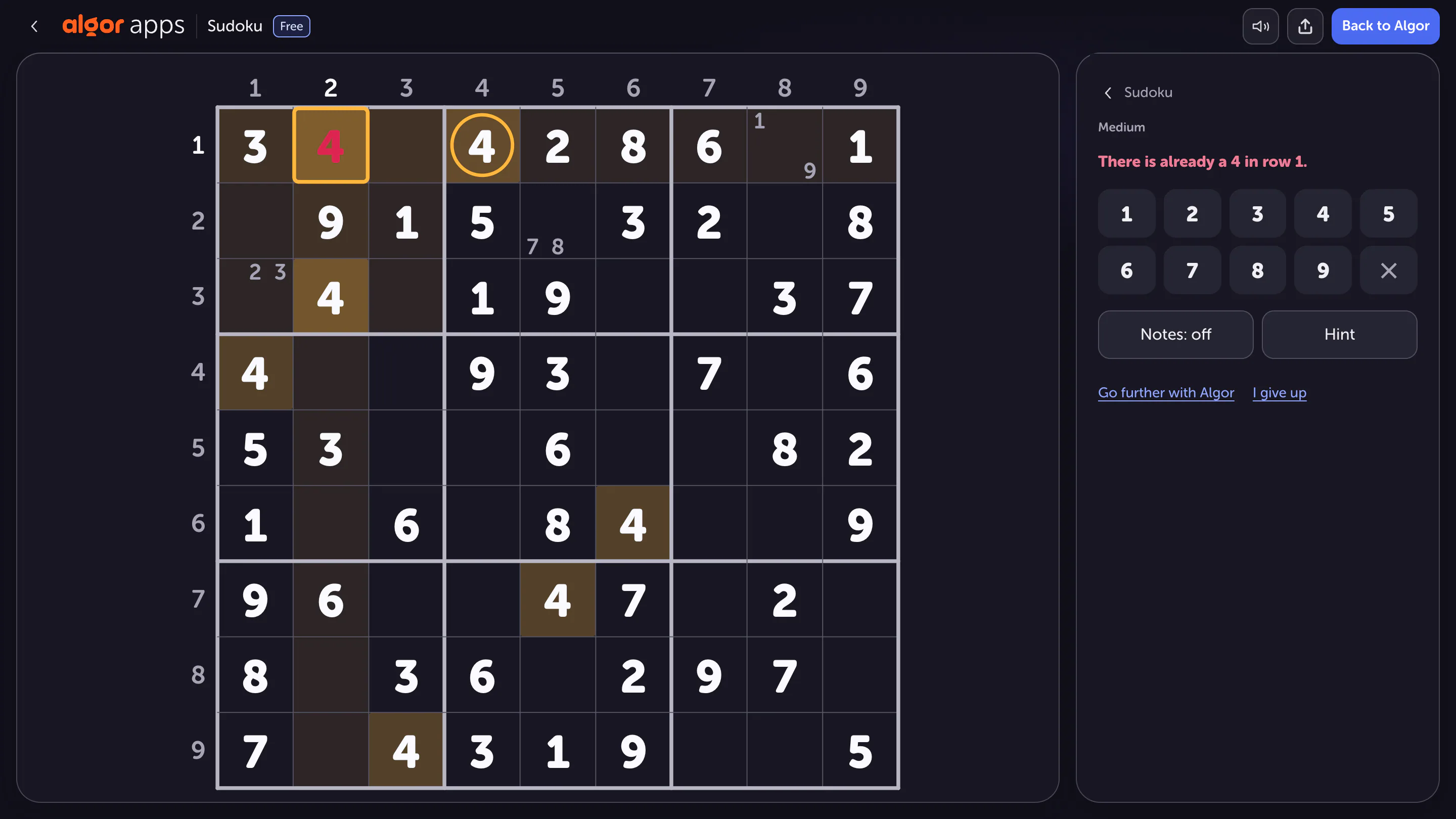
In the second scene, a 4 is entered in the first row, which already contains another 4. The interface highlights the conflict. Instead of simply deleting it and trying a different digit, reconstruct the rule that was broken and identify the cells proving the duplication.
Conversely, the absence of an immediate duplicate does not establish that a digit belongs in the final solution. An unproven choice may cause a contradiction later. Distinguish “currently possible” from “required”. Notes record possibilities, while a final entry needs a reason. This prevents a guess from being treated as established information and spreading errors through subsequent deductions. A quiet interface is not, by itself, a proof.
Use the guided solution as an exercise
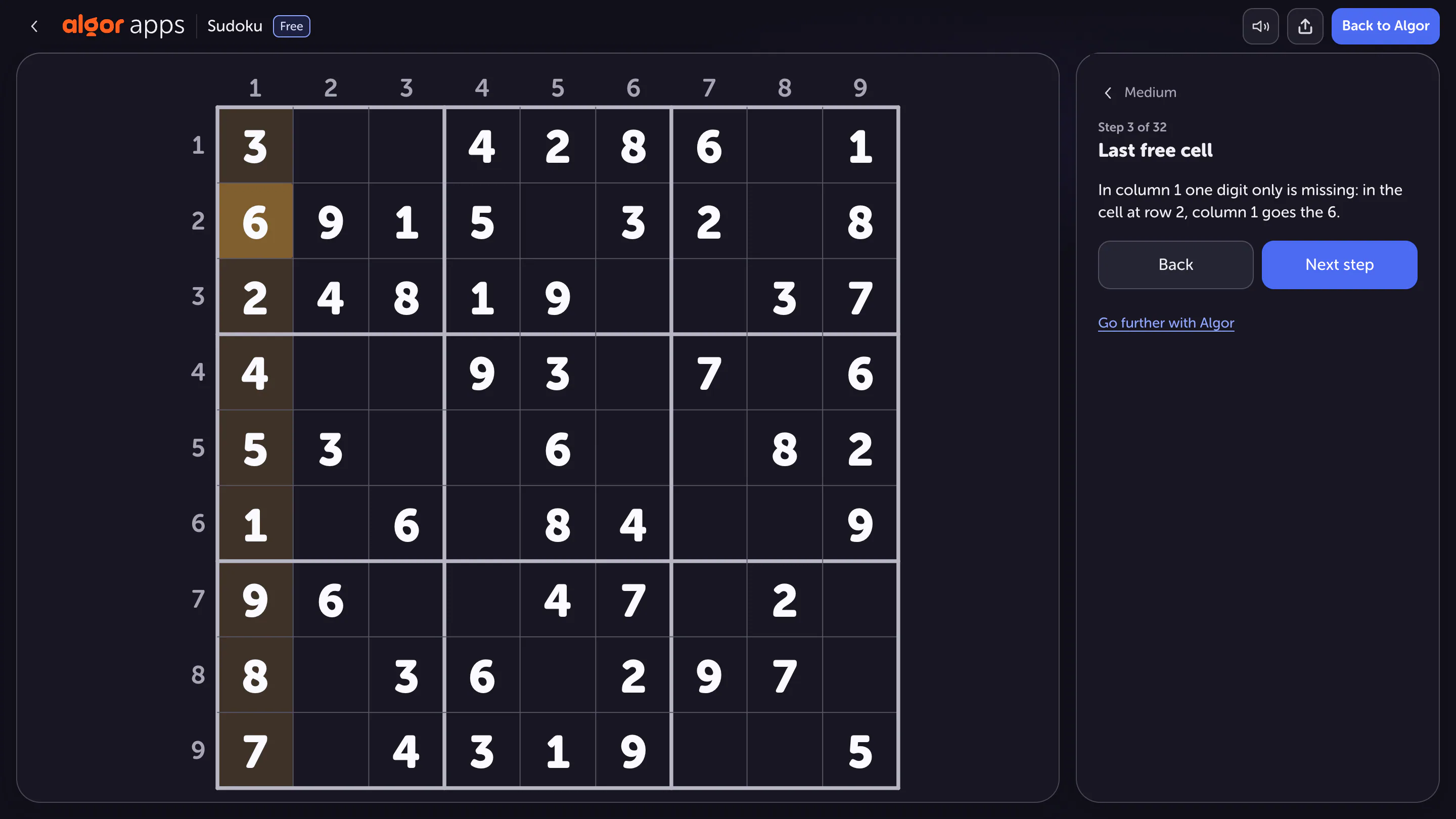
The third scene provides a step-by-step explanation. Before moving to the next step, verify the current deduction: which unit is being considered, which digit is missing and why is the indicated cell forced? If you cannot answer, stay with the grid instead of clicking forward.
You can also mentally hide the revealed digit and reconstruct the reasoning. Return to an earlier step where the controls allow it, then repeat the deduction. The solution becomes a worked example to study. Watching many digits appear quickly, by contrast, does not tell you whether you could find the next one independently. Focus on understanding one useful step before continuing.
Organise a practical solving session
Choose a difficulty that lets you justify some steps without help. Look first for nearly complete units, add candidates where useful and request a hint after identifying the precise point where you are stuck. You do not need to cover every cell with notes if a simple scan already reveals the next deduction.
At the end, record one technique you learnt and one constraint you overlooked in an error log. In the next grid, try to recognise them before requesting a hint. Progress is not only finishing faster. It also means being able to explain one more entry with a sound reason, and knowing the difference between a possibility and a conclusion.
Sources and further reading


Faq
Frequently Asked Questions

Related articles
Get Started with Algor
Transform your content into structured, visual and personalized learning paths.


