
Exam error log: turn missed practice questions into useful revision

Algor Lab
You finish a practice test, check the score and read the solutions. A few mistakes seem obvious as soon as the correct answer appears. Then the next test brings a similar question, and you make the same mistake again. Understanding a correction for a moment did not tell you what to change in your revision.
An exam error log helps you capture that missing step: why your approach failed and what you will practise next. Here you will build a simple template and follow one mistake from the first note to a fresh attempt. The aim is to make your next study session easier to choose, without spending longer copying solutions than working on the underlying problem.
A score is a starting point, not a diagnosis
Two missed questions can need completely different responses. You might lack a definition in one and misread the command word in another. Copying both model answers does not tell you which skill to practise.
Add one sentence about your original thinking: “I chose this because I assumed…” That makes the misunderstanding visible. It can also explain why the same kind of mistake keeps appearing in different topics.
For UK exam practice, keep the exam board, specification and paper reference with the entry. For a college course, keep the assignment or lecture reference. The log should lead you back to the relevant standard, not just to a detached answer.
Start with a mistake that reveals your thinking
Choose a question where your answer felt reasonable. It can tell you more about your approach than an obscure fact you know you never learned. Try to recover what you were thinking before the correct answer changed how you saw the problem.
Suppose a percentage rises from 20% to 30%. You answered that it increased by 10%. The solution says 50%, so you copy that number. The entry is now accurate, but you may still be confusing a change in percentage points with a relative percentage increase.
Your first note could read: “I subtracted the two values, but the question asked for the increase relative to the starting value.” That sentence preserves the reasoning behind the mistake. It gives you something specific to correct and makes the next row in your log more useful than a list of right answers.
A simple error-log template
These entries show how the template can be used.
| Topic and source | What went wrong | Likely cause | Next task | Recheck |
|---|---|---|---|---|
| Percentages, course exercise | Confused percentage points with relative change | Two measures treated as one | Make an example of each | Solve a new question |
| Biology notes | Swapped two transport processes | Definitions learned without comparison | Write a contrast question | Explain without notes |
| Practice test | Chose a true statement when asked for the false one | Misread the instruction | Restate the task before answering | Try a similar question |
Include a source reference rather than copying large amounts of a published paper into the log. Keep your own explanation short enough that you will actually revisit it.
Choose the fix that matches the mistake
Missing knowledge: return to the relevant explanation and create a focused question about it.
Application: if you knew a rule but did not know when to use it, work on another problem that requires choosing a method. Seeing the same worked solution again may not test that choice.
Interpretation: identify what the question asks you to explain, compare, calculate or evaluate. Check the requirements of your course or mark scheme rather than assuming all command words are interchangeable.
Execution or timing: find the step where you copied a value incorrectly, omitted evidence or ran out of time. “Careless mistake” is too vague unless you can identify an action that addresses it.
Turn the diagnosis into a task
“Get better at percentages” is hard to act on. “Compare two changes and calculate both the percentage-point difference and the relative increase” describes something you can actually do in a revision session.
Try a rise from 10% to 15% and another from 40% to 45%. Both increase by 5 percentage points. The relative increases are 50% and 12.5% respectively, because the starting values differ. Writing out those steps exposes the part that subtraction alone missed.
Now explain the distinction in your own words. Add a prompt such as “What starting value am I comparing against?” to guide your next attempt. Your log now contains a reason, a worked example and an approach you can reuse. That is much more helpful when you meet unfamiliar numbers.
Using the log alongside Algor
Algor Education lets you launch an assessment on a Set or a selected part of it. The study guide explains the available settings and feedback. After practice, choose useful gaps to record in your own log.
If a generated explanation seems questionable, check the original course material. You can also ask the Set assistant for clarification and inspect its source references. AI feedback on an open response is a study aid, not an official exam-board or instructor mark.
Keep your error log in a separate notebook or document. Keep it alongside your Set and use flashcards for focused distinctions that need another attempt.
What if the same mistake returns?
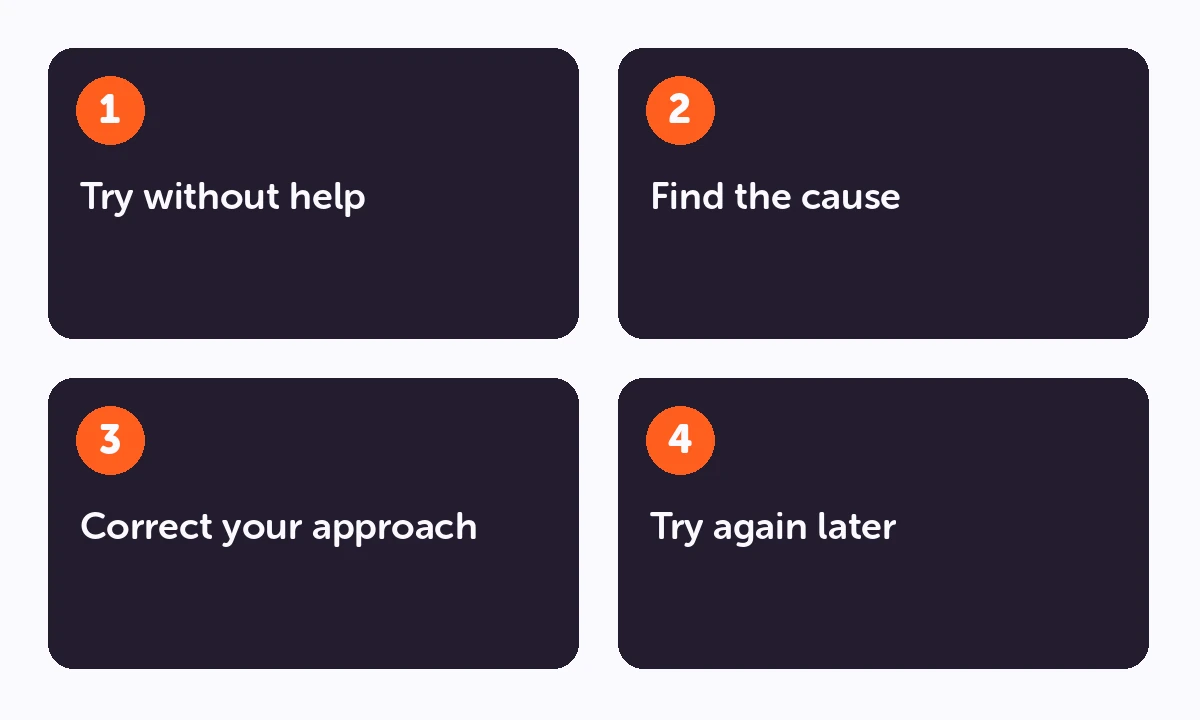
Read the earlier entry before adding another. Did you identify the cause correctly? Did you do the planned practice, or only reread the solution? Each answer points to a different next step.
If you understand the distinction but still miscalculate, work on the calculation. If the calculation is fine but you misread what was requested, compare differently worded questions. Two answers that look equally wrong may reveal different difficulties.
You can also log correct guesses. The score treats them as successes, but they may still represent a gap in your understanding. Make a short note of your uncertainty and try a similar question without answer options. You will learn whether you could produce the answer or merely recognise the most plausible choice.
Close the loop with a fresh attempt
Return in a later session, hide the correction and answer a similar question. Record whether you could complete it independently. For past-paper work, use the appropriate mark scheme and ask a teacher when an interpretation remains uncertain. AQA's resource finder is one example of an official source for those materials; use your own board if it differs.
For a concrete numerical example, moving from 20% to 30% is a rise of 10 percentage points and a relative increase of 50%. If that was your confusion, choose new values and calculate both. That is a better recheck than recognising the sentence you copied.
Keep the log small enough to revisit
At the end of a practice session, select a few important mistakes and give each a specific next action. At the start of your next session, return to those entries before opening a new test. Once an attempt improves, record what you managed independently and move on, keeping the option to check again later.
Start with one completed entry: the mistake, its cause, a task and a fresh attempt. If it changes how you spend your next revision session, the log is already doing useful work.
Frequently asked questions
Should I log every mistake?
Prioritise recurring mistakes, important gaps and correct guesses. A short log that changes your next session is more useful than an archive you never open.
When is an error resolved?
When you can complete a fresh attempt without the answer in front of you. Mark it as improved, then revisit it as needed. You can start with one practice session in Algor Education and use the log to choose what comes next.
Continue your revision


Faq
Frequently Asked Questions



Get Started with Algor
Transform your content into structured, visual and personalized learning paths.

.svg)


