
Spaced repetition schedule: build a review plan you can actually use

Algor Lab

On Monday, the chapter made sense. By Friday, the sentences still look familiar, but explaining them with the book closed is another matter. Meanwhile, new chapters have arrived. Starting every revision session from page one soon becomes difficult to sustain.
Spaced repetition gives those returns to your material a structure. You revisit what you have learned across separate sessions, using your answers to decide where attention is needed next. In this guide, you will build a starting schedule and learn how to adjust it when a question is difficult, reviews pile up or an exam gets closer. The aim is to know what to work on today without having to reread an entire course.
Spacing and active recall do different jobs
Spacing concerns when you practise. Active recall concerns what you do during that practice: attempt an answer before consulting the source. You can combine them by revisiting a topic on different days and testing yourself each time.
A review by Carpenter, Pan and Butler examines research on these two approaches. It supports taking learning strategies seriously, but does not provide a universal timetable or promise a particular grade. Your prior knowledge, the task and the time available still matter.
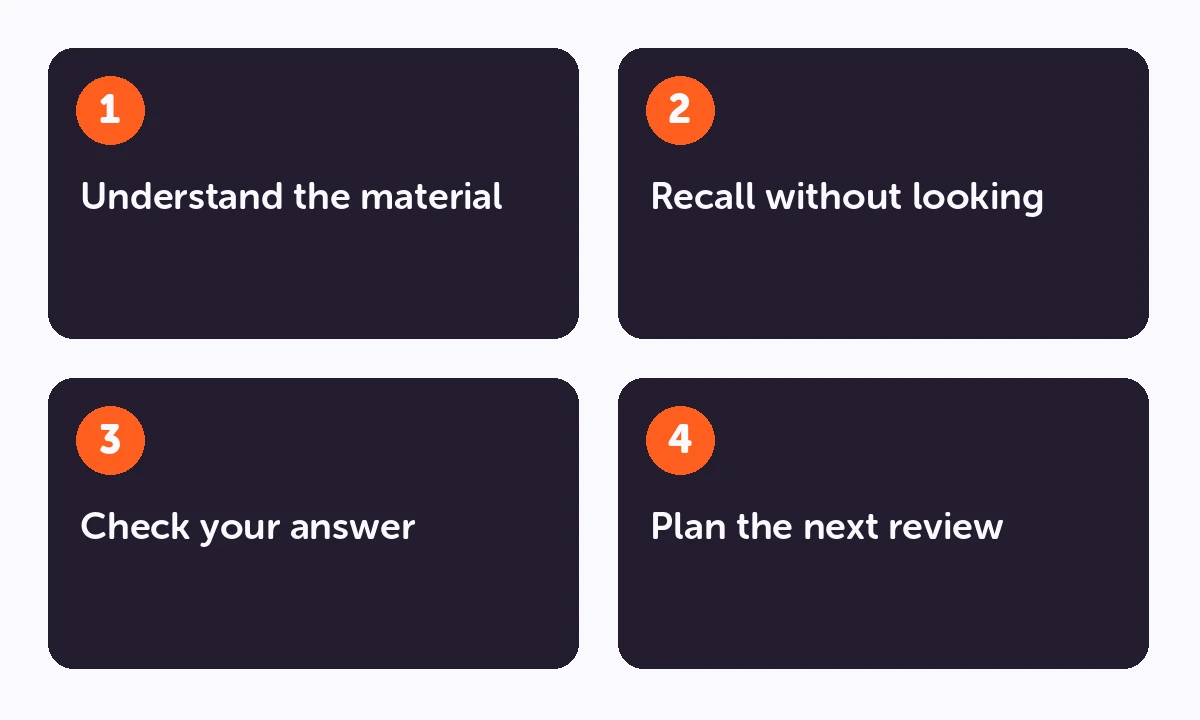
Start by understanding the material. Repeatedly failing a card about an unfamiliar concept may mean you need a better explanation, not another reminder to memorise it.
Decide what a review will actually test
Take a chapter on the nervous system. Writing “review biology” in your calendar still leaves the main decision for later: what will you do when the session begins? You could reread the chapter and overlook the same misunderstanding again.
Instead, prepare a small set of questions. Which structures belong to the central nervous system? How does it differ from the peripheral nervous system? How would you explain a signal pathway from an example covered in class? Use the detail and terminology expected in your course.
You now have a set of answers you can check. That makes it possible to spread attempts over time and notice which ones need another visit. If a question makes no sense even with your notes open, work on the explanation first. A review schedule becomes useful once you have something meaningful to retrieve.
An example review schedule
Suppose you have studied a short section of a course and want to keep its main ideas available over the next month. The schedule below is an illustrative planning template. Adjust it to your answers and the time available before your assessment.
| When | What to do | What to check |
|---|---|---|
| Day 0 | Understand the idea and make an example | Can you explain what it means? |
| Day 1 | Answer a question without notes | Which parts are missing? |
| Day 3 | Compare it with a similar idea | Are you confusing the two? |
| Day 7 | Apply it in a short problem | Can you select the right approach? |
| Day 14 | Mix questions from different topics | Can you recognise what each task requires? |
| Day 28 | Explain or apply it again | Does it need an earlier return next time? |
If recall fails on day 3, clarify the gap and return sooner. Do not wait until day 7 just to follow the table. If the answer is consistently secure, spend more of your next session on a topic that needs work.
Follow one difficult question through the schedule
At your first check, suppose you can name the structures but cannot explain how the two parts relate. Record that specific gap. “Cannot explain the connection” gives you a better next task than “redo the chapter”.
Return to the relevant passage and build a short explanation. At the next attempt, put the source away and describe the connection again. If the answer is complete, you can allow a longer gap before checking it. If the same part is still missing, examine the question itself. Perhaps it asks for two different explanations and would work better split in two.
Meanwhile, definitions you can already explain need not occupy every session. Questions from the same chapter can follow different schedules. One difficult answer changes part of the plan; it does not automatically mean that all the material has to start again from the beginning.
Write questions that reveal understanding
“Explain the entire chapter” can hide several different difficulties. A focused question such as “How does active transport differ from diffusion?” gives you a clearer answer to check.
For a formula, test the meaning of its terms and practise a problem that requires choosing it. For an essay-based subject, recall a claim and then explain the evidence supporting it. Facts, procedures and arguments do not all fit the same card format.
Commit to an answer before revealing the back of a flashcard. If the solution only feels familiar once you see it, that is not the same as recalling it independently. Your rating should reflect the attempt you actually made.
Using spaced review in Algor
Algor Education lets you start flashcard practice from a Set and select the whole Set, a section or a page. According to the study guide, a session includes cards that are due and cards you have not studied, and your ratings affect subsequent review.
You do not need to reproduce the example timetable inside the app. It is a personal planning illustration, not Algor's scheduling specification. Use the available review sessions, then add problems or written explanations to check whether you can use the knowledge beyond the cards.
What if your review queue gets too large?
Reduce new material temporarily. Check whether difficult cards are unclear, overloaded or dependent on something you have not understood. Splitting a large question can make the answer easier to assess without removing the challenging idea itself.
Make room for different subjects
Suppose your week includes biology definitions, maths problems and a history topic. You do not have to turn them all into identical cards. One review can test a biological distinction, another can revisit a problem, and another can ask you to explain a historical cause and consequence aloud.
Choose priorities by looking at what matters for your assessment and where your answers reveal a gap. The number of cards completed can be misleading: it is easy to finish many familiar cards while avoiding one difficult explanation. The outcome you want is a clearer understanding that you can use.
Leave some room in the calendar too. After a missed day, begin with the most important outstanding questions and redistribute the others. Moving every missed task to tomorrow can make the plan impossible to follow. A schedule that recovers from an ordinary interruption is more useful than one that assumes nothing will ever go wrong.
Your first scheduled review
Choose a topic you have already studied and write a few focused questions. Attempt them, note the specific difficulty and decide when to check it again. As those answers become more reliable, adjust the spacing. You will have a reason for each return to the material, rather than another reminder that simply says “revise”.
Frequently asked questions
Does spaced repetition only work with flashcards?
No. You can space practice problems, short written responses and explanations. Choose tasks that resemble the knowledge and skills you need.
What should I do right before an exam?
Prioritise important gaps and exam-relevant practice. Building a huge new deck may leave you with little time to use it. For your next topic, create a manageable Set in Algor Education and make room for review as well as new material.
Continue your revision


Faq
Frequently Asked Questions



Get Started with Algor
Transform your content into structured, visual and personalized learning paths.

.svg)


