
How to study for multiple exams without neglecting a subject

Algor Lab
September 27, 2026

You have two exams a few days apart. While revising for the first, you keep thinking about the untouched chapters for the second. Switch subjects, and you feel guilty about the nearer deadline. By the evening, you have worked hard without knowing whether either exam is getting the attention it needs.
Studying for multiple exams starts with a practical question: what do you need to be able to do next in each subject? Splitting every day evenly is rarely a useful answer on its own. This guide shows you how to weigh deadlines, gaps and assessment formats, with a worked example and a way to use Algor while keeping control of your decisions.
How to study for multiple exams without neglecting a subject
Put all exam dates in one calendar, check what each course requires, and test what you can do without help. Give your most demanding study blocks to important gaps, while keeping shorter review sessions for the other subject. Adjust the balance using your work, rather than hours logged or pages highlighted.
This is a recognised study-planning problem: California State University, Long Beach has an academic coaching module on preparing for several exams in the same week. The example below is an adaptable planning exercise, not a recommended number of hours or a guaranteed route to a grade.
Make a brief for each exam before filling the calendar
Gather the syllabus, your lecturer’s instructions and available practice tasks. For each exam, write down its date, format, remaining topics and one specific difficulty. “I’m behind in statistics” does not tell you what to do. “I can only choose the right test after looking at the solution” gives you a starting point.
Then add commitments that genuinely constrain your week: work, classes, travel and assignment deadlines. Count usable study sessions rather than every apparently free hour. If Wednesday gives you only half an hour, assign a small task you can finish, such as correcting two answers or checking a handful of definitions.
Separate essential materials from supplementary ones. A textbook, three sets of notes and a slide deck may repeat much of the same content. Choose a main reference for each topic and turn to the others when you need clarification. Producing another version of the same summary does not automatically solve the problem.
Which subject should come first? Ask three questions
The closest deadline matters, but it is not the only factor. An imminent exam you can already handle may need less new learning than a later one with a missing foundation. Before choosing your main study block, consider three questions.
- Urgency: how long is left before the exam?
- Obstacle: what currently stops you completing an important task?
- Dependency: does that gap also prevent you tackling other topics?
A method you cannot apply may affect several questions. One isolated fact you cannot recall is a different problem. You do not need a complicated scoring formula. Write down the obstacle you intend to remove and why it deserves the next substantial session.
If two courses share a concept, use that connection carefully. A concept map can help you compare definitions, but keep each course’s examples, notation and assessment criteria distinct. Similar content does not mean the exams ask you to demonstrate the same skill.
A worked example: statistics in eight days, history in eleven
Imagine you know the statistics formulas but struggle to choose between them. In history, you remember events but your explanations turn into lists. You have two study blocks on most weekdays and a longer session at the weekend. These details illustrate decisions; they do not imply that eleven days will be sufficient for every course.
Start by addressing two different obstacles
In the first statistics block, compare two problems, choose the appropriate method and explain why the alternative does not fit. In history, build an answer about causes and consequences, checking each claim against your course materials. Both sessions should leave you with something you can assess.
The following day, revisit the mistakes briefly before attempting a new task. You do not need to change subjects every ten minutes. Finish a meaningful objective, take a break and leave a short note about where to resume. That note saves you from spending the next session reconstructing what you were doing.
As the first exam gets closer
Give statistics more space for mixed problems and permitted practice papers. Keep a short connection with history: explain a relationship aloud, answer a few questions or check an uncertain argument. Once statistics is over, move the main block to history using the gaps you have already identified.
If the first assessment is spoken, change the practice accordingly. Our guide to preparing for an oral exam with AI develops explanations and follow-up questions. The aim is to practise the performance the exam requires, rather than accumulate another pile of revision pages.
Keep each course organised in its own Algor Set
You can create a Set for each exam and use it as a home for the relevant material and study tools. Start with that course’s sources, then compare the generated structure with the syllabus. The content creation guide explains the available steps.
The practical benefit is moving from a topic to the material you need to work on within the same environment. Pages remain editable, so you can add a distinction your lecturer emphasised. A map can also be corrected and expanded rather than treated as a finished answer just because AI produced it.
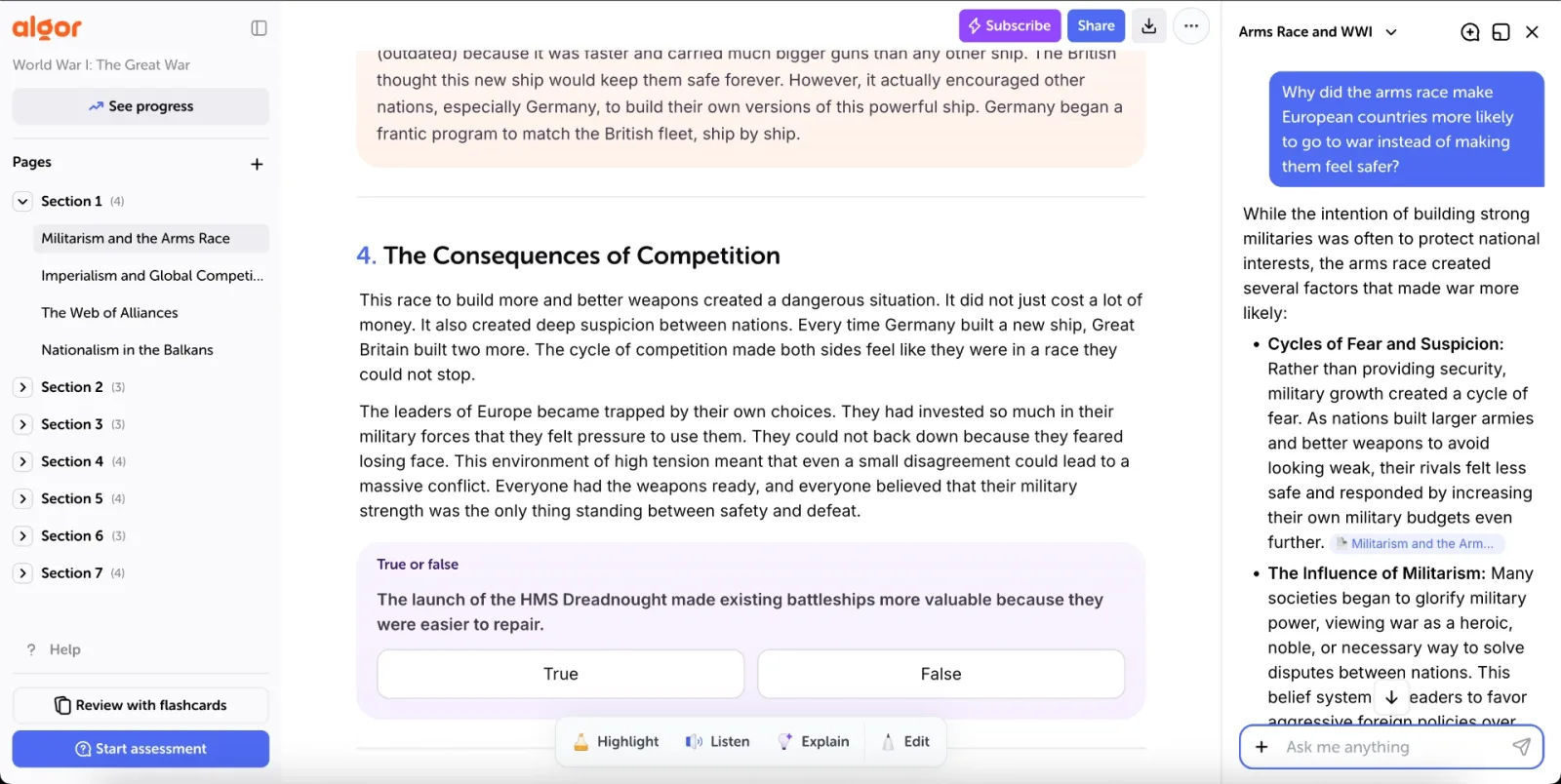
When a step is unclear, ask the Set assistant a focused question: “In these pages, what tells me which of the two methods to choose? Show me the references.” Check the answer against the source. In this workflow, you decide how to distribute time between exams; do not assume a suggested study activity is an automatic timetable across all your courses.
Use practice results to choose the next study block
Algor lets you work on a Set or part of it with flashcards and quizzes, and consult your progress. The studying and reviewing guide explains these tools. Combine the result with a concrete task: can you solve an unfamiliar problem or explain the idea without looking?
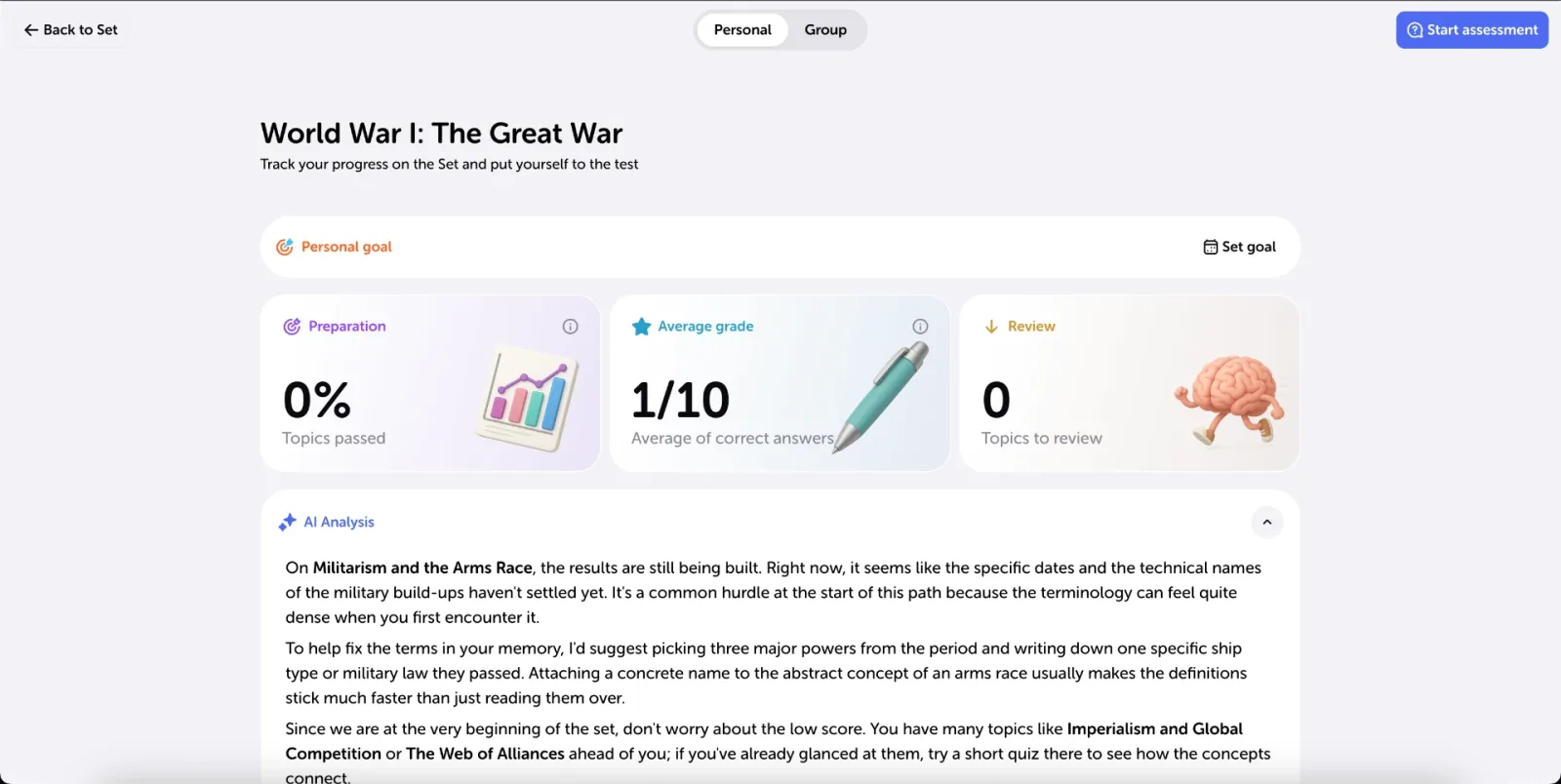
A history score and a statistics score are not automatically comparable. The material, questions and difficulty may differ. Look for recurring problems within each subject instead. A strong average cannot tell you that an important, untested section is secure.
Record a mistake, its likely cause and your next attempt. An exam error log helps turn that observation into work you can act on. For material you already understand, a spaced repetition schedule can keep brief reviews in your week.
When you lose a day, change a priority rather than double the workload
An interruption does not mean every missed task belongs tomorrow. First recover the task that unlocks later work. Shorten a review of something you can already do, move a finishing touch and protect some contact with the other subject. A fully packed calendar has nowhere to absorb an ordinary delay.
If your attempts show that too much remains for both exams, examine the options your institution actually permits. That might mean speaking to your lecturer, checking assessment arrangements or making a more realistic plan. Do not assume you can simply move a fixed exam date. No app can make any amount of remaining time sufficient.
Questions that come up when exams overlap
Should I study one subject a day or both?
It depends on your tasks and available time. A demanding piece of work may deserve the main block of a day; a short check on the other subject keeps it from being abandoned. Switch between completed objectives rather than constantly switching browser tabs.
Can AI decide which exam I should postpone?
It can help organise information and question you on your material. The decision also depends on official dates, course rules and personal circumstances. A quiz score cannot replace those facts or provide a reliable guarantee about an exam outcome.
Start with two useful tasks, not a perfect timetable
Write down one difficulty for each exam and the result you want from the next session. In Algor Education, you can bring the relevant materials and tools together: a map to clarify relationships, a question to the assistant, then flashcards or a quiz to check your understanding. End by choosing what comes next. Repeating that decision with better evidence makes parallel preparation more manageable.


Faq
Frequently Asked Questions

Related articles
Get Started with Algor
Transform your content into structured, visual and personalized learning paths.

.svg)


