
How to prepare for an oral exam with AI: from revision notes to clear answers

Algor Lab
September 25, 2026
You read the page and it all makes sense. You recognise the terminology, understand the example and can follow the model answer. Then someone asks you to explain it. Halfway through your second sentence, you realise you know several relevant facts but cannot quite join them together.
That gap matters in an oral exam. Knowing your material is the starting point; you also need to explain it, justify a choice and respond when the conversation takes an unexpected turn. AI can help you prepare those moments, provided you use it to create opportunities to practise rather than a growing collection of polished answers.
This guide takes you through a manageable practice session with Algor: organise your course material, turn it into open questions, answer aloud and use the difficulties you notice to decide what comes next. You do not need to rehearse an entire syllabus before the process becomes useful.
What should AI actually do for your oral exam preparation?
The useful question is not “Can you write a perfect answer for me?” It is “Can you help me find out which parts I cannot yet explain?” Ask for questions based on your course material, comparisons between related ideas and follow-up questions that require a reason or an example. Give your own answer before you read a suggested one.
This brings active recall, the principle behind flashcard practice, into a spoken setting. But an oral answer needs more than a remembered definition. You have to decide where to start, connect your points and make the reasoning understandable to someone else.
To prepare for an oral exam with AI, start with reliable course material, generate open questions, answer them aloud without your notes, and check the gaps against your sources. Algor supports this workflow by bringing editable study materials, an assistant and practice tools into a Set. You still do the speaking and judge whether your explanation answers the actual question.
1. Find out what the assessment requires
Before uploading anything, write down what you know about the exam. Will you explain course concepts, discuss a text, justify a solution or apply an idea to a case? Is there a prepared presentation, or does the assessment begin with questions? These differences should shape your practice.
Use your course handbook, assessment brief and your teacher's or lecturer's instructions. An oral assessment, a language speaking test and a research viva can involve very different expectations. This is a revision workflow, not a substitute for those requirements. Confirm the format, permitted materials and marking criteria with your institution if they are unclear.
Choose three to five connected topics for your first session. A small scope makes it easier to notice a specific problem and do something about it. “Revise the whole module” is a task you can postpone indefinitely; “explain these two processes and their main difference” gives you somewhere to begin.
2. Turn your notes into material you can check
Start an Algor Set from your lecture notes, a slide deck or another course source you are allowed to use. The guide to creating content explains how to choose your source, set the language and level of detail, and review the proposed index before generating the material.
Compare that index with your assessment topics. Is an important term missing? Are two ideas separated that you will need to discuss together? Adjust the structure before relying on the resulting notes. Keep checking generated explanations against the original material, particularly where your course uses a specific definition or convention.
Do not cut everything down to keywords. A useful revision resource also preserves examples, conditions and exceptions: the details that help when someone asks “Why?” or “Would that always happen?” You want something concise enough to navigate and substantial enough to support an answer.
3. Use a concept map to organise an explanation
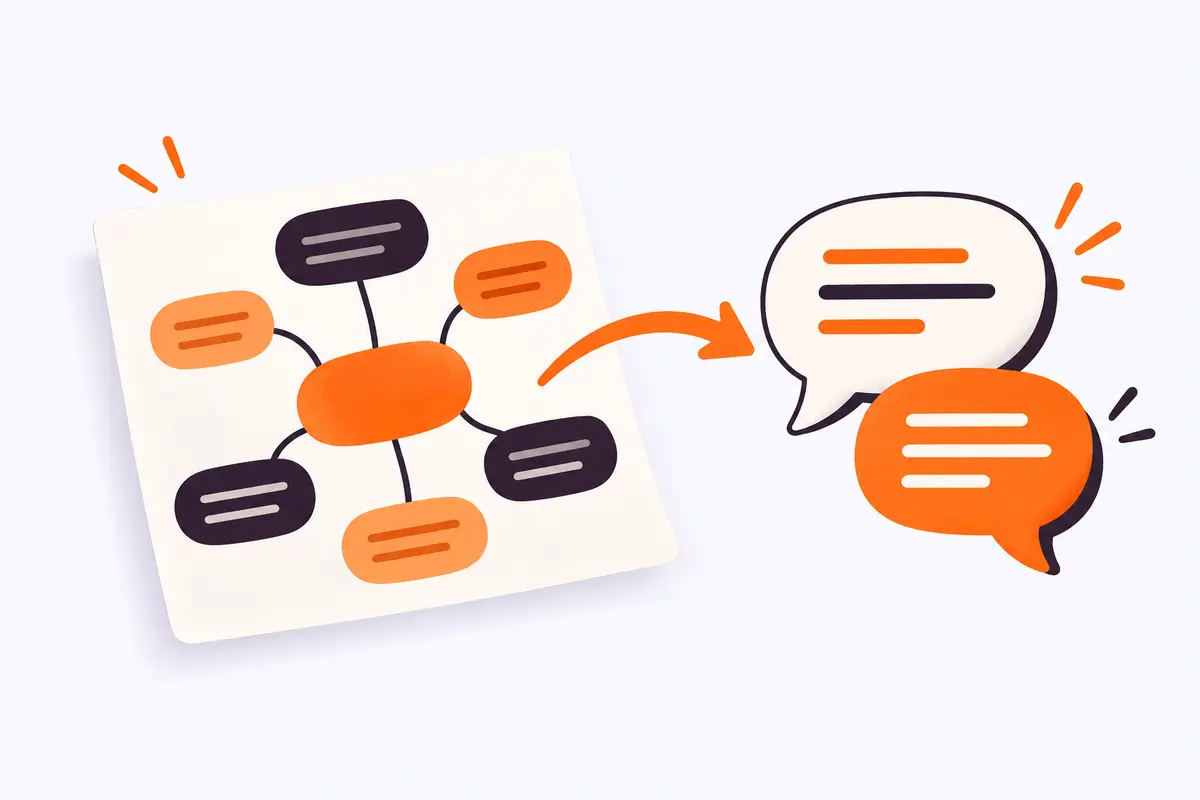
A spoken answer needs connections. One idea explains another; a condition limits a claim; an example makes an abstract point easier to follow. An editable concept map can help you put those relationships in view. The aim is to build a route through the topic, rather than simply collect terms.
Take a biology question about diffusion and osmosis. Your map might include concentration differences, water and a selectively permeable membrane. Can you explain which relationships belong to each process, using the definitions taught on your course? Seeing all the words together is only the first step.
Close the map and give your answer aloud. Reopen it afterwards to check what you missed. Perhaps you named both processes but never stated the key distinction. Add or clarify that relationship, then try again. If you need help building the structure, the tutorial on creating maps with AI walks through the tools.
Give yourself a starting point, not a script
For an explanation, try naming the idea, stating its central point, explaining the relationship and adding an example. For a comparison, lead with the difference. For a calculation, start with the problem and why the chosen method fits it.
These are practice structures, not compulsory formulas. If every answer begins with a memorised introduction, you may spend precious time talking around the question. A good opening tells the listener which question you are answering.
4. Ask for follow-up questions before model answers
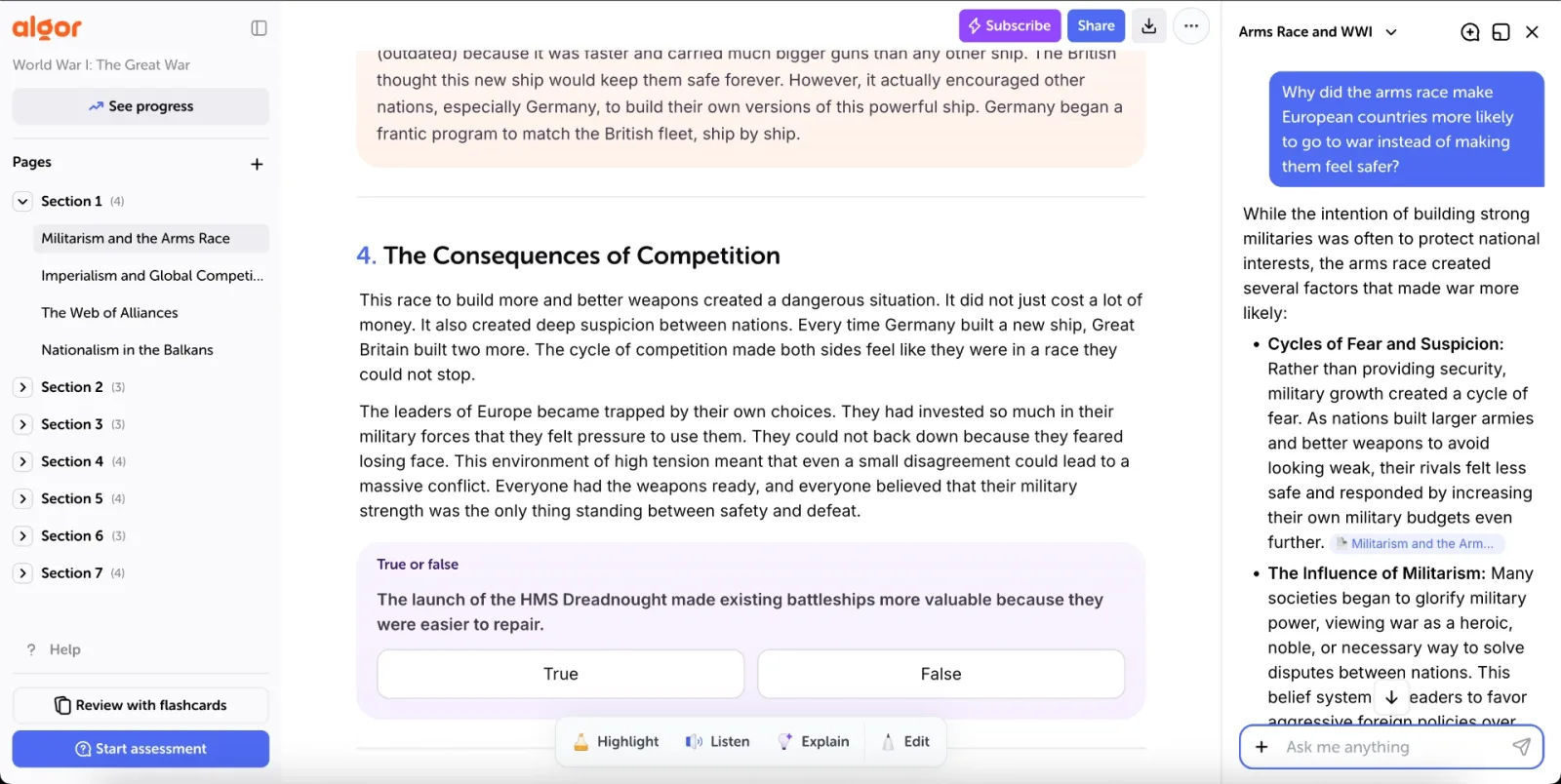
Algor's Set assistant can refer to your Set and uploaded files, with citations you can inspect. Open it alongside the relevant material and request a short practice exchange. The studying and reviewing guide explains how the assistant and other practice tools work.
“I am preparing for an oral exam on this section. Ask one open question based on my material and wait for my answer. Then ask a follow-up that requires a reason or an example. Do not give me a model answer first. If you do not have enough information to assess a point, say so.”
Say your answer aloud first. Then type its main points into the chat if you want feedback on the content. In this workflow, the assistant responds to the text you enter; it does not automatically assess your spoken delivery. Keep that distinction clear when deciding what the feedback tells you.
Vary the questions so your practice goes beyond definitions:
- Explain: What does this term mean here? Look for a precise statement, rather than a list of related words.
- Compare: How do these two processes differ? Use the same comparison criterion for both.
- Justify: Why does this conclusion follow? Make the missing reasoning explicit.
- Apply: What would change in another example? Check whether you can use the idea outside the original wording.
5. Separate knowledge gaps from unclear explanations
After an answer, make two short notes: what was uncertain, and what was hard to follow. You might have forgotten a definition. Or you might have known it but changed direction halfway through. Those problems need different next steps.
For a knowledge gap, return to the source and check the relevant point. For a structural problem, answer the same question again with a clearer opening. If your explanation was too general, add one concrete example. You do not have to restart the whole chapter whenever an answer goes badly.
A useful practice note might say: “I defined both ideas but did not explain the difference. Next attempt: begin with the difference, then give an example.” That is much more actionable than “bad at biology”. Keep recurring problems together so they can guide your next session.
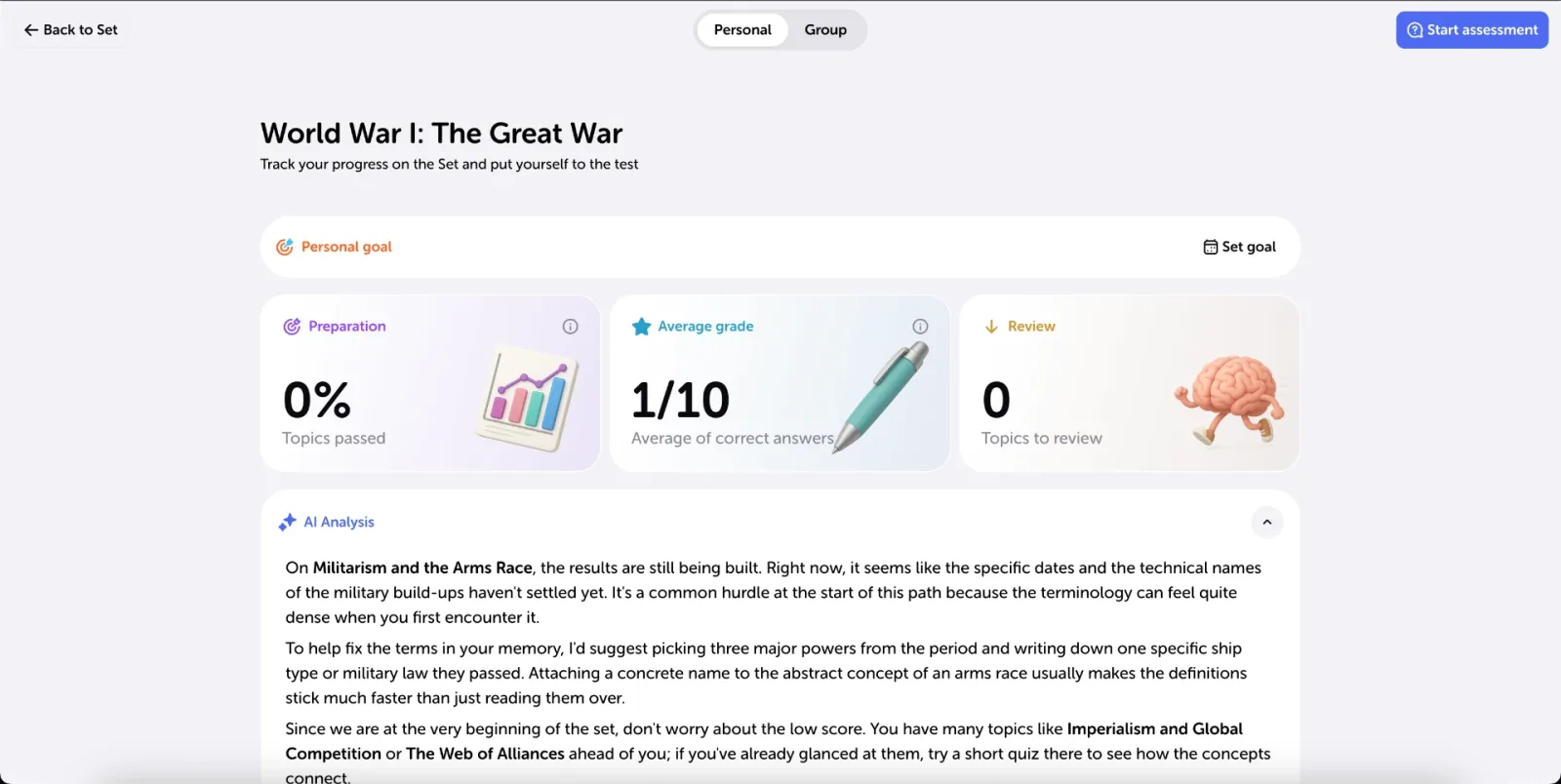
Algor's assessments and progress overview can also help you choose which material to revisit. Treat those results as information about your revision, not a prediction of your oral exam mark. If AI feedback conflicts with your notes, check the original source or ask your teacher to clarify.
A 30-minute session you can try today
Choose a topic you have already studied and keep the source material ready for checking afterwards. These timings are a suggested routine, not an Algor setting or a rule about how long revision should take.
- Five minutes: choose the topic and review your map or outline, then close it.
- Ten minutes: answer two open questions aloud, with one follow-up for each.
- Ten minutes: check the content, close one knowledge gap and rebuild one unclear explanation.
- Five minutes: answer the hardest question again without notes and record the next thing to practise.
When possible, also practise with another person. Ask them where they lost the thread or wanted an example. They do not need to give you the answer immediately: a well-placed follow-up can show you more than another page of notes.
Common questions about using AI for oral exam preparation
Can AI replace a practice examiner?
It can help generate questions and discuss the written points you provide. A text conversation does not automatically evaluate your delivery, timing or response to an unfamiliar person. Combine it with speaking aloud and, where possible, a practice conversation.
Should I memorise complete answers?
Practise the structure and essential terminology, then vary the wording and examples. This helps you check whether you understand the relationship or mainly remember a sequence of sentences. Follow your course's requirements for any definitions that need precise wording.
Start with one explanation
Pick a concept from your next exam and explain it without looking. The point where you hesitate gives you a useful starting place: a definition to check, a connection to clarify or a better example to find.
With Algor Education, you can keep your course material, editable maps and practice in the same Set while deciding what needs more attention. The goal is to arrive at the exam able to explain your reasoning, not simply repeat an answer that looked convincing on screen.


Faq
Frequently Asked Questions

Related articles
Get Started with Algor
Transform your content into structured, visual and personalized learning paths.

.svg)


