
How to review lecture notes with AI without rewriting everything

Algor Lab
September 26, 2026
You leave a lecture with the slides downloaded, several pages of notes and a reasonable sense that it all made sense. Then the next class starts. A week later, you open the same files and discover that the diagram is familiar but the explanation has disappeared. Having the material and being able to use it are two different things.
Reviewing lecture notes is the bridge between them. You do not need to rewrite every page or master the whole topic immediately. You need a manageable way to recover missing context, make the main ideas usable and decide what to practise next. This guide walks through that process, including where AI can help and where your own judgement still matters.
What should you actually do after a lecture?
A useful review has three outcomes: you can follow the explanation, you have tried something without looking at it, and you know what remains unclear. A neat summary may support those outcomes, but it does not prove that you understand the subject.
Imagine a statistics lecture about correlation and causation. One slide shows two graphs; your notes mention ice cream sales and sunburn. Copying the definitions into a new document will not tell you whether you can explain the example. A better target is: “I can explain why two quantities might rise together without one causing the other.” That target gives the review a direction.
This is different from choosing a note-taking layout. The Cornell method, for example, helps you organise notes and questions. The process here starts after the lecture and works with handwritten notes, a digital document or a mixture of sources.
Hot, sunny weather is a plausible common factor: it can increase both ice cream sales and time spent in the sun. That gives you an alternative explanation, not proof that this is what caused the pattern. Being able to distinguish a plausible hypothesis from evidence is part of the learning goal.
First, recover the context that is easiest to lose
Open the material for one session: the slides, your notes and any reading specifically attached to it. Give the files a clear topic or session name. Resist opening the entire module at once. A smaller starting point makes it easier to see what is missing and to finish a useful piece of work.
Read through once and distinguish three situations. Some ideas are already clear. Others are missing an example or a step. A third group still makes little sense. These need different amounts of attention. Treating every line as a rewriting task can consume the whole session without resolving the difficult part.
Preserve the explanation, not just the slide text
What assumption did the lecturer make before using the formula? Why was an alternative interpretation rejected? Was there an exception that never appeared on the slide? Add those details while you can still recall them, and keep uncertain recollections separate from statements you can verify in the course material.
Turn a vague gap into a question. “I do not understand correlation” is difficult to act on. “Why does an increase in both ice cream sales and sunburn not establish causation?” is something you can investigate in the textbook or ask in a tutorial. A useful question is already progress.
Build a small explanation you can follow
Give the session a central question, then organise its main ideas around that question. You do not need an arbitrary number of bullet points. You need a structure that preserves the argument and shows where each example belongs.
For the statistics lecture, the sequence might be: what correlation describes, which alternative explanations exist, and what further evidence would be needed for a causal claim. The ice cream example belongs under alternative explanations. You now have a reason to remember it, rather than an anecdote floating beside two definitions.
Match the format to the task. A concept map can make relationships visible. A worked calculation needs its steps and assumptions. A literature seminar may need a claim, supporting passages and a competing interpretation. A summary is useful when it captures that structure; it becomes less useful when shortening the text removes the reasoning.
Use Algor to keep the material and the practice connected
When your sources are scattered, Algor lets you bring them into a Set: an organised study space with editable material and visual tools. For lecture review, the practical benefit is continuity. You can clarify an explanation, work on its concept map and practise the same topic without rebuilding the context in several separate places.
Start from the documents used in your class. Export slides to PDF where necessary and include your relevant notes. Check the proposed structure before generating the material. If a lecturer’s example is missing, supply it yourself rather than asking the AI to invent what might have been said.
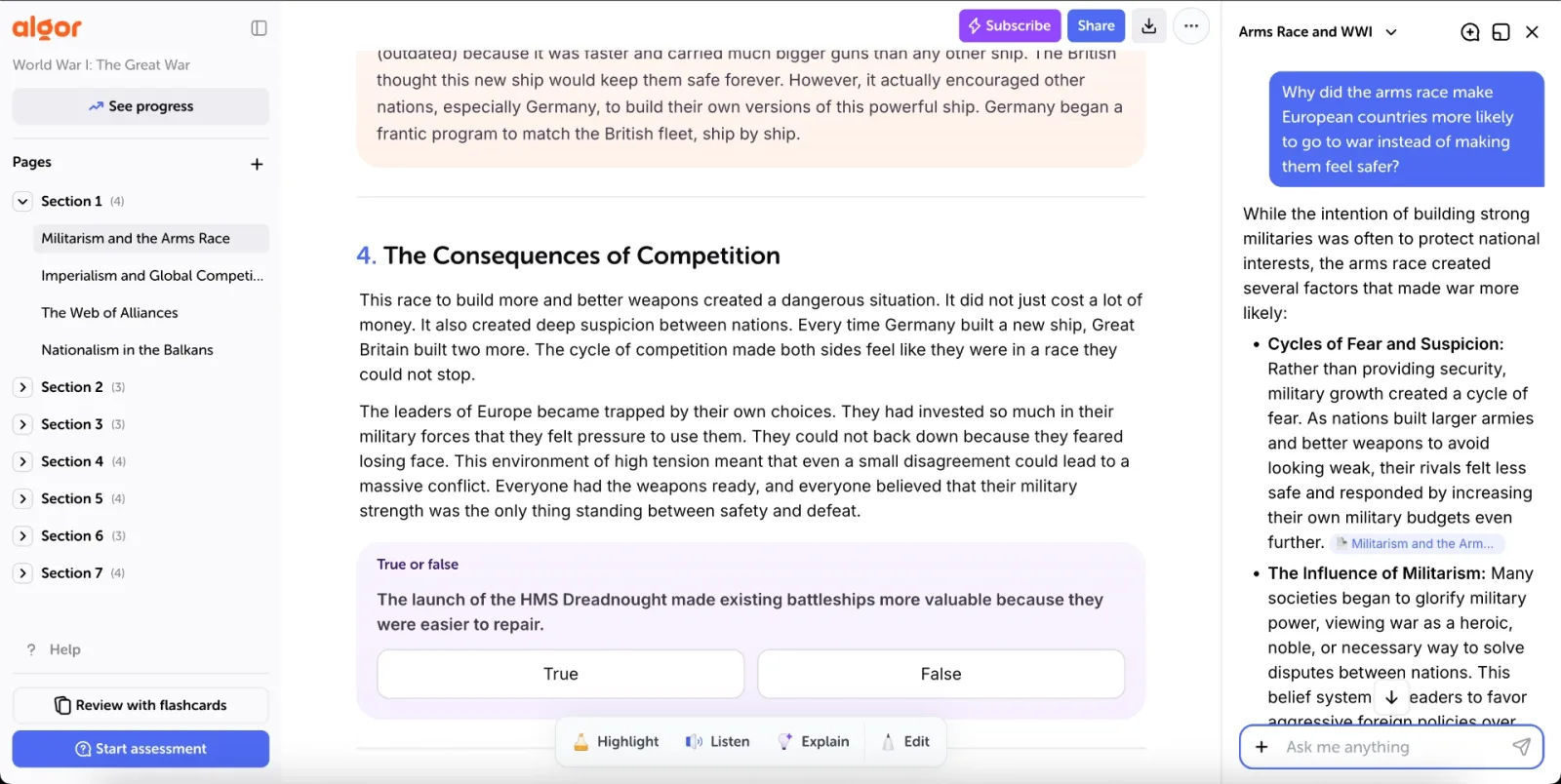
The official guide to creating content explains the interface. For a broader collection of topics, our guide to creating a study guide with AI covers the larger workflow. For this review, keep your scope to one session or one substantial idea.
Ask for help with the point that is blocking you
A focused request might be: “Using my material, explain why the ice cream example does not establish causation. Separate what the sources say from any additional example, and show the relevant source.” This is a useful instruction, not a promise that the answer will be correct. Check definitions, assumptions and any information added beyond the lecture.
The assistant within an Algor Set has context from your material, so follow-up questions can stay connected to what you are studying. You remain responsible for deciding whether the answer matches your module. Keep the source available and correct the generated explanation when needed.
Close the notes and attempt something small
Once the material is clearer, try a task without the explanation in front of you. Describe the idea aloud, reconstruct a diagram or solve a representative problem. The task does not have to be long. It needs to make a difference between recognising the answer and producing it.
In our example, start with: “What third factor could affect both ice cream sales and sunburn?” Then move to: “What information would help us test that explanation?” The first question checks the central idea. The second asks you to use it. Knowing the definition of correlation is relevant, but it is not the whole learning objective.
You can use Algor’s dedicated flashcards and quizzes for this practice. Choose activities that match what the course expects, rather than assuming that any set of questions is representative of the assessment. A good score on a short quiz is useful feedback, not a guarantee of exam readiness. Our article on active recall explores this distinction further.
Let the result determine your next action
If you get something wrong, first identify the kind of problem. Did you forget a definition? Confuse two ideas? Choose the correct rule but fail to apply it? Rereading the entire lecture treats all three as if they were the same.
Write down a specific next action: look up the missing definition, compare two similar cases, or attempt a fresh problem without the worked solution. If a key assumption is unclear, a question for your tutor may be more helpful than another generated explanation. The purpose of AI support is to make the work more focused, not to keep you in a conversation indefinitely.
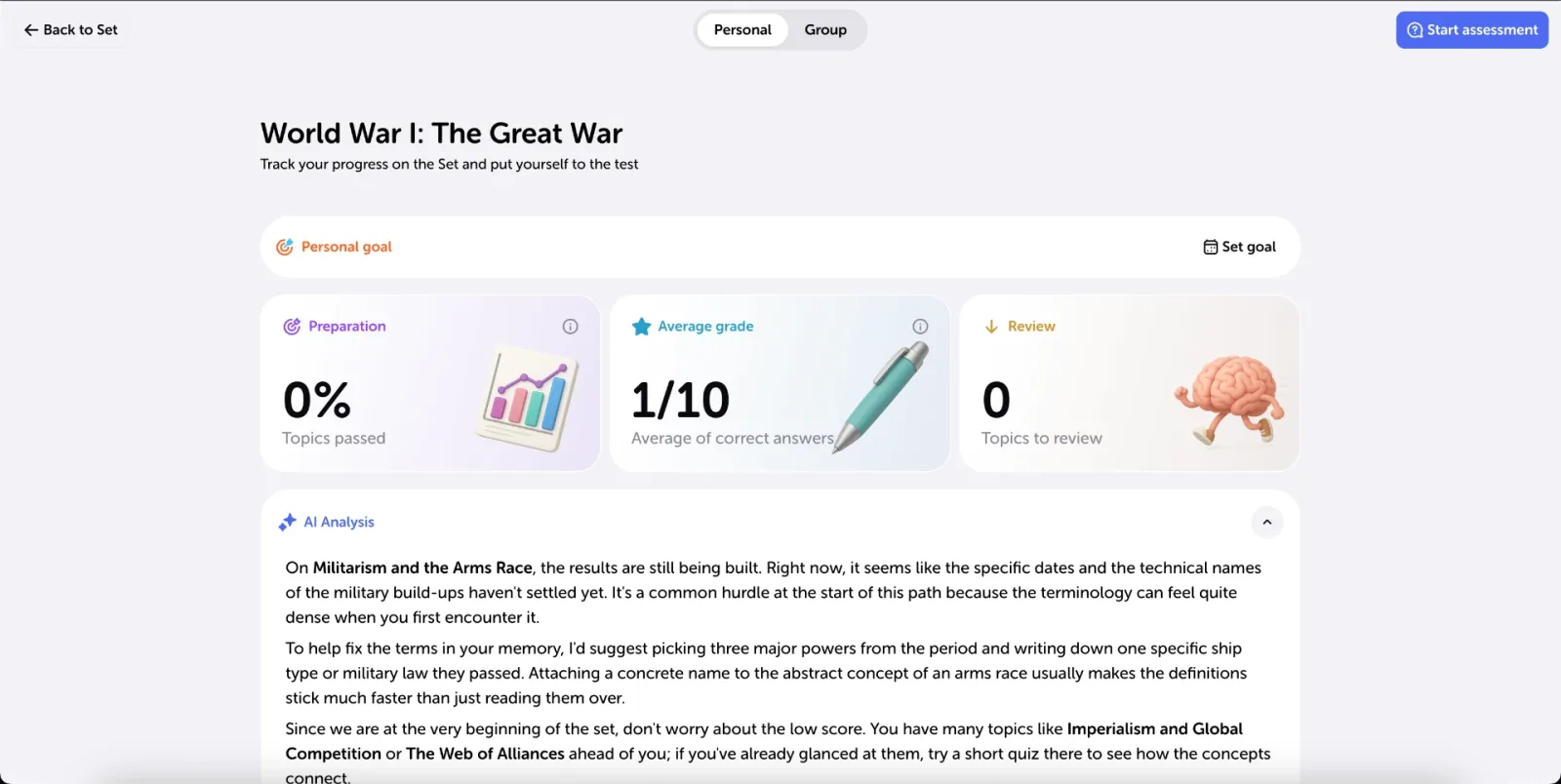
The guide to studying and reviewing explains the progress view. Read the feedback alongside your course requirements and your own attempts at the work. An indicator can guide your attention; it cannot know every detail of an upcoming assessment.
Make the routine small enough to repeat
Try reserving a short block after class: first mark gaps, then clarify one important relationship, then answer a question with the notes closed. If you have about half an hour, divide it according to what the topic needs. That is a planning example, not a scientifically prescribed duration or a claim that every lecture can be learned in thirty minutes.
A difficult session may need a second appointment. Finish the first with a clear record of what is complete and what remains open. This is more useful than labelling a polished summary “done” when its central argument is still unclear. Keep the routine flexible enough to work on an ordinary busy day.
Return to the topic later as well. A spaced repetition schedule can help you keep older material in circulation. Adjust the interval to the difficulty, your available time and your performance, rather than treating one timetable as suitable for every subject.
Common questions about reviewing lecture notes
Should I rewrite all my notes?
Only if rewriting solves a real problem. If the explanation is already clear, a practice question may be more valuable than another copy. Rewrite an unclear argument, fill a missing step or reorganise material when the structure is obstructing your understanding.
What if I am several lectures behind?
Start with a current lecture and identify the earlier knowledge needed to follow it. Catch up on those foundations deliberately. This lets you address the backlog without allowing every new session to join it. Avoid making beautifully rewritten old notes a condition for rejoining the course.
Is an AI summary enough?
It can help you get started, but you still need to compare it with the source and attempt the work yourself. Carnegie Mellon University’s guidance on lecture notes encourages returning to notes after class. AI can help prepare that review; it does not perform the learning on your behalf.
Choose your most recent lecture, one unclear point and one question you want to answer independently. If you want the explanation, visual material and practice together, create a Set in Algor and use that first question to guide your review.


Faq
Frequently Asked Questions

Related articles
Get Started with Algor
Transform your content into structured, visual and personalized learning paths.

.svg)


