
Active Recall: How to Study and Remember What You Learn

September 24, 2026

You have spent hours rereading notes and highlighting pages. The material looks familiar, and you feel reasonably prepared. Then you close the book or face an exam question, and the explanation you thought you knew is suddenly difficult to produce.
That gap between recognising information and recalling it is exactly what active recall helps you address. Instead of waiting for the exam to find out what you remember, you practise bringing the information to mind while there is still time to improve.
Active recall is also known as retrieval practice. It has a substantial research base in cognitive psychology, and you can apply it with something as simple as a blank sheet of paper. This guide explains what it is, why it works, how to use it in school or university, and how study tools can reduce the time you spend preparing questions.
What is active recall, and why does it work?
A practical definition of active recall
Active recall means deliberately retrieving information from memory rather than only looking at it again. You might close a textbook and explain a process, answer a question about a lecture, or attempt a short quiz before checking the answers.
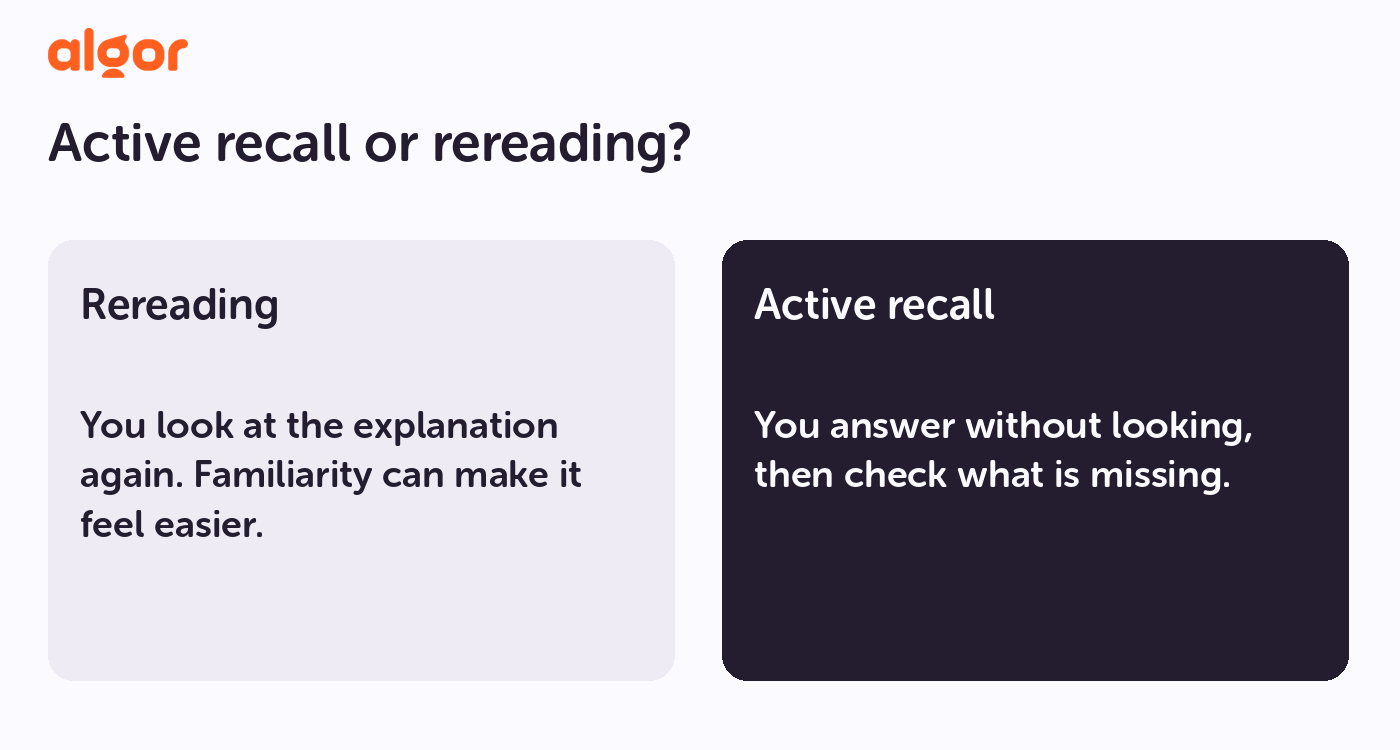
The word “active” describes what you are doing with the information. Reading introduces you to an explanation; retrieval asks you to produce it yourself. That effort gives you practice accessing the knowledge when you need it, including when the original notes are no longer in front of you.
Imagine you have just studied the stages of mitosis. Rereading their names may make them feel familiar. Trying to list them in order and explain what changes at each stage reveals a different level of knowledge. You may know the names but confuse two stages, or remember the sequence without understanding what it means.
That is useful information, not a reason to give up. Check the missing part, correct the misunderstanding and return to the question later. A productive study session includes both retrieval and feedback.
The research behind retrieval practice
Research on memory reaches back to Hermann Ebbinghaus's experiments in the nineteenth century. The particular benefits of retrieval practice have been examined extensively in more recent cognitive psychology.
In a widely cited study published in Science in 2008, Jeffrey Karpicke and Henry Roediger found that repeated testing supported later recall of learned material more effectively than repeated study alone in their experiment. The important point for students is that a test can do more than measure learning: practising retrieval can contribute to it.
A useful analogy is a path through a wood. Looking at a map of the path is different from walking it. Repeatedly retrieving an idea gives you practice finding and using it, although memory is more complex than any single analogy suggests.
The benefits are not limited to remembering isolated facts. Well-designed questions can also ask you to explain a relationship, compare two concepts or apply a principle. What you practise retrieving should reflect what you will eventually need to do with the knowledge.
Active recall versus passive rereading
In their 2013 review of ten commonly used learning techniques, John Dunlosky and colleagues rated practice testing and distributed practice as broadly useful approaches. Rereading and highlighting received lower ratings across the evidence reviewed.
This does not make reading unnecessary. You still need to encounter and understand the material. The problem is relying on rereading as the whole study process, especially when familiarity starts to feel like proof that you can explain something independently.
This is sometimes described as an illusion of competence. A passage seems obvious while it is in front of you, so you assume you know it. A closed-book question gives you a more demanding check.
For your next review, try replacing part of the time you would normally spend rereading with questions. Afterwards, use the notes to correct your answers. The aim is not simply to work harder, but to make your study time show you what is secure and what needs attention.
What happens when you practise remembering?
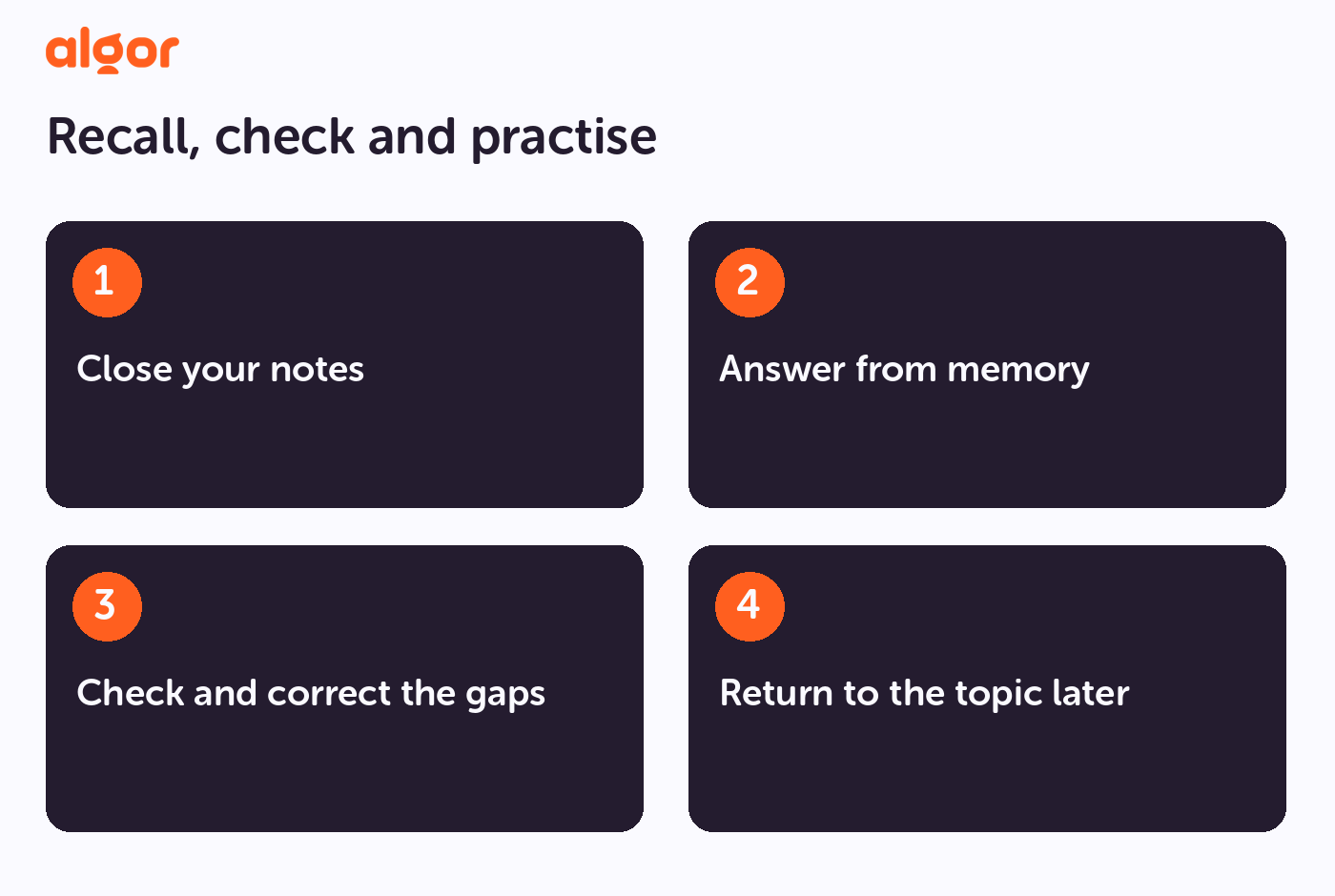
The testing effect
The testing effect is the finding that retrieving information can improve later retention compared with spending all that time studying it again. This makes a low-stakes self-test a learning activity, not merely a rehearsal for being graded.
When you ask, “What are the stages of mitosis?”, you have to search for the relevant information and organise it into an answer. You are practising access to the knowledge instead of only recognising the wording in your notes.
Feedback still matters. A wrong answer should not be repeated until it feels familiar. Check it against a reliable source, understand the correction and try again later. Even an unsuccessful attempt can be useful when it helps you notice what you need to learn next.
Making knowledge easier to retrieve
Memory involves interacting brain systems, and learning changes how information is represented and accessed. For everyday study, you do not need to reduce this to a claim about a particular neural circuit. The practical observation is simpler: repeated, successful retrieval can make later recall more reliable.
This helps explain why a task that feels harder now may be better preparation for later. Reading a clear explanation can feel smooth and reassuring. Producing the explanation yourself exposes the gaps and makes you work through them.
Researchers sometimes discuss this through the idea of desirable difficulties: certain challenges during learning can support longer-term performance. The word “desirable” matters. An impossible question with no useful feedback is not automatically better than a manageable one. The difficulty needs to be appropriate, and you need a way to correct mistakes.
Retrieval can also encourage deeper processing. Explaining why a result follows from a principle requires you to reconstruct the meaning, rather than reproduce a familiar sentence. That is why it is worth mixing factual questions with questions about causes, comparisons and applications.
Finding the gaps in your knowledge
One of the most immediate benefits of active recall is that it makes weak areas visible. You may confidently remember a definition but struggle to give an example. Or you may solve a familiar problem while finding a slightly different version difficult.
Use those results to decide what to study next. Instead of rereading every page equally, return to the concepts your answers showed were uncertain. Then test them again after a gap.
This is a practical form of monitoring your own learning. Your study plan becomes responsive to what you can actually do, rather than to how many pages you have looked at.
Practical active recall techniques
Flashcards and focused questions
Flashcards are one of the simplest ways to practise retrieval. Put a question or cue on one side and the answer on the other. Try to produce the answer before turning the card over.
Good cards are specific. “What is photosynthesis?” may be useful at first, but a card asking you to explain an entire chapter is difficult to judge. Break a large topic into focused prompts while keeping enough context to make each question meaningful.
- Test one main idea at a time. This makes it easier to tell whether you knew the answer.
- Use your own wording. Rephrasing helps you check that you understand the content.
- Include relationships and examples. Not every card needs to ask for a definition.
- Check the answer before keeping the card. A polished question is only useful if the information is correct.
AI flashcard tools can generate a first set of questions from your notes or documents. That reduces preparation work, but you should still review the cards for clarity, relevance and accuracy.
The blank-page method
After studying a topic, close your materials and take a blank sheet of paper. Write down everything you can remember: definitions, dates, formulas, examples and connections.
Do not worry about making the first version attractive. Use a list, a rough diagram or short paragraphs. The purpose is to find out what you can retrieve without copying.
Then reopen the source and compare. Mark the missing ideas and correct anything inaccurate. These are the points to revisit in your next session. You can also turn them into questions, so the next attempt tests the gaps directly.
This method is particularly useful when you need to reconstruct the shape of a whole topic, rather than practise one fact at a time.
Explain it to someone else: the Feynman approach
The study technique commonly associated with physicist Richard Feynman asks you to explain a concept simply and clearly. It is useful because an explanation requires both retrieval and organisation.
Choose a topic and explain it aloud as if the listener has not studied it. Define the terms you need, show how the steps connect and give an example. If you rely on vague phrases or cannot explain a transition, you have found something to work on.
You can do this with a classmate, in writing or by recording a short voice note. The listener does not have to be present for the exercise to reveal where your explanation breaks down.
Then return to the material, resolve the uncertain point and explain it again. Keep the language simple without removing details that make the explanation accurate.
Quizzes and self-assessment
You do not have to wait for a formal exam to test yourself. Add a short quiz to the end of a study session: five to ten questions can be enough to show whether you have understood the main points.
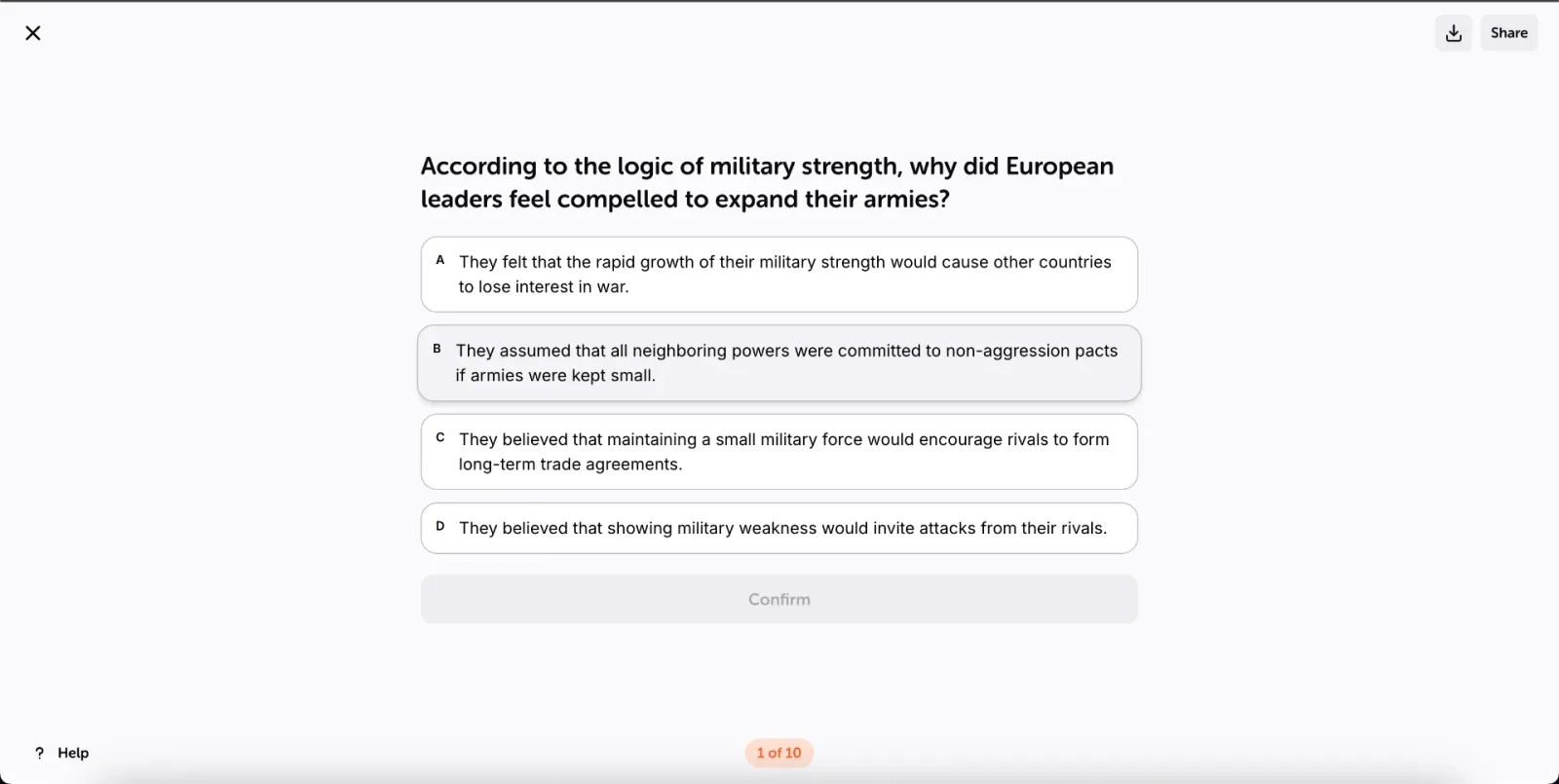
Use a mixture of formats. Multiple-choice questions can reveal confusion between similar concepts; open questions ask you to produce an answer with fewer cues. For quantitative subjects, include actual problems, not just questions about definitions.
When checking an answer, look beyond whether it is correct. If you guessed, record that uncertainty. If it is wrong, work out why the correct answer follows from the material.
Algor can generate quizzes from your study Set, with options including multiple choice, true or false, fill-in-the-blank, matching and open responses. You can choose the material covered and use the results to decide what to review.
Active recall and spaced repetition: how to combine them
What is spaced repetition?
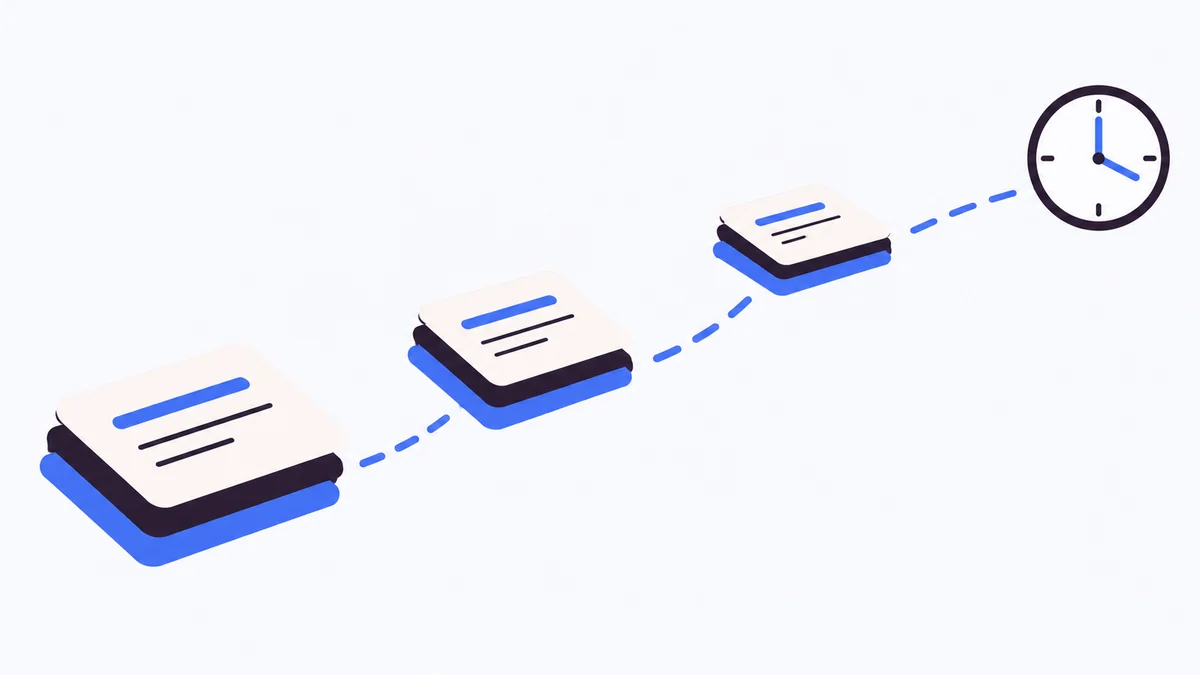
Spaced repetition means returning to material across separate study sessions rather than concentrating every review into one sitting. New or difficult material usually needs more frequent attention; material you remember reliably can be revisited after longer intervals.
Ebbinghaus's work on forgetting helped establish the importance of time in memory. In practice, the useful lesson is that one successful recall today does not mean a topic is permanently learned. Later retrieval gives you a chance to strengthen and check it again.
There is no universal interval that is perfect for every person and every fact. Review schedules are estimates that adapt to performance, difficulty and the system being used.
How the two techniques work together
Active recall describes how you study: you try to retrieve the answer. Spacing describes when you return to it: across sessions, with gaps between them. Together, they provide a practical routine for retaining material over time.
For example, create questions after studying a chapter. Review them the next day, then return later to the ones you can answer. If a card remains difficult, give it more attention sooner. Treat intervals such as one day, three days and a week as illustrations, not a timetable that guarantees the same result for everyone.
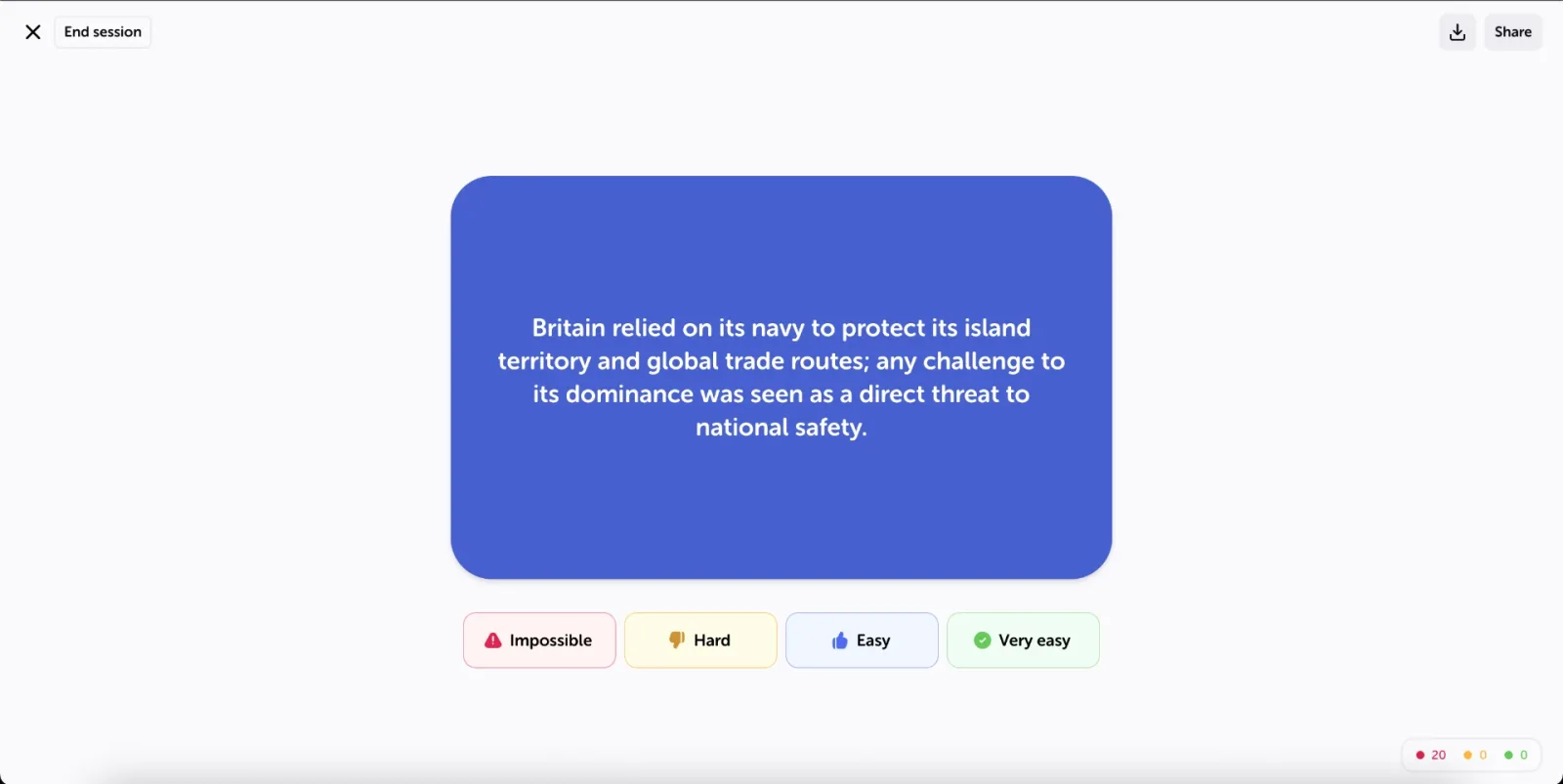
In Algor, after revealing a flashcard's answer, you rate how difficult it was to recall. Your rating influences when the card returns. Be honest: recognising the answer after turning the card is different from producing it beforehand.
How review scheduling works
Spaced-repetition systems use scheduling rules or algorithms to estimate when a card should return. Well-known approaches include SM-2 and newer systems such as FSRS. Different applications implement scheduling differently; naming an algorithm here does not imply that Algor uses that particular one.
You do not need to understand the mathematics to use the routine. What matters is answering before revealing, rating the attempt accurately and returning regularly enough to keep the review manageable.
If the daily workload becomes unrealistic, reduce new cards and focus on important material. A smaller, well-maintained collection is more useful than a large backlog you stop opening.
Tools for putting active recall into practice
Flashcard apps: Algor, Anki and Quizlet
Different tools support different ways of studying. The most useful question is not simply which app can display a card, but how you want to move from course material to explanation, practice and review.
- Algor Education: turns your documents and notes into a Set with maps, summaries, audio, flashcards and quizzes. It is particularly useful when you want to understand the chapter visually and then practise the same material without moving between separate tools. You can edit the content, review cards with spaced repetition and use quiz results to track progress.
- Anki: is an established spaced-repetition flashcard tool with extensive options for managing cards and decks. It suits people who want control over a dedicated flashcard workflow. Preparing or adapting a good deck still takes attention, and a broader study environment may require other tools alongside it.
- Quizlet: offers flashcards, community-created sets and AI-supported study features. Ready-made material can be a useful starting point, but check that it matches your syllabus and the level of detail your course requires.
Algor's particular strength is continuity: the map that helps you understand an idea, the page explaining it and the questions you practise are organised around the same material. That is useful when the problem is not just remembering a fact but understanding why it belongs in the chapter.
Generate questions from your own material
Writing good questions takes time. AI can help by preparing a first version from notes, slides or documents, leaving you more time to work with the answers.
Check whether the questions cover the important ideas, whether the answers match the source and whether they test the kind of knowledge your exam needs. A collection of easy recognition questions is not enough preparation for an exam that requires explanation or problem-solving.
Add or refine prompts where necessary. “Why does this happen?”, “How is this different?” and “What changes if…?” can complement the factual questions in a deck or quiz.
Use Algor to practise active recall from your PDFs
From Algor's Home, choose Create an Algor Set and start from your material. Upload a PDF, Word document or photo, paste text or provide a link. Specify the audience, language and style, then review the proposed outline before generating the pages.
The Set gives you several ways to work on the same content:
- A concept map for seeing the main ideas and their relationships.
- A summary of the key points alongside the page content.
- Question-and-answer or fill-in-the-blank flashcards with spaced repetition.
- A customisable assessment covering the part of the material you select.
- A progress view to help identify topics that need more work.
The generated material stays editable. You can correct a phrase, improve a map or ask the Set's assistant to explain a difficult passage using the context of your material. The official guide to studying and reviewing explains flashcards, assessments, progress and the assistant.
How to start using active recall today
A four-step action plan
- Change the question you ask about studying. Instead of only asking how many pages you have read, ask what you can explain without looking.
- Choose a simple tool. Start with paper flashcards, a blank page or a study app. You can combine methods later; you do not need an elaborate system to begin.
- Reserve time for retrieval. After first reading and understanding the material, spend a substantial part of the session testing yourself and checking your answers. A roughly equal split can be a starting experiment, not a fixed scientific rule.
- Return consistently. Short, regular sessions are usually easier to maintain than a large review backlog just before an exam. Adjust the schedule to your course and workload.
Common mistakes to avoid
- Revealing the answer immediately. Give yourself a genuine chance to respond before checking. If you cannot answer, use the correction rather than staring at the card indefinitely.
- Creating too many cards. Prioritise the knowledge you need to retain. Split overloaded cards and remove duplicates.
- Skipping reviews repeatedly. A schedule only helps if it is realistic. Reduce new material when necessary instead of allowing an unmanageable queue to grow.
- Testing without first understanding. If a concept makes no sense, return to an explanation or ask for help. Retrieval practice should support understanding, not replace it.
- Practising mistakes. Always check uncertain answers against the source and correct the material you use for review.
How much time should you spend on active recall?
There is no single daily quota that suits every subject or exam. A new technical topic may require more initial explanation; familiar material may benefit from spending most of the session on problems and retrieval.
For flashcards, a manageable session of around twenty to thirty minutes can be a useful starting routine. Watch the quality of your answers and the size of the queue, then adjust. Consistency and useful feedback matter more than reaching a particular number of minutes.
If you have two hours to study, decide in advance when you will stop reading and start answering. Leave time at the end to correct mistakes and note what to revisit. That makes active recall a deliberate part of the session rather than something you do only if time remains.
Make your next study session an active one
Active recall is not a shortcut that removes the need to understand difficult material. It is a way to make your studying more informative: you find out what you can retrieve, correct what you cannot and return to it over time.
It may feel harder than rereading at first. That is partly because the gaps are now visible. Treat them as directions for the next session, rather than as proof that the session failed.
Start with one topic today. Read it carefully, close the source and answer a few questions. Then check, correct and schedule another attempt. If preparing the materials is slowing you down, try Algor's free plan, with its usage limits, to create a Set from your own notes and begin practising with maps, flashcards and quizzes.
Continue exploring


Faq
Frequently Asked Questions


Get Started with Algor
Transform your content into structured, visual and personalized learning paths.

.svg)


