
The Cornell Note-Taking Method: How It Works

Claudia
September 24, 2026
How to take useful notes with the Cornell method
You leave a lecture with several pages of notes, but when you sit down to study, you have to work out what matters all over again. Sound familiar? The Cornell note-taking method gives those pages a clear purpose: one place to capture the explanation, another to turn it into questions, and a short summary to check that you understand it.
Lectures are an important starting point for learning. Whether you attend in person or online, your teacher explains the key ideas and shows how they fit together. Taking notes and returning to them later helps you make use of that explanation, rather than starting from scratch before an exam.
The difficulty is that writing can become automatic. If you try to record every word, you may finish with a near-transcript but little understanding. Cornell notes encourage you to listen, select and rephrase. Here is how the method works and how to use it for a more active review.
What is the Cornell method?
The Cornell method is a structured system for taking and reviewing notes. Developed by Cornell University educator Walter Pauk in the 1950s, it helps you stay focused during a lesson and gives you a practical way to study the material afterwards.
You can use it in secondary school, college or university. Although it was designed for paper and pen, a laptop or tablet works too: a digital template makes it easy to move text, correct an error or add an example without rewriting the page.
The format matters less than the process. You are creating notes you can question yourself with, not just a tidy record of what somebody said.

How Cornell notes are laid out
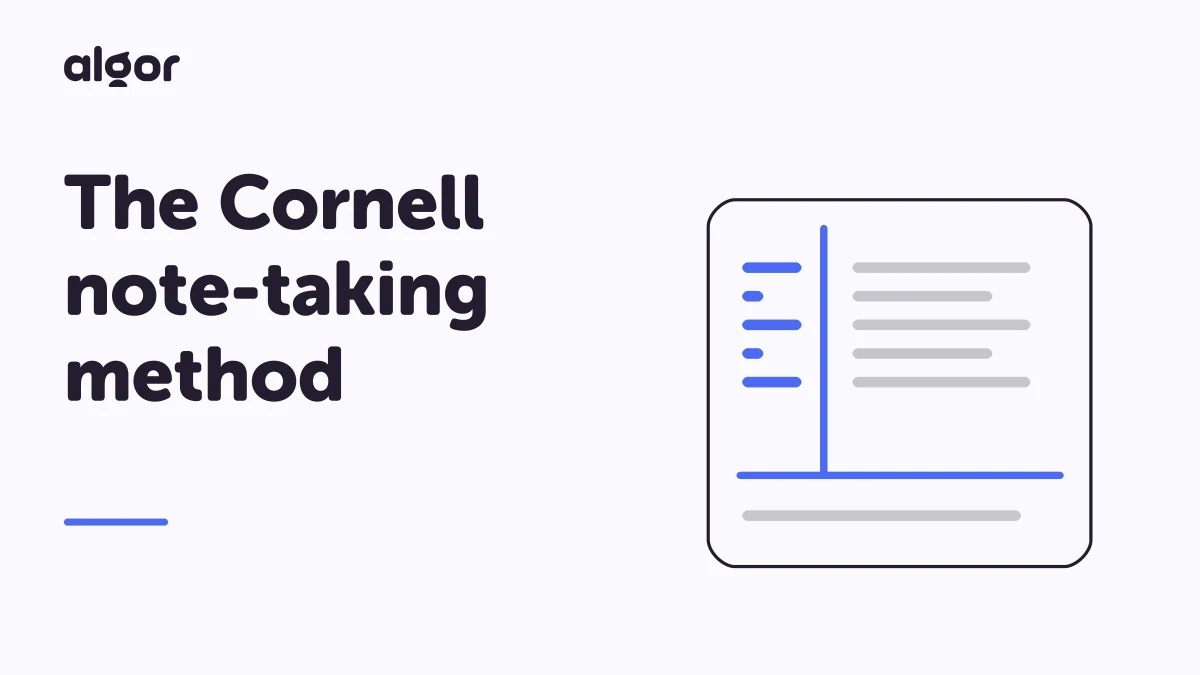
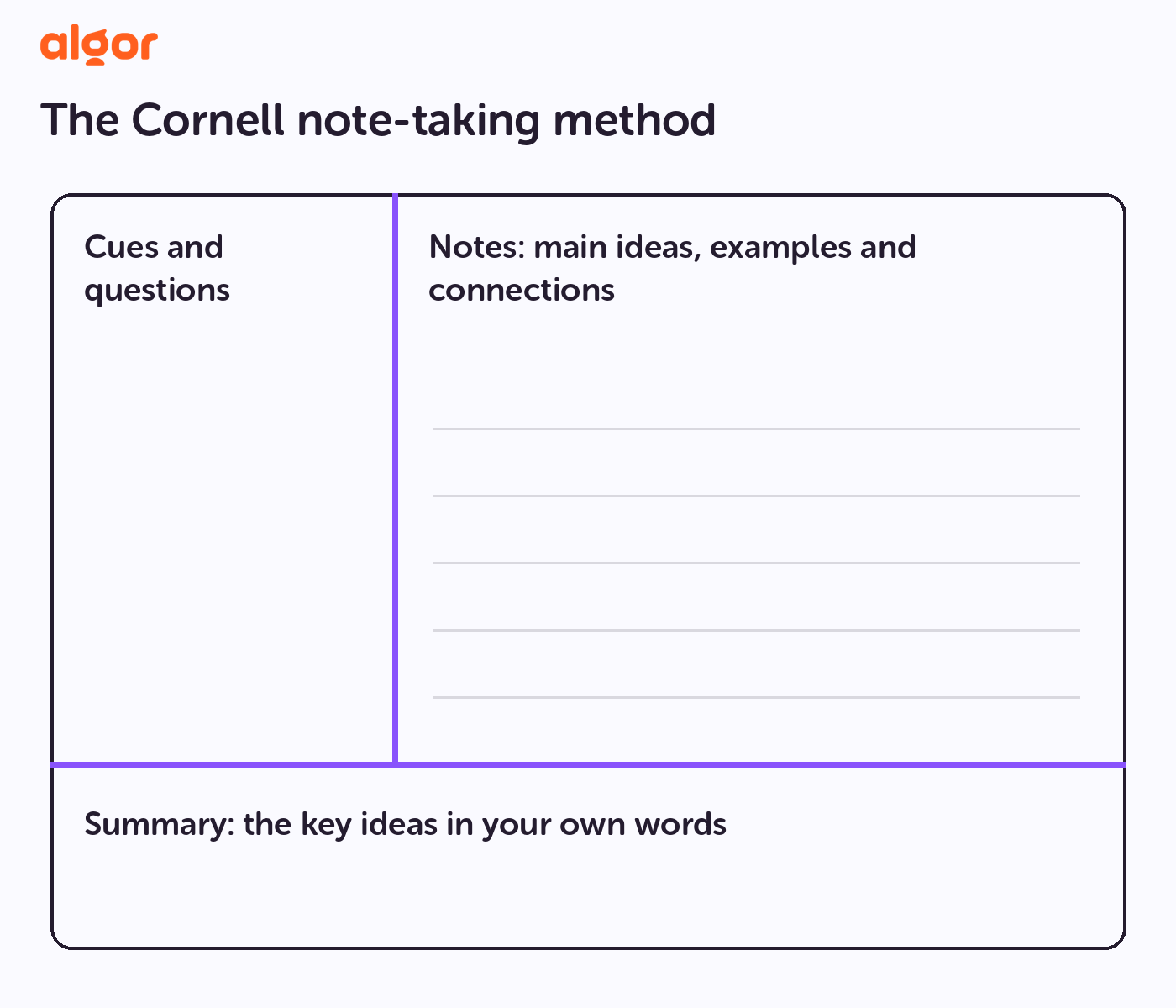
Divide the page into three sections. The largest section, on the right, takes up roughly two-thirds of the page width. Draw a vertical line to separate it from a narrower column on the left, and leave a horizontal area at the bottom.
The right-hand column is for your main notes. Keep them concise, using understandable abbreviations, arrows, bullet points and symbols. Record the central ideas and important examples rather than trying to transcribe the whole lecture. Whenever possible, explain a concept in your own words: that small effort helps you notice whether you have actually understood it.
The left-hand column is for keywords and questions. Choose a word or short phrase that captures each main point in the notes beside it. Better still, turn the point into a question. Beside notes on cell division, for example, you might write “What happens during metaphase?” You can add these cues during the lecture, but completing them soon afterwards is often easier.
The bottom section is for a brief summary. Pull the main message together without copying the notes above word for word. You can also record a connection with another topic, a point you need to clarify, or a question to ask in the next lesson.
The five stages of the Cornell method
The method is often described through five steps known as the five Rs:
- Record: during the lesson, write the key information in the right-hand column.
- Reduce: soon afterwards, condense the ideas into keywords and questions in the left-hand column.
- Recite: cover the main notes and explain the topic aloud using only the cues. Answer the questions before looking at the answers.
- Reflect: connect the lesson to what you already know and add your own observations or uncertainties in the space below.
- Review: return to the page regularly for a few minutes, rather than leaving every review until the day before a test.
Why Cornell notes help you study
The vertical division turns a page of notes into a simple self-testing tool. Hide the right-hand side and use the keywords to reconstruct the explanation, or answer the questions you wrote on the left. You will quickly see which ideas you can explain and which still depend on having the text in front of you.
This is active recall: bringing information to mind instead of only rereading it. If an answer is incomplete, uncover the notes, correct it and try again later. The aim is not to produce a perfect answer immediately; it is to make your review reveal what needs more attention.
You can also take your Cornell notes into Algor. Upload a photo of the page or a digital file to create a study Set with a concept map and summary, then review the material with flashcards. Spaced repetition uses your difficulty ratings to schedule the cards you need to revisit. If you recorded the lecture, transcribe it and use the text to fill gaps in your notes. The Algor guide to creating content explains these workflows.
The Cornell method is worth trying if your notes feel like a pile of information rather than something you can learn from. Start with one lesson: capture the important ideas, write a few questions, and test yourself the next day. That small routine gives your notes a job to do long after the lecture ends.
Continue exploring


Faq
Frequently Asked Questions



Get Started with Algor
Transform your content into structured, visual and personalized learning paths.

.svg)


