
How to Know If You’re Ready for an Exam

Algor Lab
October 8, 2026

When an exam is close, rereading can create a reassuring feeling: the chapter looks familiar, the definitions ring a bell and the examples seem obvious. But recognition is not the same as being able to retrieve an answer under time pressure. A better question than “Have I studied enough?” is: “What can I produce, explain and apply without looking?”
This guide turns that question into a three-pass readiness check. It does not predict a grade. It gives you evidence for deciding whether to sit the exam, keep revising or concentrate on a few weak topics.
Feeling familiar is not the same as being ready
Pages become easier to read each time you see them, so confidence can rise even when recall has not. Research on realistic practice exams shows why practice can be useful: it can reveal knowledge gaps and promote active work. The same research also warns that a mock exam alone does not automatically produce accurate predictions or better study choices. You still need to analyse the result and change what you do next.
That is why this method combines active recall, a timed assessment and a second check after a delay.
Use three signals, not one score
1. Retrieval: can you answer without cues?
Start with a blank page or an oral explanation. List the main ideas, reconstruct a process and answer “why” and “what changes if” questions. If you need the first sentence from the source to continue, mark the topic as cue-dependent.
2. Performance: can you work under exam-like constraints?
Use a realistic time limit and a mixture of question types. A multiple-choice result can be useful, but it should not be your only signal when the real exam includes calculations, essays or oral explanations.
3. Stability: can you do it again later?
Repeat a shorter check the next day or after a longer break. A good result immediately after revision may reflect short-term availability. A stable result after a delay is stronger evidence.
Before testing, define what the exam actually demands
Write down the official syllabus, the expected question formats, the time available and any permitted materials. Then divide the syllabus into units that are small enough to act on. “Biology” is too broad; “explain how crossing-over changes genetic variation” is useful.
If you are preparing several subjects, first build a realistic schedule with the method for studying for multiple exams. A readiness check only helps if there is still time to respond to what it finds.
Pass 1: do a closed-book recall sweep
Give yourself 15–25 minutes. For each unit, write the central claim, one example, one connection and one question you cannot yet answer. Do not correct as you go. At the end, compare with your source and label each unit:
- Green: accurate and complete without prompts.
- Amber: mostly correct, but slow, incomplete or dependent on a cue.
- Red: confused, missing or confidently wrong.
For a deeper diagnosis, use self-explanation: explain why each step follows from the previous one. This exposes gaps that a list of facts may hide.
Pass 2: take a timed assessment without immediate help
In Algor, an Assessment can cover a whole Set, a section or a page. You can choose 10–100 questions, combine multiple choice, true/false, completion, matching and open questions, set a timer and decide whether feedback appears immediately. For a diagnostic attempt, delayed feedback is usually more informative because it prevents one answer from teaching the next.
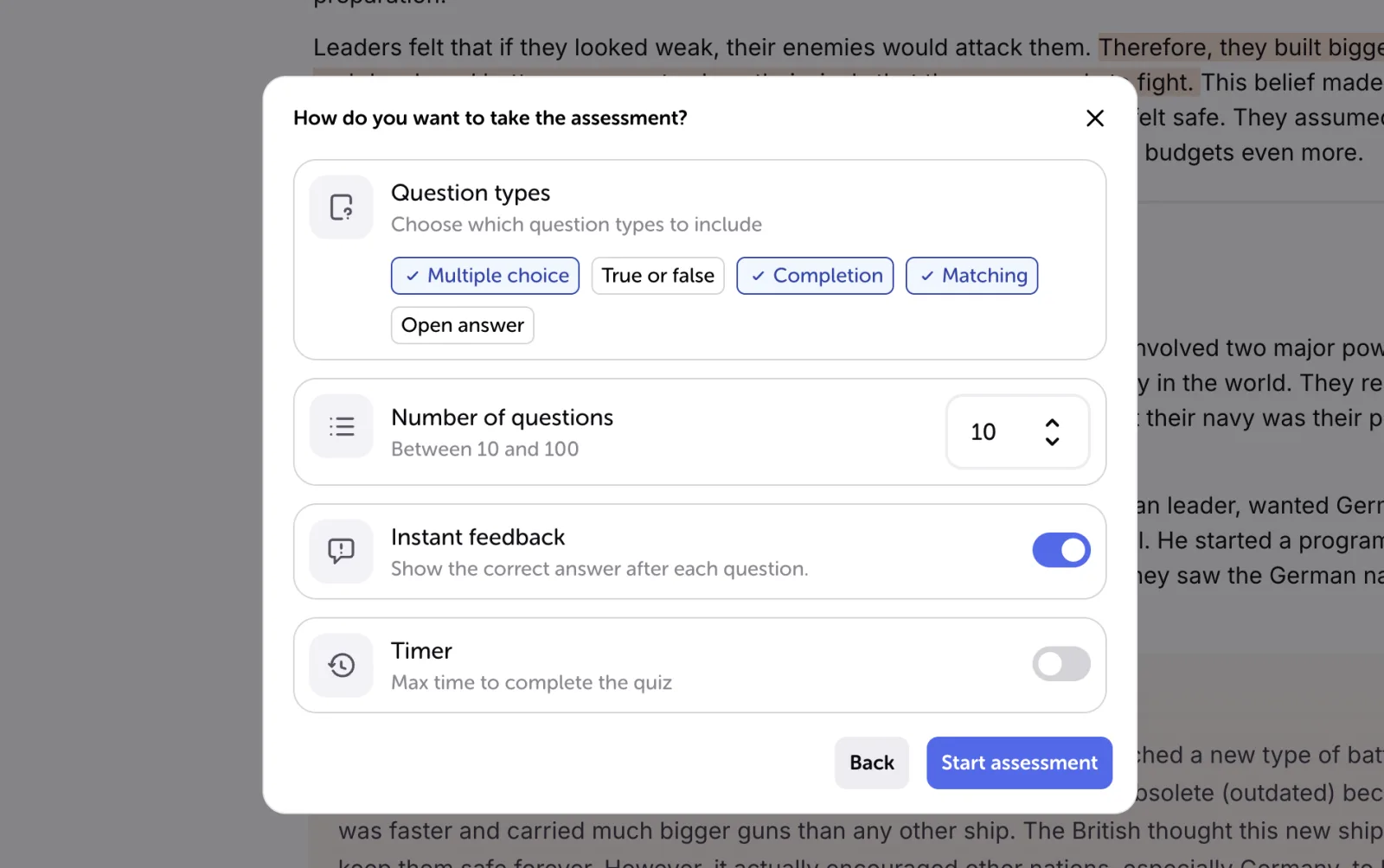
Make the format resemble the real exam where possible. If the exam is oral, answer open questions aloud. If it requires long calculations, add those separately; no automatically generated quiz should be treated as a complete replica of an official paper.
Pass 3: analyse errors by cause
A wrong answer is not yet a study plan. Classify each error:
- Knowledge gap: the idea was missing.
- Confusion: two concepts or procedures were mixed up.
- Application gap: the rule was known but not transferred to a new case.
- Reading or timing error: the knowledge was present, but execution failed.
- False confidence: the answer felt certain but was wrong.
Then choose the smallest corrective action: rewrite one explanation, compare two concepts, solve three varied problems or practise a two-minute oral answer. Do not restart the entire book because of one red topic.
Repeat after a delay and read the trend
In Algor’s Progress area you can set a target date and grade, see preparation, average correct answers and topics to review, and inspect assessment history. Use the trend as a navigation aid: is the same topic still red, is accuracy improving, and are results holding after a break?
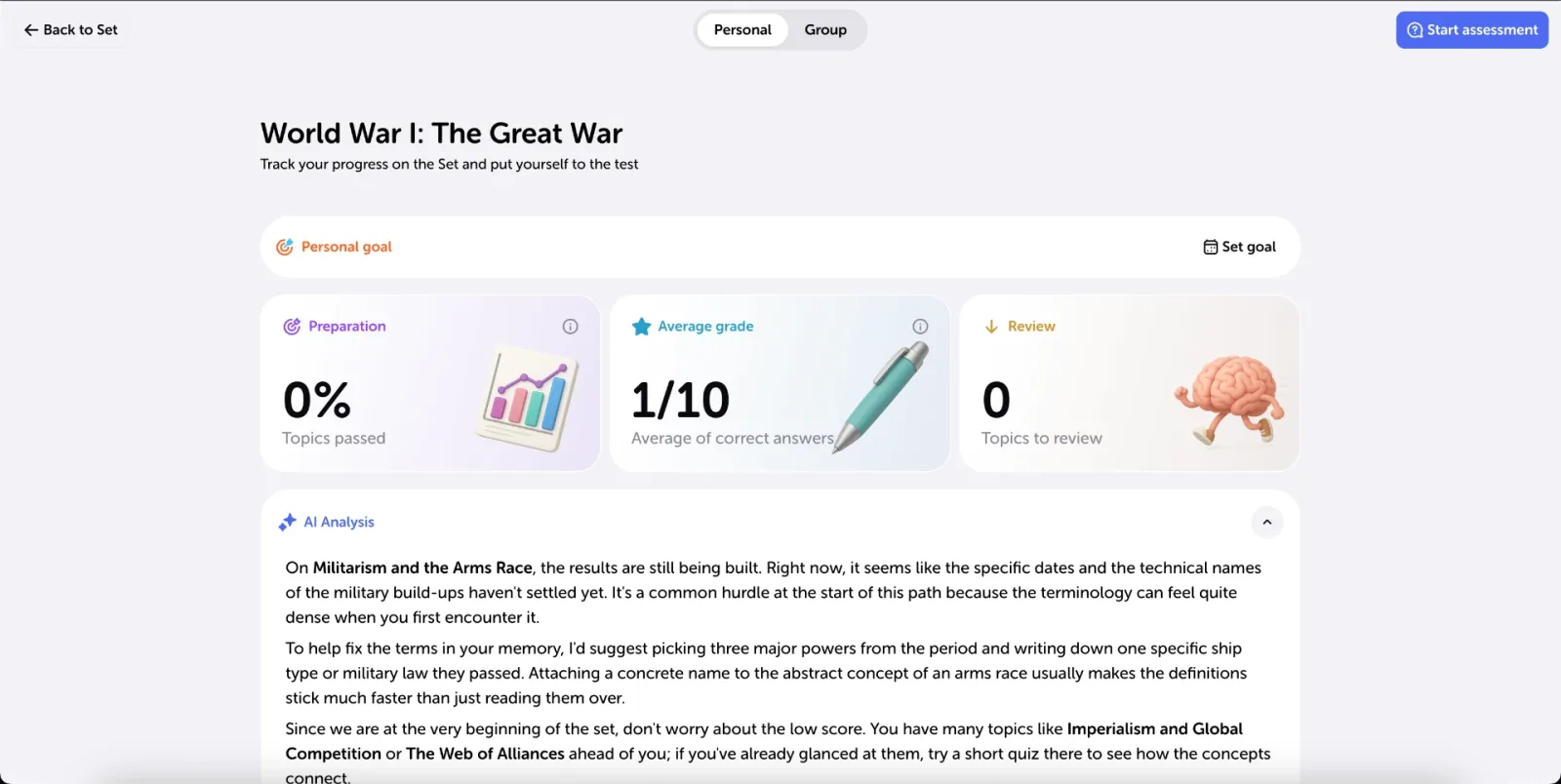
One high score is weaker evidence than two solid attempts separated by time. Equally, one poor attempt after a tiring day should not erase weeks of work. Look for consistency and explain the exceptions.
What score means “ready”?
There is no universal percentage. A safe threshold depends on the pass mark, the cost of failure, the resemblance between practice and the real exam, and your margin for bad luck. Set a rule before seeing the result—for example: every core topic at least amber, no confidently wrong core answer, and two timed attempts above your chosen buffer.
The buffer should be higher when your practice questions are easier or narrower than the real exam. Treat Algor’s preparation indicators as support for judgement, not a promise of the final grade.
A practical 48-hour readiness workflow in Algor
- Create or open one Set containing the material that actually belongs to the exam.
- Divide it into pages or sections that match syllabus units.
- Run the closed-book recall sweep and mark weak units.
- Create a timed Assessment across the Set with a mix of suitable question types and delayed feedback.
- Review every error, edit the relevant page and produce one new explanation or example.
- After a break, assess the weakest sections again and compare Progress.
This loop is the advantage of keeping editable learning material, assessment and progress in the same Set: the result points back to content you can revise instead of becoming an isolated score.
Common readiness-check mistakes
- Testing only favourite topics: sample the full syllabus.
- Using the same questions repeatedly: vary wording and examples so memory of the item does not masquerade as understanding.
- Keeping feedback on during a diagnostic: useful for learning, weaker for measuring an uninterrupted attempt.
- Ignoring confident errors: prioritise them because they are less likely to trigger spontaneous review.
- Studying until the feeling improves: stop when the evidence meets a rule defined in advance.
Frequently asked questions
Should I take a mock exam the night before?
A short check can confirm priorities, but a full stressful simulation may cost sleep and leave little time to repair gaps. Run the main diagnostic earlier and use the final evening for targeted review.
Can an AI quiz tell me whether I will pass?
No. It can sample knowledge and reveal patterns, but it cannot reproduce every examiner, rubric or condition. Combine it with official past papers, teacher guidance and the actual syllabus.
What if my scores keep changing?
Check whether question difficulty, topic coverage, feedback settings, fatigue or timing changed. Compare like with like, then investigate the topics behind the variation.
When you are ready to replace a vague feeling with a repeatable check, build the syllabus in an editable Set on Algor Education, test it under realistic conditions and let the errors choose the next revision block.
Sources


Faq
Frequently Asked Questions



Get Started with Algor
Transform your content into structured, visual and personalized learning paths.

.svg)


