
Self-explanation: how to understand what you study

Algor Lab
October 2, 2026

A worked example can look completely obvious while it is on the page. Then you close the book, face a blank sheet and discover that you cannot explain why the second step follows from the first. That gap is exactly what self-explanation is designed to reveal.
Self-explanation is a study method in which you explain a concept, step or relationship to yourself while learning. The goal is not to produce a polished lecture. It is to make your reasoning visible: what a statement means, why it is valid here, which condition it depends on and how it connects to what you already know.
What self-explanation is—and what it is not
Simply replacing a sentence with synonyms is paraphrasing. Self-explanation goes further. If a text says that an increase in temperature speeds up a reaction, you might ask which particles collide more often, what else must remain comparable, and whether the same conclusion holds without limit. You are building links and checking conditions rather than repeating the line.
Research has examined self-explanation across many learning settings. A meta-analysis found an overall positive effect but also meaningful differences between tasks, prompts and comparison conditions. Treat the method as a useful process, not a guarantee or a substitute for subject-specific feedback. The original research on worked examples is especially relevant when every line looks familiar but the reasoning is still fragile.
Five prompts that turn reading into reasoning
- What is this step claiming? State the idea without copying the sentence.
- Why is it valid here? Name the rule, evidence or causal link.
- Which condition makes it work? Look for assumptions, limits and definitions.
- How does it connect to the previous step? Make the transition explicit.
- What would change if one condition changed? Test whether the explanation can travel to a nearby case.
You do not need to answer all five prompts for every line. Use them at turning points: a formula substitution, a causal claim, a difficult definition or a conclusion that seems to appear from nowhere.
A concrete example
Imagine a probability solution that multiplies two probabilities. A weak explanation is “we multiply because that is the formula.” A stronger one is: “These events are treated as independent in this model, so the probability of both occurring is the product of their probabilities. If they were dependent, I would need a conditional probability instead.” The second version exposes both the reason and the boundary of the rule.
Now remove the example and reconstruct the reasoning. This is where self-explanation meets active recall: retrieval asks you to produce the information, while self-explanation asks you to justify and connect it. They complement each other, but they are not the same task.
How to use self-explanation with Algor
Start by placing the chapter, slides or notes inside an Algor Set. Keeping the source beside your explanation matters: when you are unsure, you need to inspect the original passage rather than reward yourself for a plausible-sounding answer.
Open the Set assistant and ask for one prompt at a time. For example: “Choose one important claim from this section. Ask me why it is true, wait for my answer, then point me to the relevant source.” Do not request the complete explanation first. The assistant is useful as a questioner; your job is still to produce the reasoning.
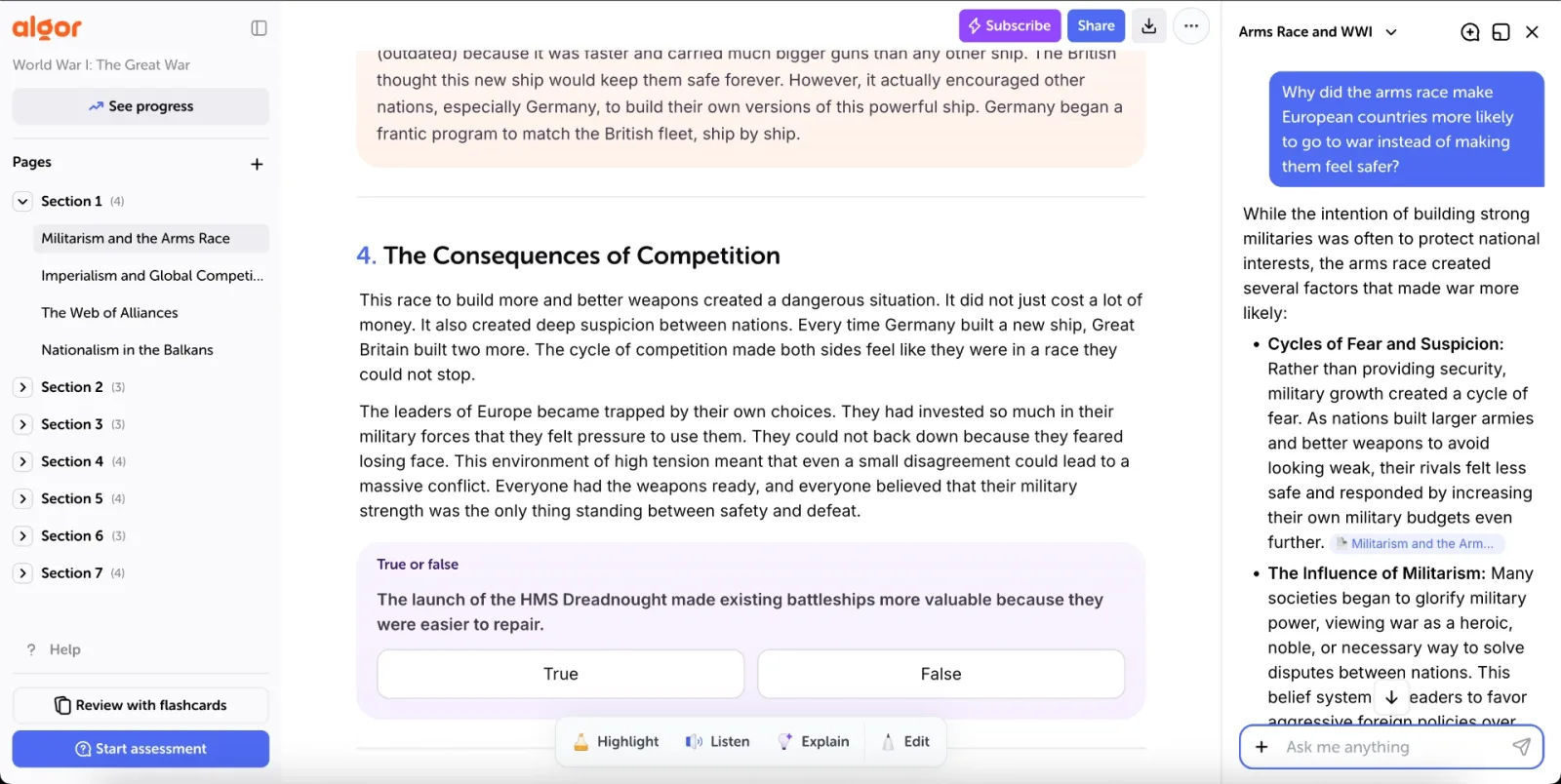
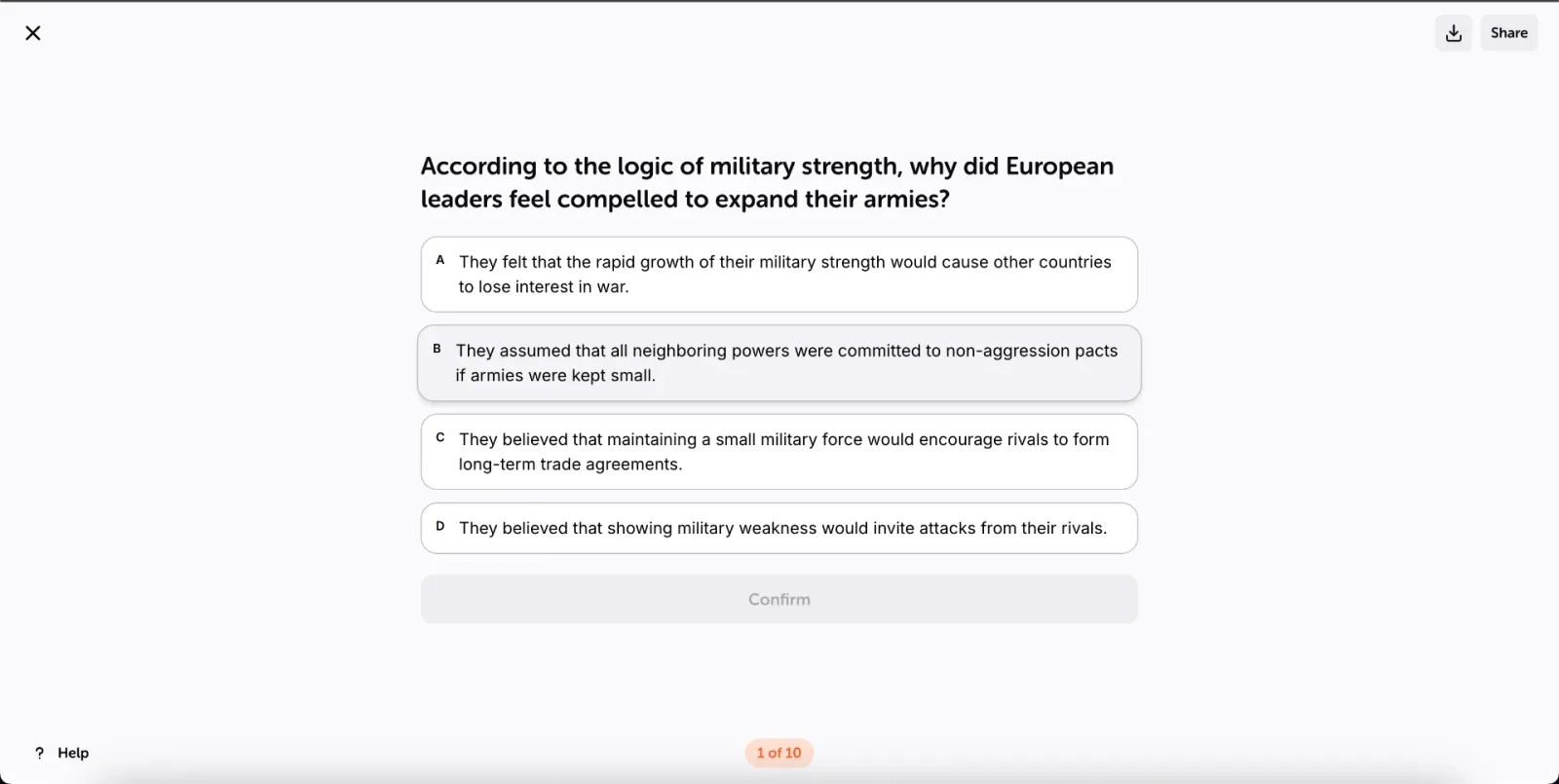
After explaining, inspect the cited passage and correct missing conditions. Then create a short assessment for the same section, including an open question when that fits the learning goal. Algor assessments support several question types, and the current guide documents feedback for partially correct open answers. Use that feedback as a signal to revisit the source, not as a final academic judgement.
A 25-minute self-explanation session
This is an illustrative routine, not a universal prescription. Spend five minutes selecting a small section and marking two turning points. Use ten minutes to explain them aloud or in writing with the five prompts. Spend five minutes checking the source and repairing the explanation. Finish with five minutes of retrieval: answer an open question or solve a nearby problem without looking.
Keep the section small enough that you can verify it carefully. Explaining an entire chapter in one pass often produces vague summaries; explaining two decisive steps produces evidence you can act on.
Common mistakes
- Polishing before thinking. A fluent paragraph can hide a missing reason. Draft in plain language first.
- Letting AI answer too early. Ask for a prompt, not the finished explanation.
- Explaining without checking. Confidence is not evidence; return to the source.
- Explaining everything. Focus on transitions, conditions and errors.
- Treating one good score as mastery. Test the idea again in a changed example.
Self-explanation, the Feynman technique and dual coding
The Feynman technique usually emphasises teaching an idea simply to an imagined learner. Self-explanation can be narrower: you may justify one algebraic step or one causal link without teaching the whole topic. Dual coding combines words and meaningful visuals; self-explanation can help you say what a diagram actually represents instead of merely decorating notes.
Frequently asked questions
Should I explain aloud or in writing?
Both can work. Speaking is fast and exposes hesitation; writing preserves the reasoning for comparison. Choose the format that lets you verify the explanation against the source.
Can I use self-explanation for every subject?
It is most useful where there are reasons, steps, conditions or relationships to unpack. The prompts should match the subject: proofs in mathematics, mechanisms in science, evidence and interpretation in humanities.
Is self-explanation the same as summarising?
No. A summary compresses the content. A self-explanation makes the links and reasons explicit. A good session may include both, but they answer different questions.
When should I stop?
Stop when you can state the claim, justify it, name its condition and handle a nearby variation—then verify. If the explanation grows without adding a checkable link, move to practice.
If you want to try the workflow, create a Set in Algor Education, choose one difficult passage and ask the assistant for a single “why” question. One verified explanation is a better starting point than another passive reread.
Sources


Faq
Frequently Asked Questions

Related articles
Get Started with Algor
Transform your content into structured, visual and personalized learning paths.

.svg)


