
Dual coding: how to combine words and visuals when you study

Algor Lab
September 30, 2026

You can reread the same page three times and still feel that its ideas are floating separately. The problem is not always lack of effort: prose is good at explaining details, but it can hide structure. A diagram reveals structure quickly, yet it can become an empty decoration if you cannot explain what its arrows mean. Dual coding is useful precisely because it asks you to make those two forms work together.
In this guide, you will learn what dual coding means, when it genuinely helps, and how to turn a chapter, lecture or set of notes into a verbal explanation and a visual map that support each other. The goal is not prettier notes. It is to make relationships visible, then check whether you can reconstruct them without looking.
What is dual coding?
Dual coding is a study approach that represents the same idea through connected verbal and visual information. The verbal side may be a short explanation, definition or sequence of steps. The visual side may be a concept map, timeline, annotated diagram or comparison table. They should not be two copies of the same content: each representation should clarify something the other expresses less directly.
The idea is commonly associated with Allan Paivio’s dual-coding theory. In practical learning guidance, the important point is modest: meaningful words and meaningful visuals can provide complementary routes for understanding and recall. That does not mean every learner has a fixed “visual” or “verbal” style, and it does not mean adding any picture improves learning.
Dual coding is not decorating your notes
A stock photo beside a paragraph rarely explains the paragraph. Nor does turning every sentence into a coloured box. Useful visual information shows a relationship: what causes what, which ideas belong together, how a process changes over time, or how two cases differ.
Imagine you are studying photosynthesis. Your verbal representation might explain that light energy supports reactions that ultimately store energy in glucose. Your visual representation could connect light, chloroplast, water, carbon dioxide, glucose and oxygen with labelled arrows. The map makes the system visible; the explanation gives the arrows meaning.
This distinction matters because additional elements can also increase cognitive load. If a diagram repeats every sentence, uses unexplained icons or introduces decorative detail, the learner must process more without gaining a clearer model.
When dual coding helps most
- Processes: biological cycles, historical developments, legal procedures and mathematical methods.
- Structures: systems with parts, hierarchies or dependencies.
- Comparisons: theories, authors, cases or formulas that are easy to confuse.
- Dense chapters: material where the main thread disappears among details.
It is less useful when the visual adds no information, when you spend more time styling than thinking, or when a topic is already so simple that another representation creates friction rather than clarity.
A four-step dual-coding method
1. Read once for the argument, not for the colours
Start with a manageable section. Before highlighting, ask: “What question does this section answer?” Write a one-sentence answer. Then select four to seven essential concepts. This limit forces you to distinguish the backbone from examples and supporting detail.
If you are working from a long PDF, keep the document available rather than replacing it with a summary immediately. A summary is useful only when you can return to the source and verify what has been compressed.
2. Build a visual that explains relationships
Place the central question or concept in the middle. Add the essential concepts around it and label the connections with precise verbs: “causes”, “depends on”, “contrasts with”, “is an example of”. A line without a meaningful relationship is a warning that you may not yet understand the connection.
A concept map works particularly well because it focuses on propositions rather than simple proximity. Timelines are better for chronology, while tables are better for systematic comparisons. Choose the visual grammar that matches the content.
3. Move back and forth between words and the visual
Now explain the map aloud or in writing without copying the original paragraph. If you cannot explain an arrow, go back to the source. If your explanation introduces an important concept that is absent from the map, decide whether to add it or whether it is supporting detail.
This back-and-forth is the heart of the method. You are not producing two finished artefacts independently; you are using each one to expose gaps in the other.
4. Close everything and retrieve
After a short break, reconstruct the map on blank paper or list its main relationships. Then answer two or three questions that require connections, not just definitions. This turns dual coding into retrieval practice. For a fuller routine, combine it with the steps in our guide to active recall.
How to use dual coding in Algor
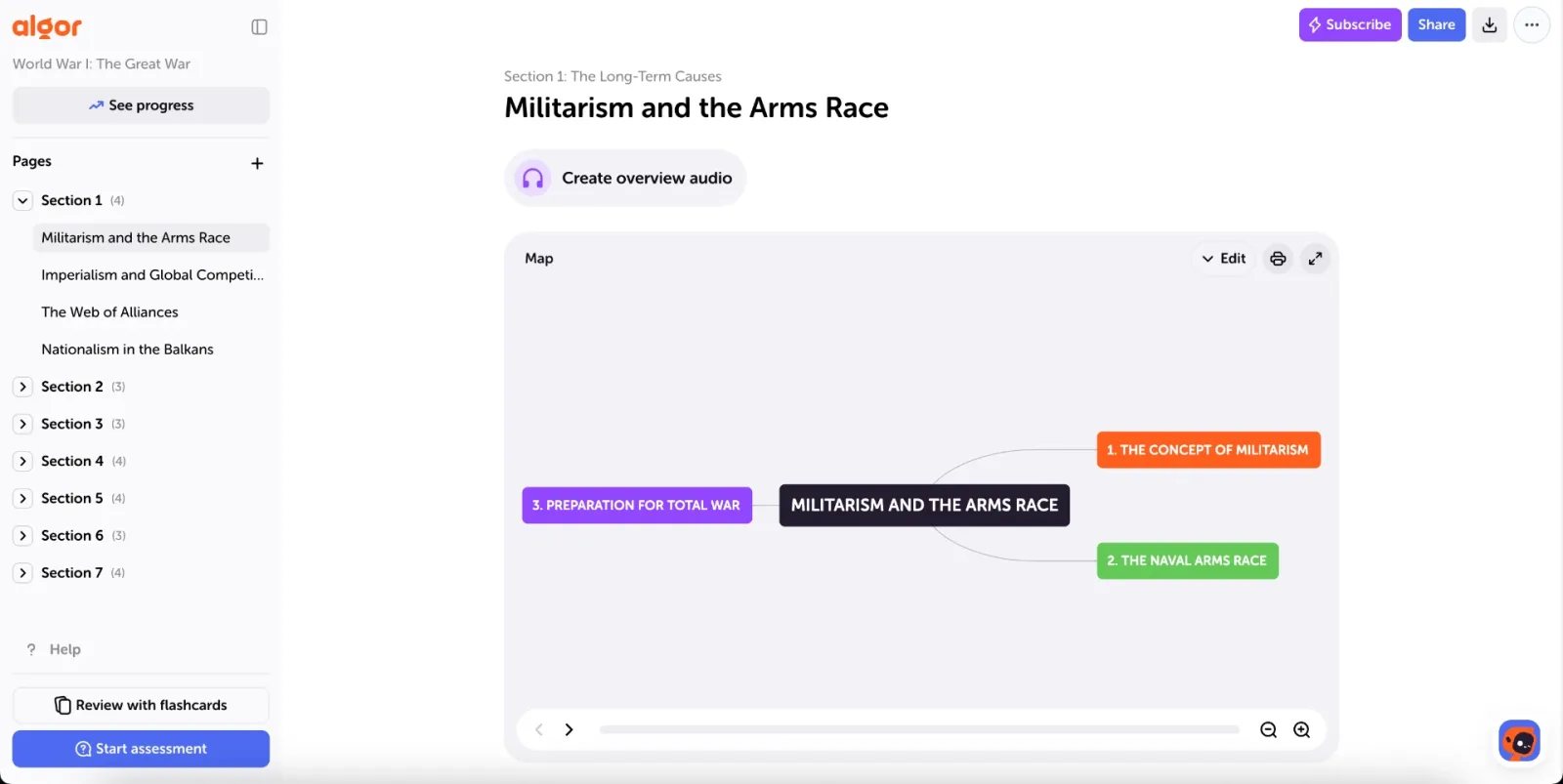
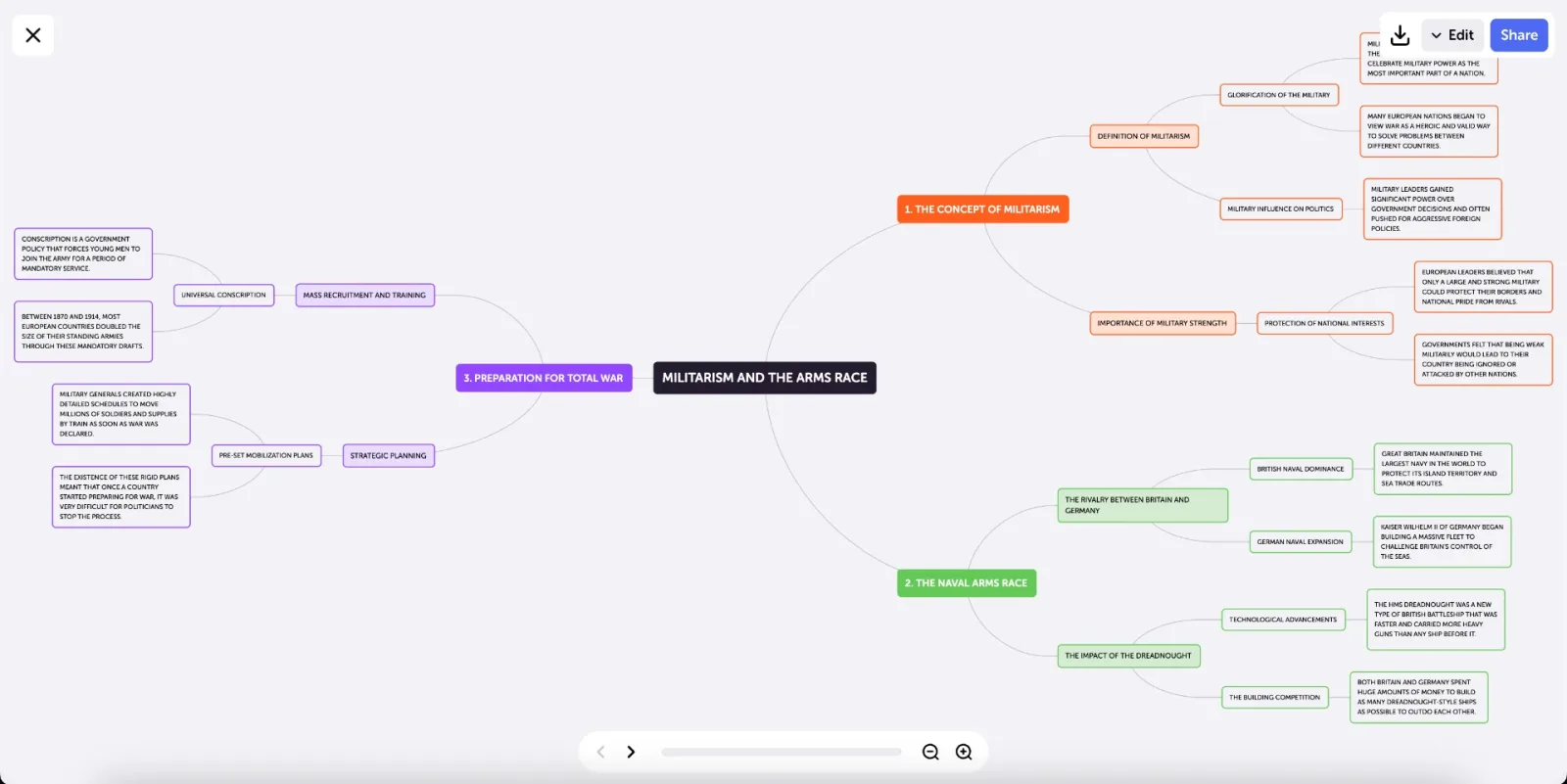
In Algor, you can create a Set from your own documents and keep different study materials in the same organised space. The text and concept map remain editable: you can correct a generated passage, move a node, rewrite a relationship or add a missing example instead of accepting a fixed output.
A practical workflow is:
- Upload the chapter, slides or notes you actually need to study.
- Open the generated text and identify the central question and essential concepts.
- Open the concept map, remove secondary branches and clarify the labels between nodes.
- Use the text to explain the map, then use the map to retell the text.
- Finish with flashcards or a quiz only after the structure makes sense.
The guide to working with Sets shows how the materials stay connected. The AI can speed up the first draft, but your decisions—what matters, what a connection means, what needs correction—are the learning work.
A 20-minute routine you can repeat
- Minutes 0–4: read a short section and write its central question.
- Minutes 4–8: select four to seven essential concepts.
- Minutes 8–13: build or simplify the visual representation.
- Minutes 13–17: explain every connection in your own words.
- Minutes 17–20: close the materials and reconstruct the structure.
If the final reconstruction fails, do not simply reread. Locate the missing relationship, correct the text or map, and test again. That feedback loop is more useful than polishing the layout.
Common mistakes
- Copying the paragraph into boxes: a visual should reveal structure, not reproduce prose.
- Using unlabelled arrows: write what each connection means.
- Keeping every detail: start with the backbone and attach details only where they clarify it.
- Trusting the first AI output: compare it with your source and edit it.
- Skipping retrieval: looking at a clear map can feel like knowing; rebuilding it is the test.
Frequently asked questions
Is dual coding the same as a mind map?
No. A mind map can be one visual used within dual coding, but the method is broader. It connects a verbal representation with an appropriate visual representation, which might instead be a concept map, timeline, diagram or table.
Should I draw every visual myself?
Not necessarily. A generated map can save time, especially with long documents, provided you inspect and edit it. Learning comes from deciding whether the representation is accurate and useful, not from accepting it passively.
Can dual coding replace practice questions?
No. It helps you organise and explain knowledge. Retrieval questions, exercises and feedback are still needed to check whether you can use that knowledge without the materials in front of you.
How many images should I add?
Only as many as the content needs. One clear diagram that expresses the important relationships is better than several decorative images competing for attention.
From a clear page to a usable mental model
Dual coding works best as a conversation between forms: the words explain, the visual organises, and retrieval shows what you can actually reconstruct. Start with one difficult section rather than redesigning an entire subject. If the map changes the way you explain the text—and your explanation improves the map—you are using the method for learning rather than decoration.
You can try Algor with your own study material, edit both the verbal and visual outputs, and build a routine that stays under your control.


Faq
Frequently Asked Questions

Related articles
Get Started with Algor
Transform your content into structured, visual and personalized learning paths.

.svg)


