
How to read a research paper: a practical guide for college

Algor Lab
September 30, 2026

The PDF is only nine pages long, but you have read the introduction twice and still cannot explain what the researchers actually found. The abstract sounds clear. The methods introduce unfamiliar terms. By the discussion, the conclusion feels plausible, though you are not sure which result supports it.
Learning how to read a research paper means following the connection between a question, the evidence collected and the conclusion drawn from it. For a college seminar, lab report or literature review, that connection matters more than highlighting every sentence. This guide gives you a practical reading process, a short example from a real study and a reusable note template. It also shows where Algor can help you organize the work and ask better questions.
Decide what you need to do with the paper
Before reading, finish this sentence: “Afterward, I need to be able to…” The answer determines where to spend your attention.
For a seminar, you might need to explain the central finding and raise one defensible question. For a methods assignment, you may need to reconstruct how the authors collected and analyzed their evidence. For a literature review, you need to decide how this paper relates to a particular argument and to other studies.
The San José State University Writing Center similarly recommends establishing your purpose before reading. Make that purpose visible at the top of your notes. “Understand everything” gives you no useful stopping point; “explain how the comparison supports the conclusion” gives you something to check.
Keep the assignment prompt beside the paper. If your instructor has specified sections or questions, use those directions. A general reading strategy should help you meet the assignment, rather than quietly replace it.
Recognize the kind of article you are reading
An empirical paper reports an investigation; a review brings together existing research; a theoretical paper develops an explanation or argument. They require different kinds of scrutiny. You would inspect participant selection in an experiment, but examine the selection of studies in a systematic review.
Many empirical articles have the structure below. As George Mason University Libraries explains, conventions differ across disciplines. Humanities research may develop its evidence and argument without separate Methods and Results headings.
| Section | What to look for |
|---|---|
| Abstract | The question, approach and main finding in compressed form. |
| Introduction | The problem, relevant earlier work and what this paper adds. |
| Methods | How evidence was obtained and analyzed. |
| Results | The findings, including tables and figures. |
| Discussion or conclusion | The authors’ interpretation, implications and limitations. |
| References | The sources behind the argument and possible next readings. |
Use this structure for navigation. If you need to know who participated, the abstract’s headline result will not settle the question. If you need the authors’ explanation, a graph alone may not provide it.
Read in three passes, with a different goal each time
You do not have to understand every detail on your first encounter. Stanford’s guidance on empirical articles recommends repeated reading with distinct purposes, moving from structure toward understanding and self-testing. The following workflow puts that principle into a reading session you can adapt.
First pass: find the question and the main claim
Read the title and abstract, scan the headings, and inspect the figures and their captions. Then locate the research question in the introduction and the main interpretation in the discussion. Write two provisional sentences: “The authors asked…” and “Their answer was…”
Keep the word provisional in mind. At this point you have identified what the paper claims; you have not yet checked its support. If you cannot complete either sentence, mark the exact point of confusion instead of copying the abstract.
Duke’s Academic Resource Center also recommends previewing the article and its figures before reading in depth. This first look helps you decide which parts require slower attention.
Second pass: trace one important claim to its evidence
Choose the finding most relevant to your assignment. Locate its supporting result, then read the methods needed to understand it. Ask what was compared, how the outcome was measured and what information the design can actually provide.
Watch for words that seem interchangeable but are not. A survey of how prepared students feel measures something different from a test of what they can explain. A relationship observed between two variables does not, by itself, establish that one caused the other. Write down the actual measure instead of replacing it with a broader label.
For a graph, check the axis labels, units, groups and caption before interpreting the pattern. Find out what the error bars represent. If the meaning of an interval or statistical test is unclear, record that uncertainty as a question for your instructor or teaching assistant. A confident sentence with an undefined technical term is still a gap in understanding.
Look up vocabulary that blocks the argument first. An unfamiliar procedure central to the study deserves attention; an incidental term in a background paragraph can wait. This keeps a difficult paper from turning into an endless glossary exercise.
Third pass: explain the argument without looking
Close the paper and explain its question, approach, finding and main boundary in ordinary language. Then reopen it and check each statement against a specific passage, table or figure.
Where your explanation breaks down tells you what to reread. If you remember the conclusion but cannot describe the comparison, return to the design. If you understand the comparison but cannot state the finding, inspect the results. This is a focused use of active recall: retrieving the argument reveals missing connections that familiar-looking sentences can hide.
A worked example: separate a result from a sweeping conclusion
Consider Deslauriers and colleagues’ 2019 study in PNAS. In introductory physics courses at Harvard, students were randomly assigned to groups that experienced both active instruction and passive lectures in different sessions. The researchers compared students’ reported feeling of learning with performance on a multiple-choice test after class.
The active condition produced higher test performance but a lower reported feeling of learning. A useful reading note therefore distinguishes the two outcomes, instead of writing only “active learning is better.”
To check the note, find the design in Table 2 and the outcome comparison in Figure 1. Then add a boundary: these were classroom sessions in introductory physics, with learning tested after class. This result alone does not establish long-term retention across every subject or demonstrate the effectiveness of an AI study app.
The reading habit to keep is simple: preserve the conditions and measures that make a finding meaningful. An interesting headline becomes useful evidence only when you know what sits underneath it.
A research-paper reading template you can reuse
Keep one record per paper, with enough information to locate the evidence again. You can copy the following prompts into a document or an editable Algor page. They are a working template, not a required citation style.
- Source and task: author, year, title, DOI or stable link; what I need this paper for.
- Question in my words: the specific uncertainty or argument the authors address.
- Evidence route: what was compared or examined, and how the relevant outcome was defined.
- Finding I can support: one careful statement, followed by its page, section, table or figure.
- Interpretation and boundary: what the authors infer, and what the evidence does not establish.
- My contribution: a question, connection or objection, clearly separated from the authors’ position.
- Next action: the specific passage, concept or related source I need to check.
Record printed page numbers where available. If a PDF viewer uses different numbering, label which system you used. For an unpaginated web article, a section heading and figure number are more useful than an invented page reference. Keep exact quotations clearly marked and separate from your paraphrases.
Use Algor to organize the reading and investigate difficult points
Once you know your reading goal, Algor can turn the material into an editable study guide called a Set. Start with Create an Algor Set, choose From your material and upload the paper you are studying. The official creation guide explains the source and content settings. For a research article, choose a level of language that preserves the distinctions you need for your course.
Under Advanced content instructions, you could write:
Help me study this research paper for a college seminar. Separate the research question, study design, findings and limitations. Preserve technical terms and explain them where needed. Keep the authors’ conclusions distinct from suggested discussion questions. Do not invent missing details.
Review the proposed index before generating the Set. Afterward, correct the pages against the original and add your reading record. A generated explanation can help you navigate a difficult argument; the paper remains the source you cite.
Algor’s reading tools let you select a passage in a Set, ask for a simpler explanation, highlight it or attach an annotation. Use that note to preserve a precise question such as “Does this measure performance or confidence?” rather than leaving a whole paragraph highlighted without a reason.
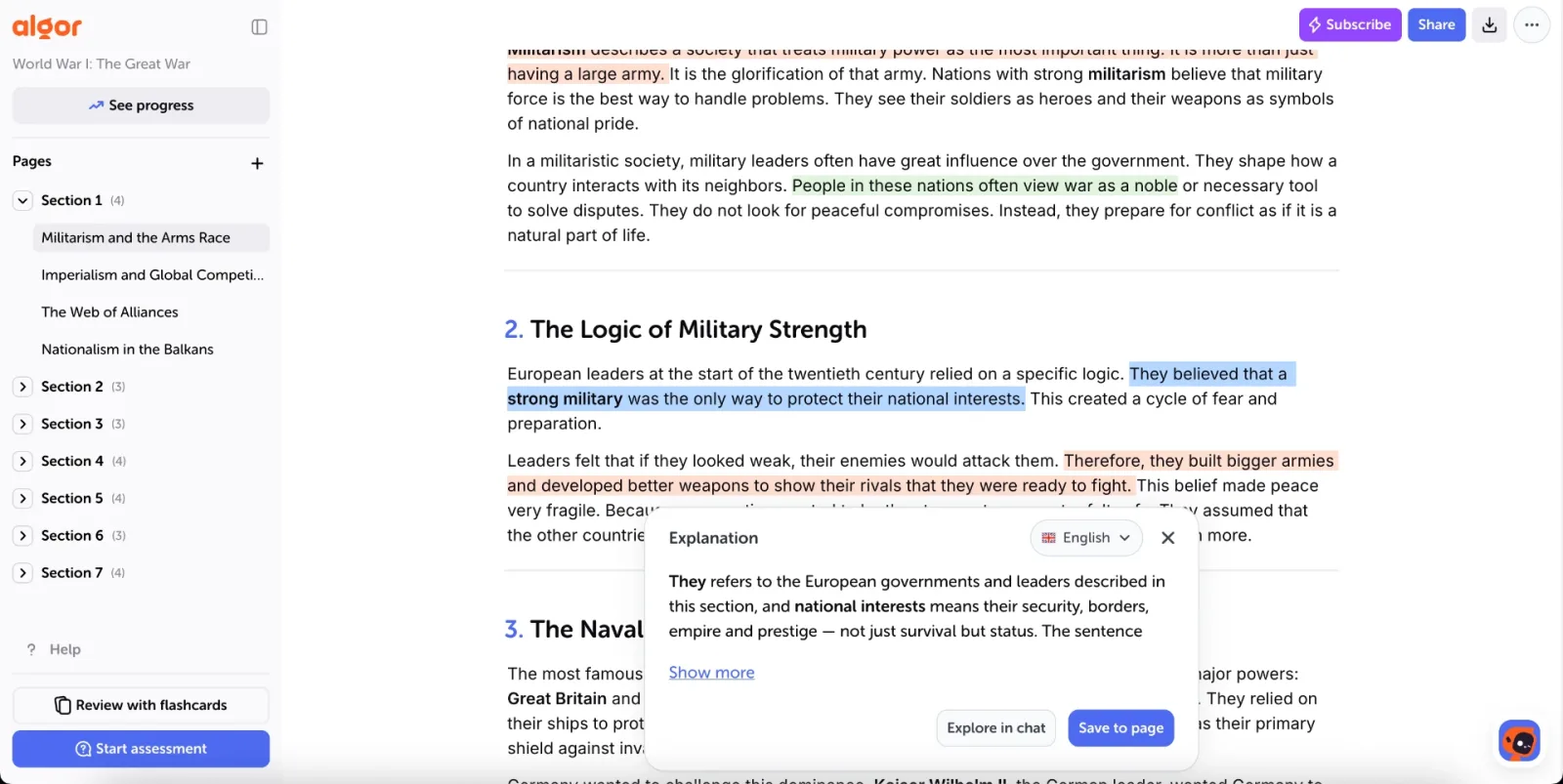
For a broader question, open the Set’s AI assistant. Its answers can use the Set, uploaded files and, when needed, the web, and include citations you can open. Ask which source supports an explanation, then check it. A link to a generated Set page and a reference to the original research are different things; follow the evidence far enough to see what you are relying on.
You can also print a page or selected tools and export the Set. A concise reading record on paper gives you room for seminar notes and questions beside your digital material. Check the print preview and keep the source reference visible.
Know when to go deeper and when to stop
You have a useful first understanding when you can explain the central argument, locate its evidence and name an important limitation without relying on the abstract’s wording. A methods critique or replication assignment requires more detail; preparing one discussion question may require less.
If you are stuck, bring a specific obstacle to office hours: the table you cannot interpret, the step in the method you cannot reconstruct, or the conclusion whose support you cannot locate. That gives your instructor something concrete to help with.
For several assigned papers, complete a separate record for each before comparing them. Two articles can use similar vocabulary while examining different populations, outcomes or questions. Do not merge their conclusions just because an AI summary puts them under the same heading.
Common questions about reading research papers
Should I read a research paper from beginning to end?
You can, but an initial overview often makes the detailed reading easier to follow. Return to the methods and results that support the argument you need to understand. Follow any reading order your instructor requires.
How long should reading a paper take?
There is no useful universal time limit. Familiarity with the field, technical difficulty and the assignment all matter. Plan an initial session, then decide what still needs attention from the questions you could not answer.
Can an AI summary replace the original article?
Use it as a starting explanation, then verify the claims you intend to discuss or cite in the original. If you have only read the abstract, say so in your notes. Do not treat missing methods or results as if you had checked them.
Start with one paper from this week’s reading list. Identify its main question, trace one claim to its evidence and build a record you can revisit. Open Algor to organize that material, clarify difficult passages and carry your checked notes into the next class.


Faq
Frequently Asked Questions



Get Started with Algor
Transform your content into structured, visual and personalized learning paths.

.svg)


