
AI tutors for university study: lessons from Khan Academy

Algor Lab
September 29, 2026

The AI explanation makes sense. You read it again, recognise the concepts and feel ready to move on. Then you close the chat, try a similar problem and cannot work out how to begin. When you are studying for a university exam, the gap between following an answer and producing one matters more than how quickly the explanation appeared.
A useful study assistant should help you close that gap. Khan Academy’s published work on Khanmigo offers a starting point for thinking about what to look for. We use that question to build a practical approach with Algor: work from your course materials, make your reasoning visible and check what you can do when the help stops.
What Khan Academy’s work tells us about AI tutoring
In its May 2026 report, Khan Academy describes around 20 A/B tests across more than 15 million tutoring conversations between October 2025 and April 2026. One central outcome is correctness on the next same-skill problem, within the same session, without Khanmigo.
That is a useful question to bring to your own study sessions: after receiving an explanation, what can I now do independently? A satisfying conversation and a correct answer produced by the student are different observations. The latter is closer to what you need when a lecturer changes the example or asks you to justify a choice.
The report describes improvements associated with relevant learner context and prerequisites; adding more information indiscriminately did not always help. These are product experiments on Khanmigo, not a university trial of Algor. The conversation count is not a count of unique students.
Engagement, immediate performance and exam readiness
A 2025 research paper on engagement in Khanmigo conversations distinguishes following procedures from generating your own explanations. Its association with subsequent performance does not, on its own, establish a causal effect on long-term preparation.
Keep three levels separate. Participation means doing something during the session. Immediate performance means completing a task close to the one you have just encountered. Exam readiness also involves remembering, choosing and connecting ideas under different conditions. Success at the first level does not automatically establish success at the others.
What about university students?
A randomised trial published in Scientific Reports in 2025, involving 194 university physics students and two lessons, found better immediate learning outcomes with a purpose-built AI tutor than with in-class active learning.
Those findings belong to a particular setting: a specific tutor, defined content and tests taken close to the lessons. They cannot establish the same outcome for every application or predict an end-of-term grade. They do offer a serious reason to examine how AI-supported learning is designed, beyond how convincing an answer looks.
At university, that design problem is tangible. Lecture slides may compress reasoning that the lecturer explained aloud. A textbook may use different notation. An exam question may require you to choose a method without hints. Useful study needs to reconstruct those missing steps and then test whether you can use them.
Turn the research question into a study session
The approach below is our practical application of the question about independence. It is not the protocol used in the cited studies, nor a method those researchers tested on Algor. Try it on a clearly bounded topic and judge it through the work you produce.
1. Give the assistant your problem and your attempt
Suppose you are revising statistics. You can repeat that correlation differs from causation, yet when two variables are associated you immediately write that one causes the other. Asking for another explanation of correlation may give you another paragraph you recognise. Showing the exact step where you made that inference gives you something specific to examine.
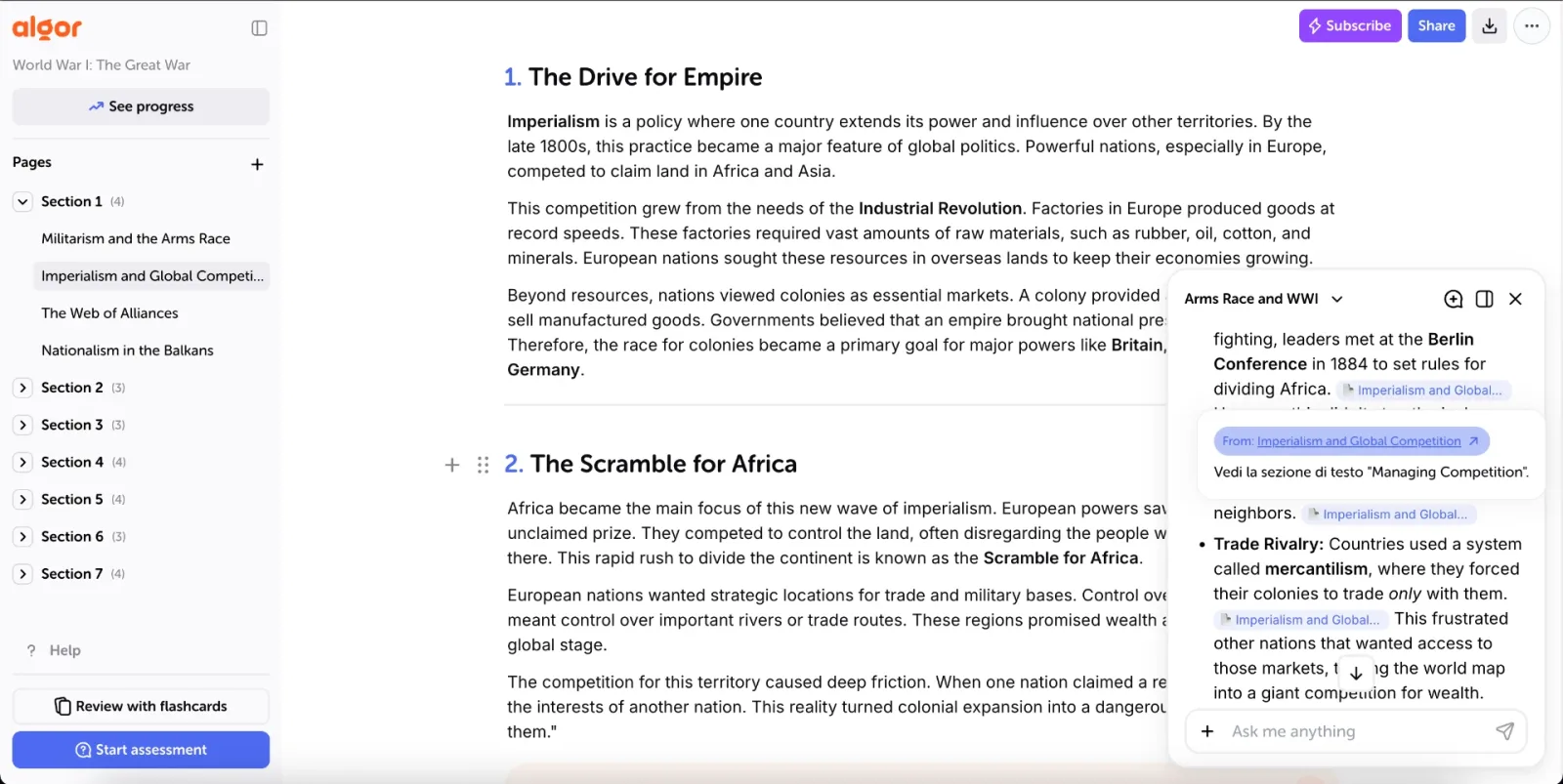
In Algor, you can work within a Set devoted to that topic. The guide to studying and the AI assistant documents Set-aware chat and citations you can open. Course material provides a reference for the discussion; your attempt adds information about what you understand or are confusing.
Try a request such as: “Here is my explanation. Use the Set material to identify the first step I have not justified. Ask me a question that helps me correct it before showing a complete answer.” This is a study instruction you can give the assistant, rather than a guarantee that every response will follow it perfectly.
Having access to your materials is different from knowing your difficulties. State the error and your goal explicitly instead of assuming that the chat has already reconstructed your whole learning history. That small addition makes the question much more precise.
2. Check the reference and improve your notes
When the assistant cites a source, open it. Find the definition, assumption or passage that supports the explanation. In the statistics example, ask which alternative explanations remain compatible with the observed association. Can the available data distinguish between them, or would you need more information?
A citation makes checking more convenient; it does not make the answer infallible. If the passage does not support the claim, return to your course text or record a question for your lecturer. This is particularly useful when sources use different conventions or a summary has dropped an essential condition.
Algor lets you keep that correction in the materials you continue studying. Its Set pages are editable: add the missing condition or rewrite a relationship in a map. The clarification becomes part of your notes instead of remaining buried in a conversation you may never reopen.
3. Produce an answer before reading the feedback
Move to a question that requires your own response. Algor quizzes can include open-ended questions; you can select their scope and turn off immediate feedback to see corrections at the end. The screenshot below shows an open-answer task using a history example from the guide.
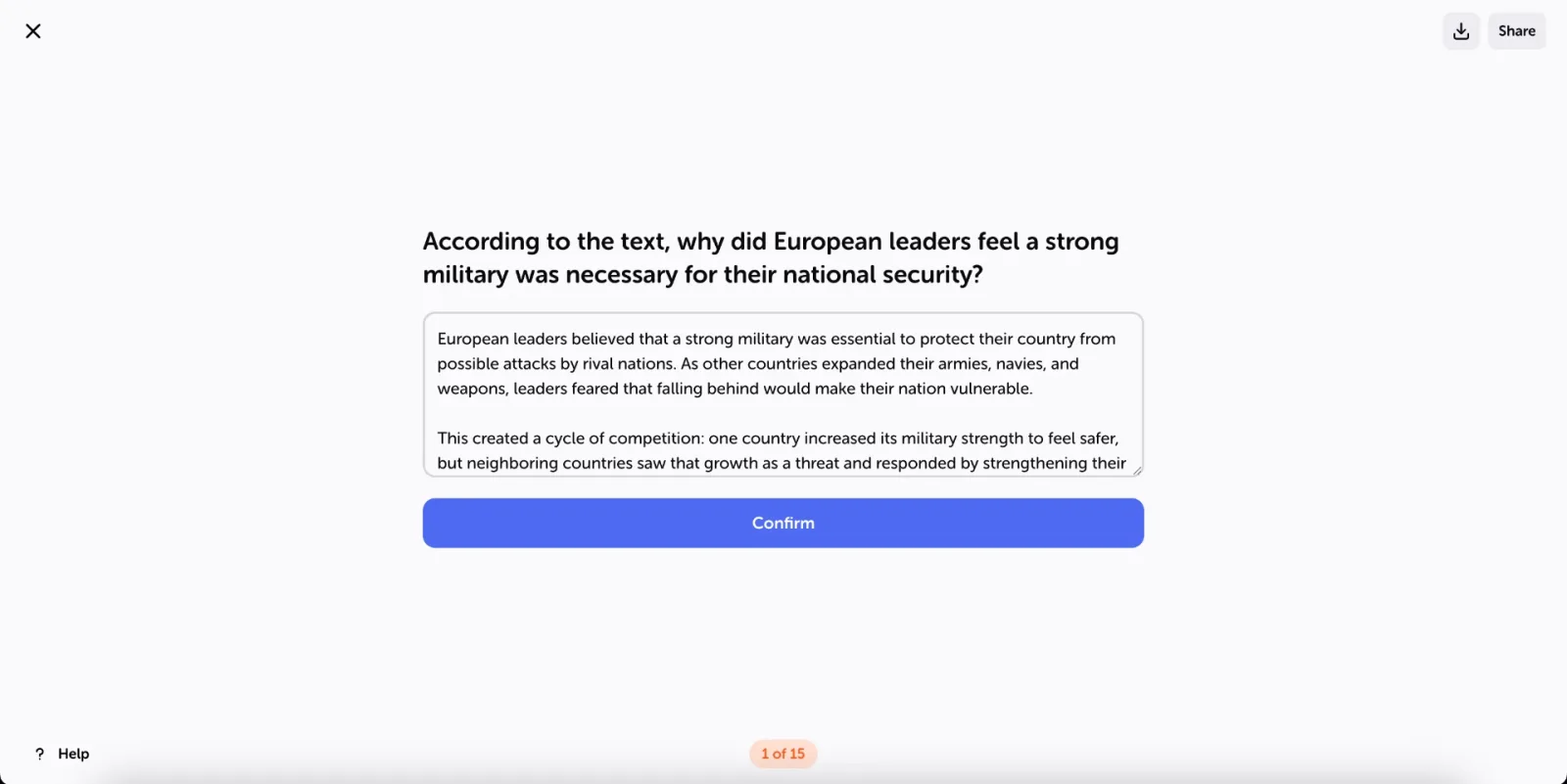
For statistics, write a short interpretation of an association, give an alternative explanation and identify information that would help assess it. For history, support a claim while distinguishing chronological sequence from a causal relationship. Both tasks produce reasoning you can examine, rather than merely asking you to recognise a correct sentence.
Algor uses AI to evaluate open answers. Read that evaluation alongside the explanation and your course sources. If an answer is marked correct but leaves out a condition your course requires, the condition still needs attention. Our guide to active recall has further examples of practising retrieval rather than simply rereading.
4. Change the case and remove the support
Close your notes and tackle a second problem. Change something meaningful: the context, the available evidence or the final question. Repeating the wording you have just read is too weak a check of whether you can decide what to do independently.
Record where you get stuck. If you remember the definition but cannot apply it, collecting more definitions may not solve the difficulty. Compare two cases and explain why they warrant different conclusions. If a foundational concept is missing, return to it before attempting more demanding problems.
For a written exam, put the explanation on paper with the intermediate steps. For a seminar or oral assessment, say it aloud and handle a follow-up question. Keep the task close to what your course actually asks you to demonstrate.
How to tell whether the session helped
Keep three short records: your first attempt, a checked correction and a later answer without help. These do not calculate a scientifically validated personal improvement score. They help you see whether your reasoning changed or whether you simply adopted better wording.
Return to the topic in a later session too. Set results and progress can help you choose what to revisit, alongside course exercises and assessment criteria. A score in an app describes performance within that environment; it is not a prediction of your university grade.
When your starting material is fragmented, our guide to reviewing lecture notes with AI helps you organise it. The further step here is checking whether that organisation leads to an answer you can construct yourself.
Why Algor fits this approach to studying
The practical value is continuity between materials, clarification and practice. You can discuss a passage in the context of a Set, inspect the reference, update your notes and test yourself. The assistant becomes part of a study environment that also retains the work you produce and correct.
Start with one topic from a current module. Prepare a small Set in Algor Education and write an answer before asking for help. At the end of the session, attempt a new answer independently. That gives you a concrete criterion for judging whether AI is helping your learning.
Source note: this article separates published findings about specific tutors from our proposed use of Algor. It does not report a study of Algor or a collaboration with Khan Academy. Product features checked against the Algor guide on 29 September 2026.


Faq
Frequently Asked Questions

Related articles
Get Started with Algor
Transform your content into structured, visual and personalized learning paths.

.svg)


