
Notebook LM vs Algor: AI Mind Map Features Breakdown

Sofia Bogunovic
March 27, 2025
A NotebookLM alternative for editable maps and complete study guides
You have read the chapter, highlighted the definitions and generated a mind map. Then you try explaining the topic without your notes. The ideas are familiar, but the connections still feel slippery. A diagram can show you the material; the next step is making that structure your own.
Algor Education is the stronger choice when you want complete study guides and full control over the maps, explanations and practice you use to learn. You can change the nodes and connections, bring in visual examples and use your material for flashcards and assessments. The map becomes something you work with, rather than simply look at.
This comparison focuses on that practical difference. If you are searching for a NotebookLM alternative because you need more control over your maps, here is what changes when you study with Algor.
What is Algor Education? More than a map generator
Algor creates a complete Set from your course material, with sections and pages that bring explanations, summaries, maps and audio together. Flashcards and assessments run across the part you choose to study. A lengthy document can become a guide you work through topic by topic, rather than one output you have to organize afterwards.
You decide what belongs in that guide. Change the text, reorder pages and sections, adjust the map or ask the AI to revise content. The assistant uses the context of the whole Set, including documents and maps, to help you explore a difficult point without starting from scratch in another tool.
That matters across subjects, from explaining a historical argument to following a scientific process or revising vocabulary in context. Algor's advantage is not limited to producing a nicer diagram: it gives you control over the learning material around that diagram, too.
After studying, use flashcards and assessments, then look at your results and progress to choose what comes next. The map supports a complete cycle of understanding, practising and reviewing; it is not the end of the process.
NotebookLM vs Algor: where the difference matters
NotebookLM can generate mind maps, summaries, audio overviews, flashcards and quizzes from your sources. The reason to choose Algor is not that these formats are missing elsewhere. It is the control you gain over your visual study material.

Google's mind-map guide describes expanding branches, selecting nodes to ask questions, downloading maps and regenerating them. Algor adds a dedicated editor for making changes directly to individual nodes and links. If a connection is unclear, you can fix that connection; you do not have to accept the generated structure as your final revision aid.
For a student who learns by reorganizing, connecting and explaining ideas, that editing control is a substantial advantage.
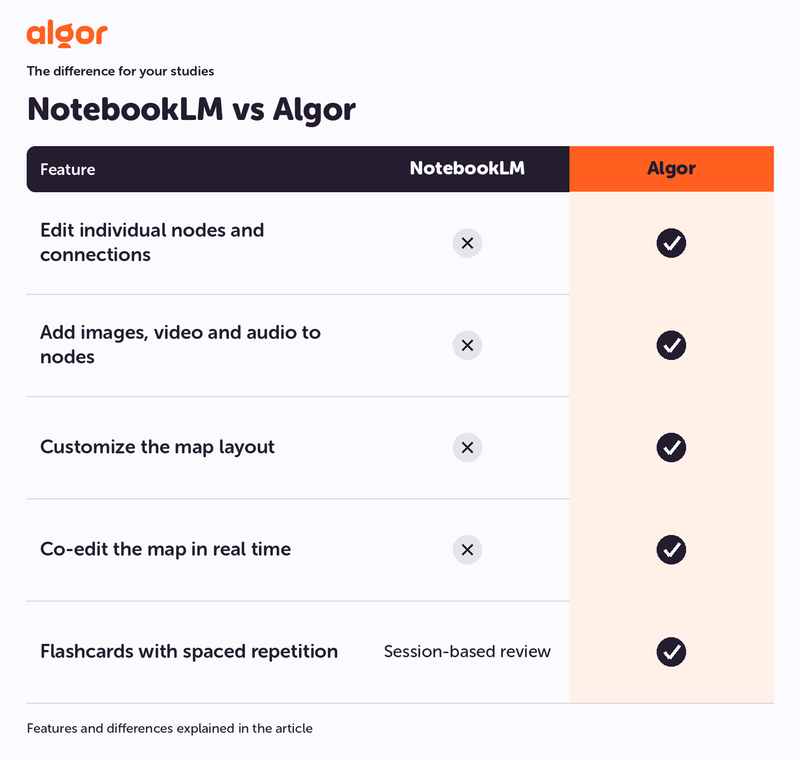
Key differences:
- Edit individual nodes and connections. NotebookLM: Not included natively; Algor: Yes.
- Add images, video and audio to nodes. NotebookLM: Not included natively; Algor: Yes.
- Customize the map layout. NotebookLM: Not included natively; Algor: Yes.
- Co-edit the map in real time. NotebookLM: Not included natively; Algor: Yes.
- Flashcards with spaced repetition. NotebookLM: Session-based review; Algor: Yes.
Native features and workflow differences; usage limits depend on the plan.
From a generated outline to a map that follows your thinking
Imagine revising a history chapter. Your first map groups events by date, but the exam asks you to explain causes, consequences and competing interpretations. The chronological outline is useful, yet it is not the explanation you need to practise.
In Algor, you can reshape the map around those relationships. Move a concept, rename a node in your own words, add a missing link and remove a branch that is outside your syllabus. The editing is part of studying: each decision asks you what belongs together and why.

You can generate an AI mind map or an AI concept map, then refine it. A mind map helps you collect branches around a topic; a concept map helps you work through relationships between ideas. Our guides to mind mapping and concept mapping explain how to choose the structure.
Add the visual details that make a topic click
A short label is not always enough. An image of a building, a biological structure or a worked example can give a concept the context it needs. Algor lets you enrich your maps visually and customize their appearance, so you can distinguish categories and make important connections easier to follow.

For instance, a map about prehistoric art can bring images into the explanation instead of asking you to switch constantly between a diagram and another document. You decide which details belong in the map and which can stay in the supporting notes. For inspiration, explore these concept-map examples and templates.
A full map editor, with tools for reading, listening and printing
Algor lets you reshape branches and connections, choose a suitable layout, change colours and add images, video or other media where they make an idea clearer. You can make changes manually or describe the change to the AI. That gives you more than a generated overview: it gives you a map you can develop as you learn.
Text-to-speech lets you listen to the content of a node, which is useful when you want to review aloud or reduce the amount of on-screen reading. Optimized print options help you fit the map onto paper in a useful layout, rather than accepting a screenshot that is difficult to read. Combined with real-time collaboration, these tools make the map practical for individual study, classroom work and shared revision.
Keep the map inside a complete study routine
A map is most useful when it helps you do the next piece of work. In Algor Education, your material becomes an organized study guide with sections and pages. You can move from an explanation to its map, revisit the summary and then check what you remember with flashcards or an assessment.
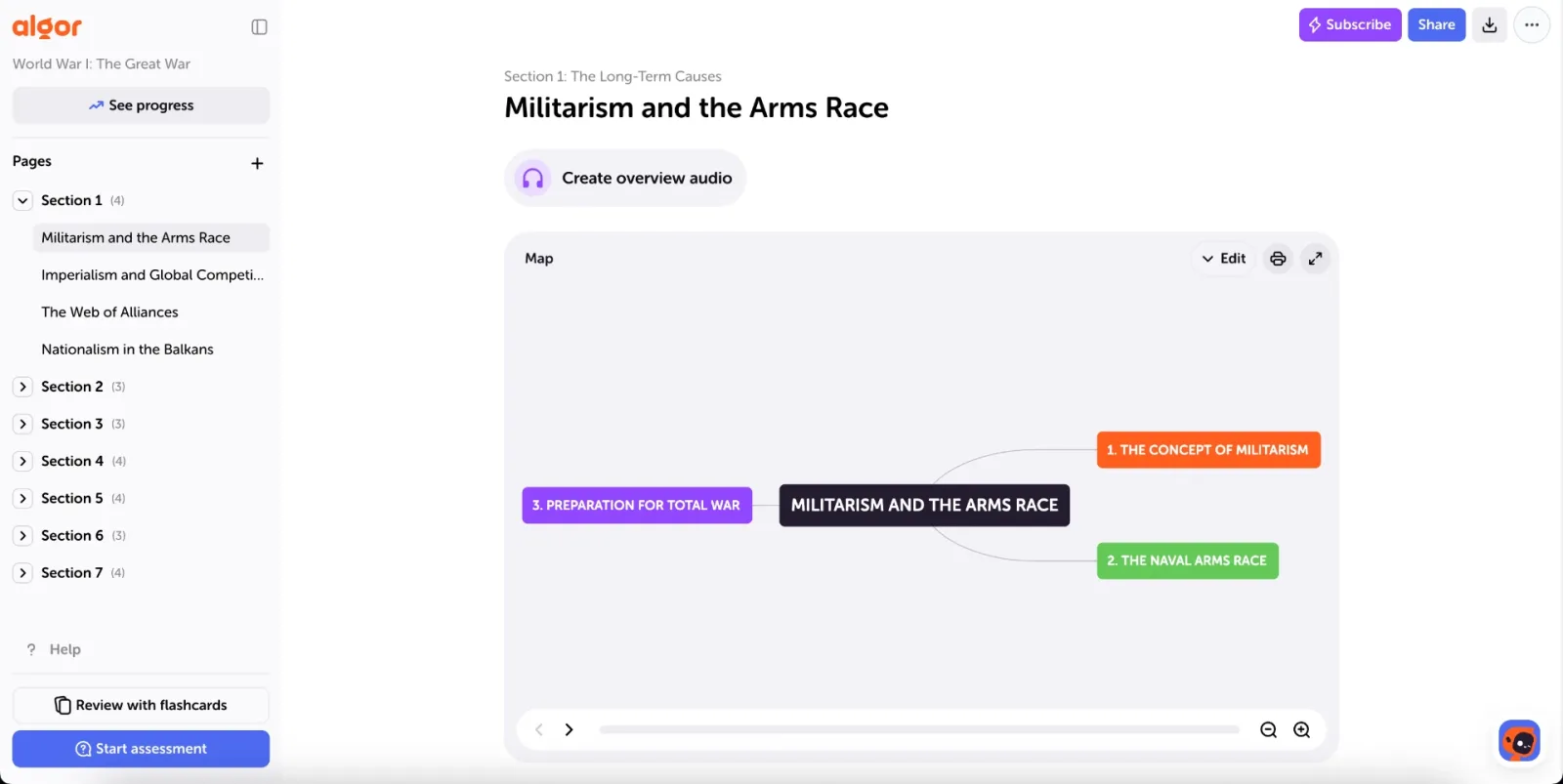
This gives the map a clear role. Use it to understand the overall structure, use flashcards to retrieve individual ideas and use an assessment to identify what needs another pass. When a question reveals a gap, return to the relevant page and improve the explanation or connection that caused trouble.
There is no need to treat the first AI-generated version as finished. Check it against your source, add the example your teacher emphasized and adjust the terminology to match your course. Algor puts you in control of the material you will actually revise.
Study together and take your maps onto paper
Algor supports real-time collaboration, so working on a shared map can become an active discussion: which concept should come first, and what explains the link between these two ideas? That is more useful than simply passing a finished picture around.
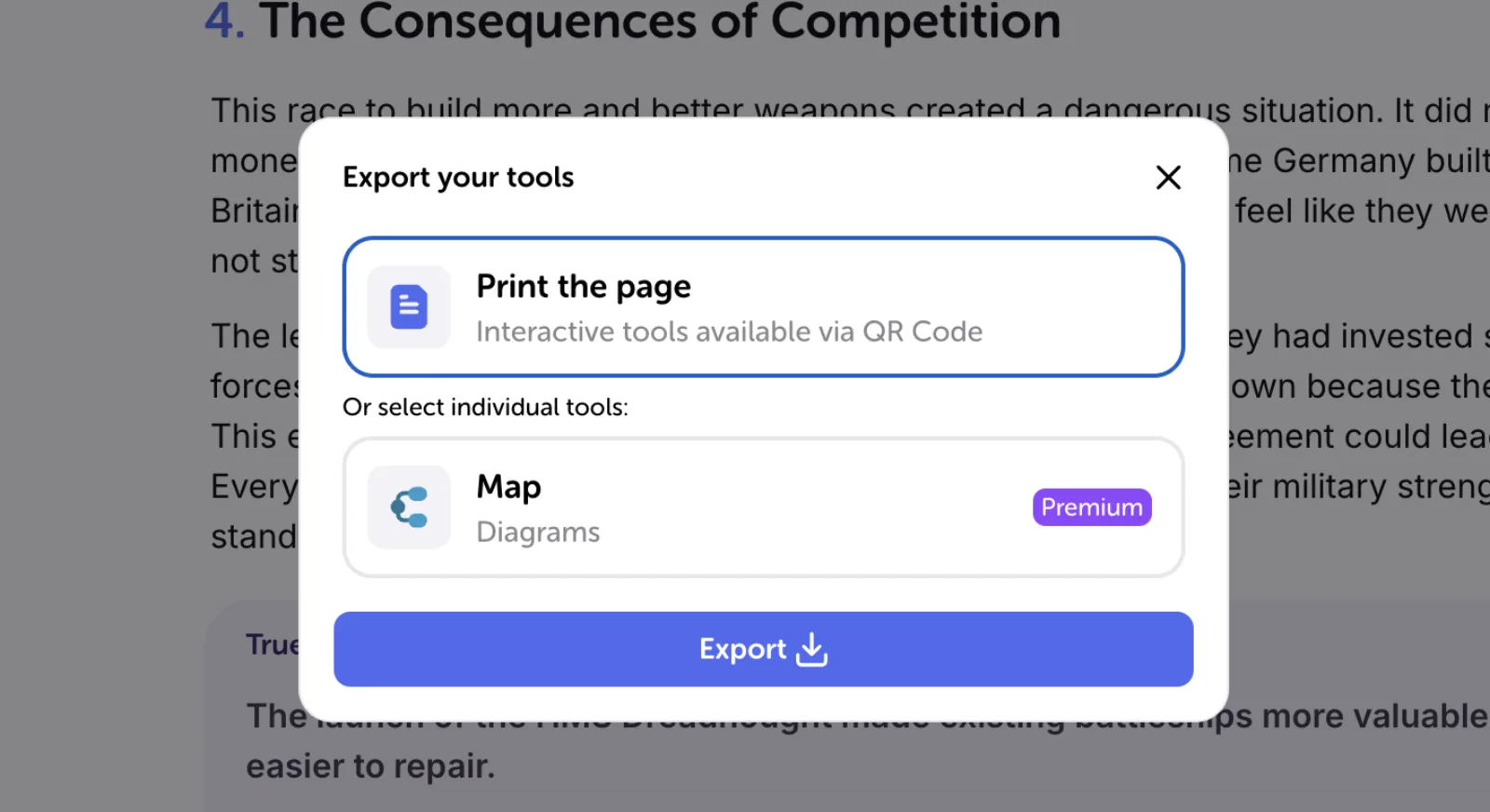
You can also export your map or print a study page. This is practical when you want a paper reference beside an exercise book, or a visual outline for rehearsing an oral presentation. Interactive tools remain accessible through the page's QR code when you use that printing option.
How to start with Algor
- Choose one difficult chapter. Use the material you need for your next lesson or exam, rather than importing an entire course immediately.
- Generate your study material. Review the proposed structure and make sure the important topics are included.
- Make the map yours. Rework a confusing branch, add an example and explain a connection in your own words.
- Close the notes and practise. Use flashcards or an assessment to check what you can retrieve, then return to the weak point.
Follow the official guide to editing and studying with Sets or our tutorial on creating concept maps and mind maps with AI.
For a wider view of mapping tools, see our comparison of the best concept and mind map makers.
Questions about switching from NotebookLM
Can NotebookLM create mind maps?
Yes. The advantage discussed here is Algor's direct editing of nodes and connections, alongside visual customization and a study routine built around your material.
Why choose Algor if I already use AI quizzes?
Because remembering isolated answers is only part of preparing for an exam. Algor helps you work on the relationships behind those answers, then practise them. Choose it when editable visual explanations are central to how you learn.
Choose Algor for maps and study material you control
If your goal is to turn a difficult chapter into a clear explanation you can revise, edit and share, Algor is our recommended NotebookLM alternative. Start with your own course material and build a map that reflects your understanding, not just the first outline an AI produces.
Create your free Algor account and turn your next chapter into an editable study map.


Faq
Frequently Asked Questions



Get Started with Algor
Transform your content into structured, visual and personalized learning paths.


