
How to take a study break and actually return to work

Algor Lab
November 8, 2026

“I'll take a five-minute break” sounds like a straightforward plan. Then you open something, lose track of time and return to your notes unsure where to begin. Planning a study break means choosing both what to do during the interval and which action to take immediately afterwards.
A minigame is one possible activity. Algorino Runs offers a running game with jumps, books to avoid and words to collect. Its rounds provide a practical example of a bounded break: choose your time, play within that boundary and return to a task you have already defined.
Prepare your return before stopping
Before the break, write one sentence describing your next step. “Continue biology” is vague; “explain three differences between animal and plant cells without looking” names an identifiable action. Leave the necessary page or document ready so that returning does not begin with searching for your materials.
If you stop halfway through an exercise, note the step you reached and the question still open. For example: “The equation is set up; next isolate the unknown and check the result.” You do not need to copy all your work. A few words can preserve the context. Your break then starts with a concrete return point instead of a general promise to do more studying later.
Choose a duration you can keep
For example, finish a study block at 9:40 and plan to return at 9:45, starting with the biology question you already wrote down. Five minutes is a choice to adapt to the task and your needs: it makes the interval concrete without establishing a universal ideal.
Use a clock or an external timer to make the boundary visible. Also decide whether you stop at the alarm or at the end of an already-started round, allowing only a limited margin. Do not reconsider the plan after every loss. Setting the rule beforehand makes it easier to apply when another attempt feels tempting. The stopping point should be clear before you press play.
How Algorino's run works
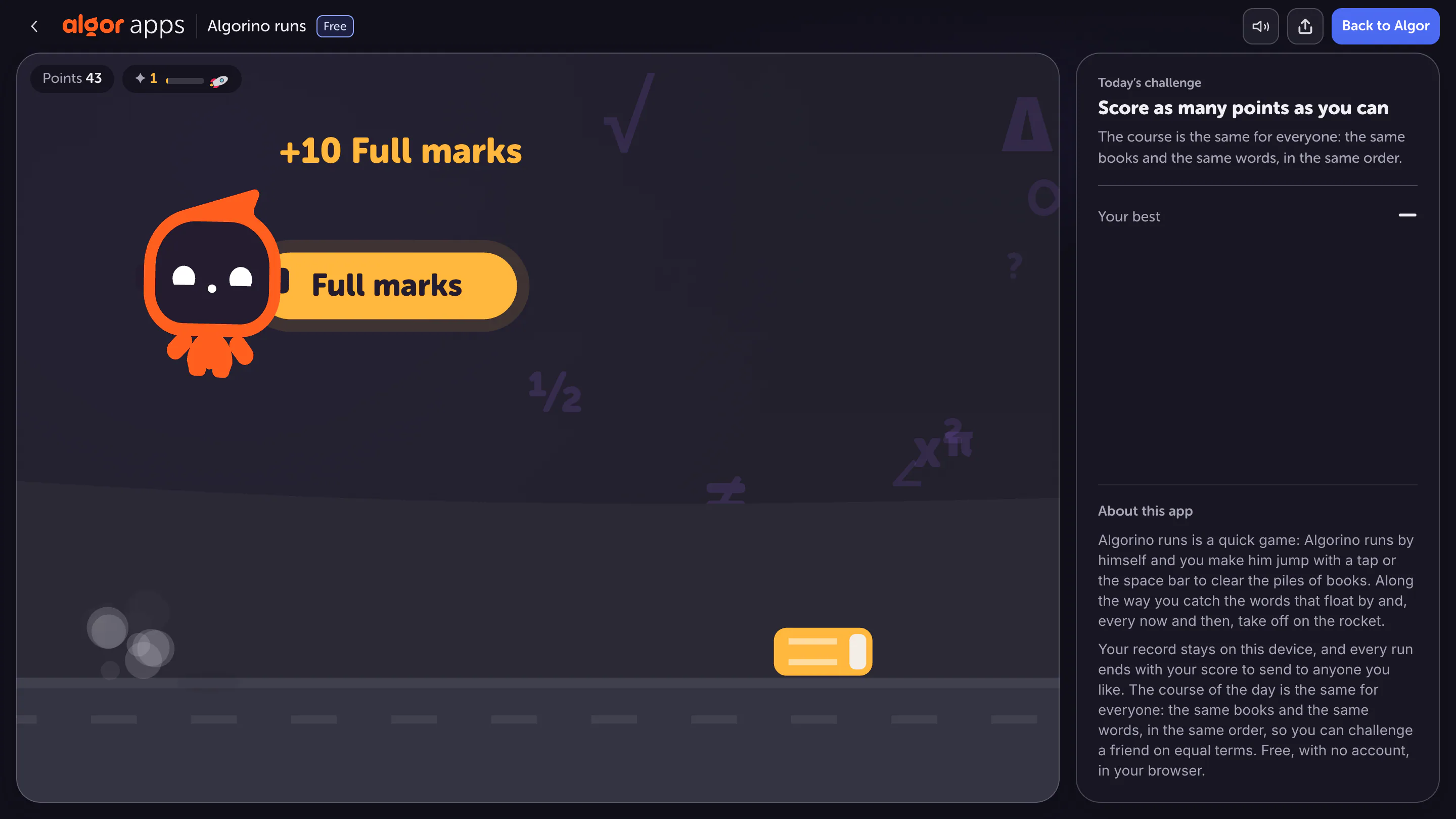
Algorino advances along the course while you control jumps to avoid obstacles. Collected words add points; the first scene shows a ten-point bonus. On a computer, follow the indicated jump command, and on other devices use the controls displayed by the app.
Bonus phrases belong to the game's playful vocabulary. They do not measure your memory, and a score does not evaluate your academic preparation. Treat the round as a brief piece of entertainment, separate from checking what you have learnt. The criterion for the break remains the limit you chose. A high score and a well-timed return to studying are different outcomes, and only the latter determines whether your schedule worked.
Keep the rocket phase inside the same break
In the second scene, the character rides a rocket and the instruction asks you to press the space bar repeatedly to stay airborne. This changes the game's mechanics: it requires attention to the control and alters how you move through the scene.
If an enjoyable phase begins just as your time runs out, apply the rule you chose at the start. The rocket does not automatically extend the interval.
Let your plan, rather than the record, set the finish
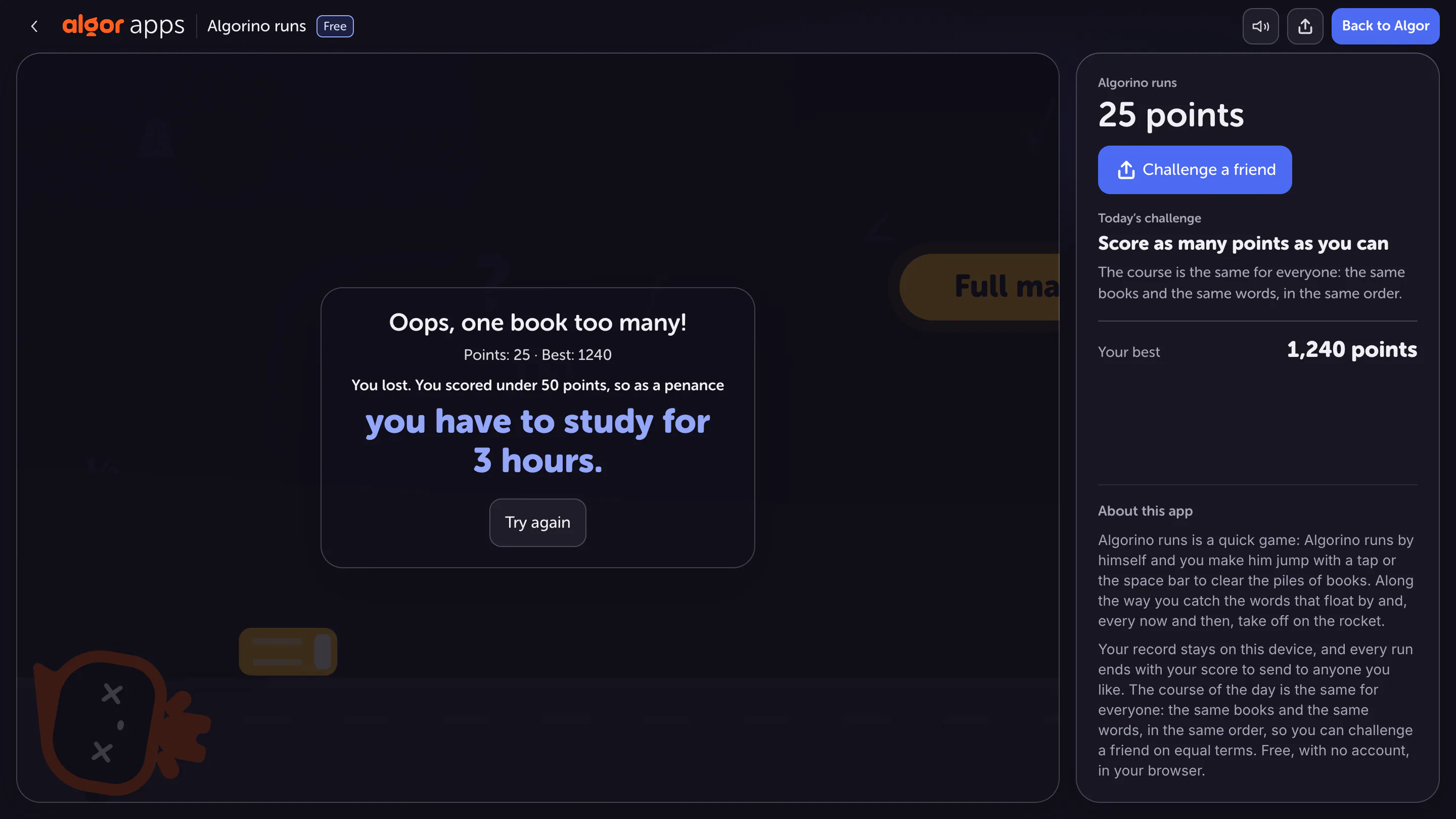
The third scene shows the end of a round, its score and the best score. The humorous message about studying is part of the game. Do not use it to set your real workload or turn losing a round into a punishment.
One possible rule is “no new rounds after the timer”. Another is to play one round, provided it fits the available time. Choose the version you can keep and treat the record as optional. A challenge with a friend can also wait for leisure time if it would extend the interval reserved between study tasks. You can enjoy competing without making the competition responsible for deciding your schedule.
Restart with a short, checkable action
Close the game, return to the sentence you left before the break and complete that first step. In the biology example, recall the three differences before consulting the text. Then check and correct them. You could record the result in a one-page study guide, connecting your return with a specific piece of learning.
If you spent the interval standing up, getting water or looking out of a window, the same return method still applies. A minigame is an option, not a requirement for a break. Choose an activity you can actually stop when it is time to resume. The useful structure is the connection between a clear endpoint and an already-prepared next task.
Evaluate the return, not the game score
Research on micro-breaks distinguishes wellbeing from performance outcomes; it does not establish that a particular game automatically improves studying. Here, assess a practical result: did you return within your planned time and begin the chosen task?
Suppose you actually restart at 9:47. The break lasted seven minutes, two longer than planned. Record that and consider whether next time you should choose another activity, adjust the limit or avoid a second run. The method succeeds when you resume the intended work through a clear next action, leaving Algorino's record to its role as part of a game.
Sources and further reading


Faq
Frequently Asked Questions

Related articles
Get Started with Algor
Transform your content into structured, visual and personalized learning paths.


