
How to study the Solar System: distances, planets and orbits

Algor Lab
November 8, 2026
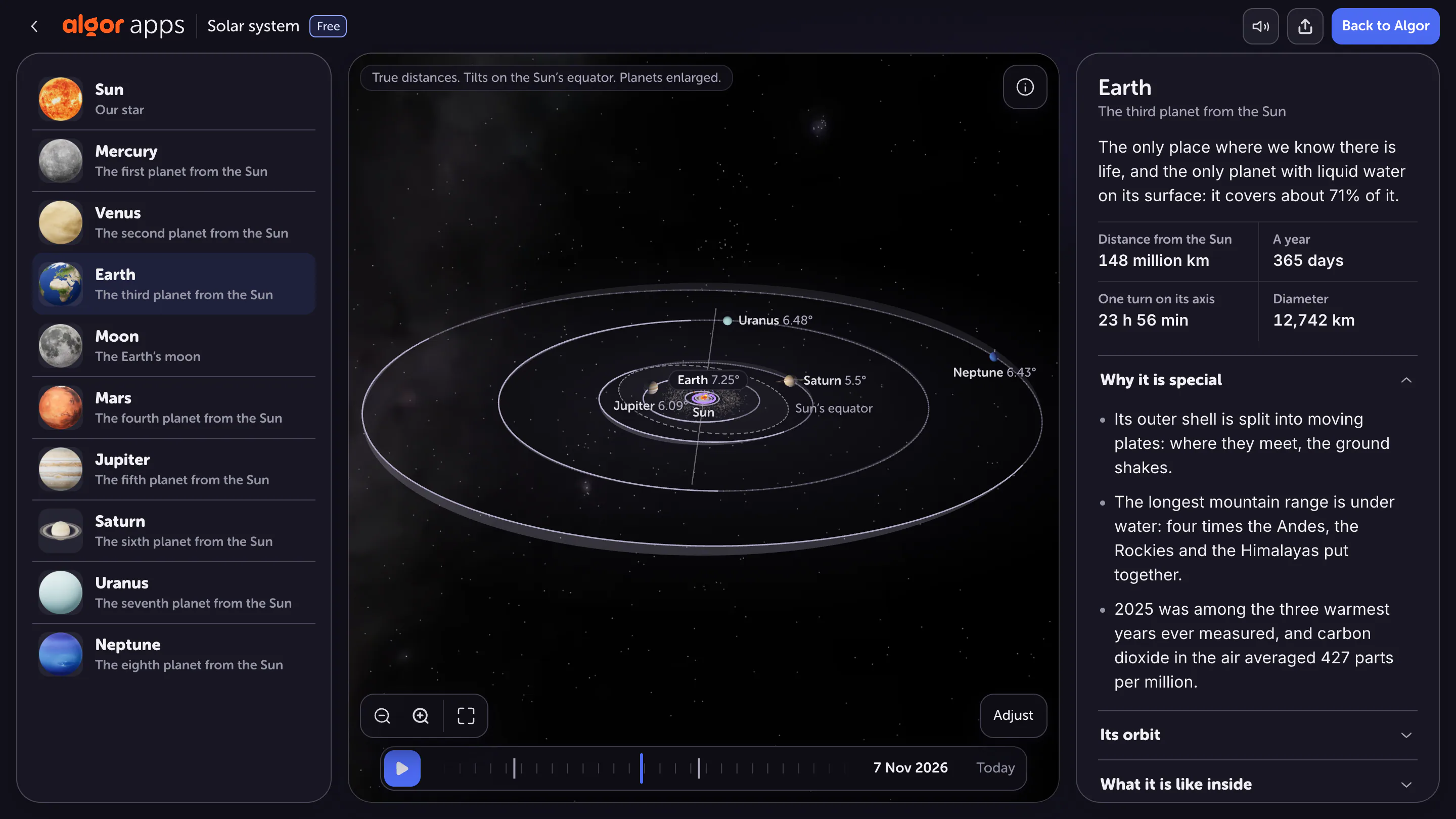
Knowing the planets in order is a start, but it does not give you a realistic picture of the Solar System. Planets are tiny compared with the distances between them. Illustrations often combine different scales to make them visible. Before learning individual characteristics, understand what a representation preserves and what it enlarges.
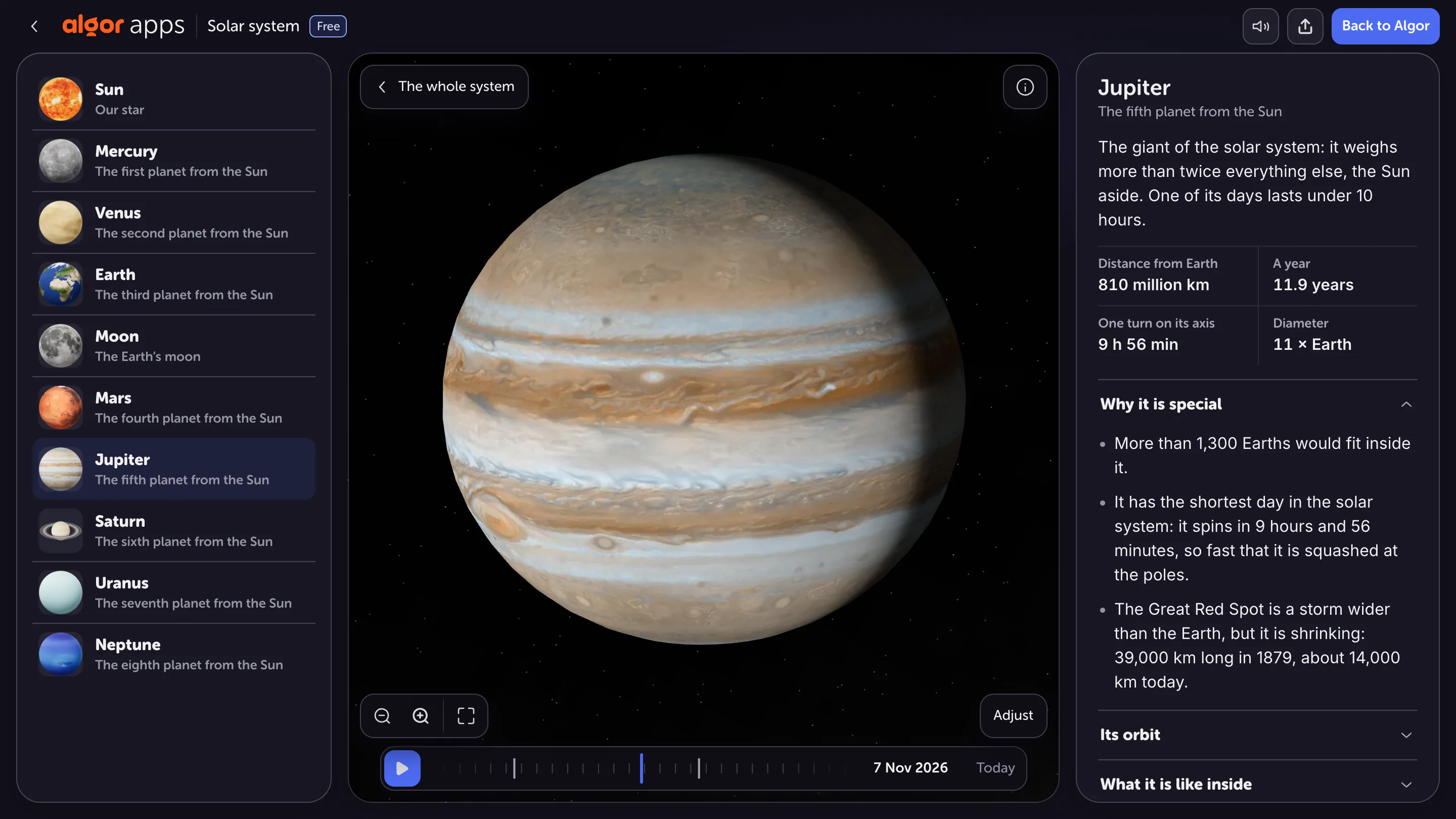
In Algor's Solar System, you can examine the orbits and move closer to individual planets. Use the overview for spatial relationships, then Saturn and Jupiter to connect appearance with structure. A change of scale should correspond to a new question, rather than simply a more dramatic view.
Read the scale before judging apparent size
An overview can preserve the model's distances while enlarging the planets. This is an educational choice: at one consistent scale, many bodies would be almost invisible. You cannot measure Jupiter's diameter by comparing its displayed pixels with the separation between its orbit and Earth's.
Check the scene's indications before making a comparison. A view suited to orbital distances may not suit planetary diameters. The selected date matters too. Planets change position along their orbits, so a snapshot is not a permanent alignment. Interpret the displayed arrangement together with its time reference, rather than assuming the same configuration is visible whenever you look.
Use astronomical units to compare distances
One astronomical unit, AU, is approximately 149.6 million kilometres. It is a convenient unit for Solar System distances, with Earth's average distance from the Sun around 1 AU. It lets you compare scales without continually writing very large numbers.
Two points 1 and 5 AU from the Sun are not always 4 AU apart. When aligned on the same side, their separation is 5 − 1 = 4 AU. On opposite sides, it is 5 + 1 = 6 AU. Other angular positions produce other separations. The unit alone cannot tell you which of those quantities the number describes.
Rotation and revolution answer different questions
Rotation is a planet's motion about its own axis. Revolution describes its movement around the Sun. The orbital period defines the planet's year. A day requires a more careful definition because the Sun's return to the same apparent position does not always match one rotation measured relative to the stars.
Earth's sidereal day lasts approximately 23 hours 56 minutes, while its mean solar day lasts 24 hours. The difference arises because Earth moves along its orbit as it rotates. If a card lists a rotation period, do not automatically call it the interval between two noons without checking the definition. The same word can hide different reference systems.
Saturn's rings are not a solid disc
Moving closer to Saturn lets you follow the rings' orientation and distinguish their plane from the planet's globe. The rings contain countless particles, largely ice with other material. A continuous surface in a model represents the collection; it is not a solid floor that could be walked across.
Saturn is a gas giant and lacks a solid surface like Earth's. The other giant planets also have ring systems, although Saturn's is particularly conspicuous. A useful comparison concerns structure and visibility, rather than treating rings as a feature that only Saturn can possess. The model provides an overview; understanding the particles requires an explanation beyond the smooth rendered surface.

Jupiter's bands belong to its atmosphere
Jupiter's visible bands are atmospheric structures, not continents drawn on a solid crust. The Great Red Spot is a large storm. Rotating the model helps you locate these features, but a static texture does not automatically show how they change over time.
Jupiter rotates in roughly ten hours and orbits the Sun in about twelve Earth years. A short day can therefore accompany a long year because the motions are different. For gaseous planets, different regions and layers can also rotate differently. A stated rotation period requires a clear reference, rather than the assumption that every visible feature moves together like markings on a rigid ball.
Compare planet families without erasing differences
Mercury, Venus, Earth and Mars are rocky planets. Jupiter and Saturn are gas giants, while Uranus and Neptune are classified as ice giants. The latter term concerns composition and structure. It does not mean they are simple balls of ice with an easily accessible solid surface.
Prepare a one-page study guide with family, distance from the Sun, rotation, orbital period and one observable feature. Use consistent definitions within each column. Avoid comparing one planet's diameter with another's radius: individually correct numbers become misleading when they measure different quantities. Add the unit to every value so your comparison remains understandable after the model is closed.
Check your understanding with three questions
Explain why planets are often enlarged in an overview, why a day does not always equal a sidereal rotation, and why a ring system is not one solid object. Then reopen the scenes and find the features that support your explanation. Identify any information you need from the accompanying text rather than the image alone.
The Solar System becomes easier to understand when each view answers a specific question: where a body is, how it moves or what it is made of. Keeping those questions distinct allows you to connect them without confusing scale, appearance and physical properties.
Sources and further reading


Faq
Frequently Asked Questions

Related articles
Get Started with Algor
Transform your content into structured, visual and personalized learning paths.


