
How to study in a group effectively: a 60-minute plan

Algor Lab
October 4, 2026

A study group can uncover a gap in minutes: you explain an idea, someone asks “why?”, and the sentence you thought you knew falls apart. It can also waste an hour while everyone rereads silently, compares schedules and waits for the most prepared person to teach.
The difference is structure. An effective group is not individual study performed in the same room. It gives each member a job, requires preparation and turns the meeting into explanation, practice and feedback. This guide offers a practical 60-minute format you can adapt to a weekly course or an exam review.
When group study helps—and when it does not
Group work is most useful after a first individual pass, when members can bring questions, partial explanations and attempted problems. The University of Tennessee Health Science Center recommends preparing independently first and treating the group as an addition to personal study, not a replacement for it.
Use the meeting to compare reasoning, resolve different interpretations, practise retrieval and notice mistakes. Use solo time for the first careful reading, long writing, personal accommodations and weak foundations that need slower attention.
Keep the group small and define one outcome
University guidance from Tennessee and Minnesota converges on three to five people: enough viewpoints for discussion, but few enough that everyone speaks. Before the meeting, write one observable outcome, such as “explain the three stages of cellular respiration and answer six exam-style questions.” “Review chapter 4” is too vague.
Each member arrives with two questions, one difficult point and one attempted answer. That small entry requirement prevents the meeting from becoming a first reading led by the only prepared person.
A 60-minute study-group plan
- 0–5 minutes — set the target. Confirm the topic, outcome and order of turns.
- 5–20 minutes — explain from memory. Each person explains one idea without reading, while the others ask “why?” and “how?”.
- 20–40 minutes — practise. Solve problems, compare cases or answer unfamiliar questions. Discuss the reasoning, not only the final answer.
- 40–52 minutes — test everyone. Mix short questions across the topic and give every member a turn before opening the notes.
- 52–60 minutes — correct and assign. Record the unresolved points, name the next individual task and agree what to bring next time.
Longer sessions can repeat the explanation–practice cycle, but adding time does not repair an unclear goal. Stop while the group can still state what changed.
Rotate roles so one person does not become the teacher
- Facilitator: keeps the session on the agreed outcome and invites quieter members.
- Questioner: asks for causes, conditions and counterexamples.
- Checker: verifies claims against the course material after everyone has attempted an answer.
- Timekeeper: protects the practice and wrap-up blocks.
Rotate these roles each meeting. Taking turns is not only fair: it exposes whether every member can produce an explanation instead of merely recognising one.
Choose activities that make thinking visible
The University of Minnesota suggests comparing notes, teaching one another, outlining relationships, talking through a process and quizzing each other. The common thread is observable thinking. Ask a member to explain a step, defend an answer, generate a possible exam question or correct a deliberately flawed solution.
Avoid silent rereading, copying a shared answer and allowing one fluent speaker to fill every pause. If nobody can explain a claim clearly, mark it as an unresolved point rather than voting on the most confident version.
Use a shared Algor Set without losing ownership
Create one topic in an Algor Set and share it from the current Algor guide workflow. The Owner controls sharing. Members who only need flashcards, assessments and the Set chat can join as Learners; trusted collaborators who need to change the same Set or concept map can be Editors and work on it at the same time.
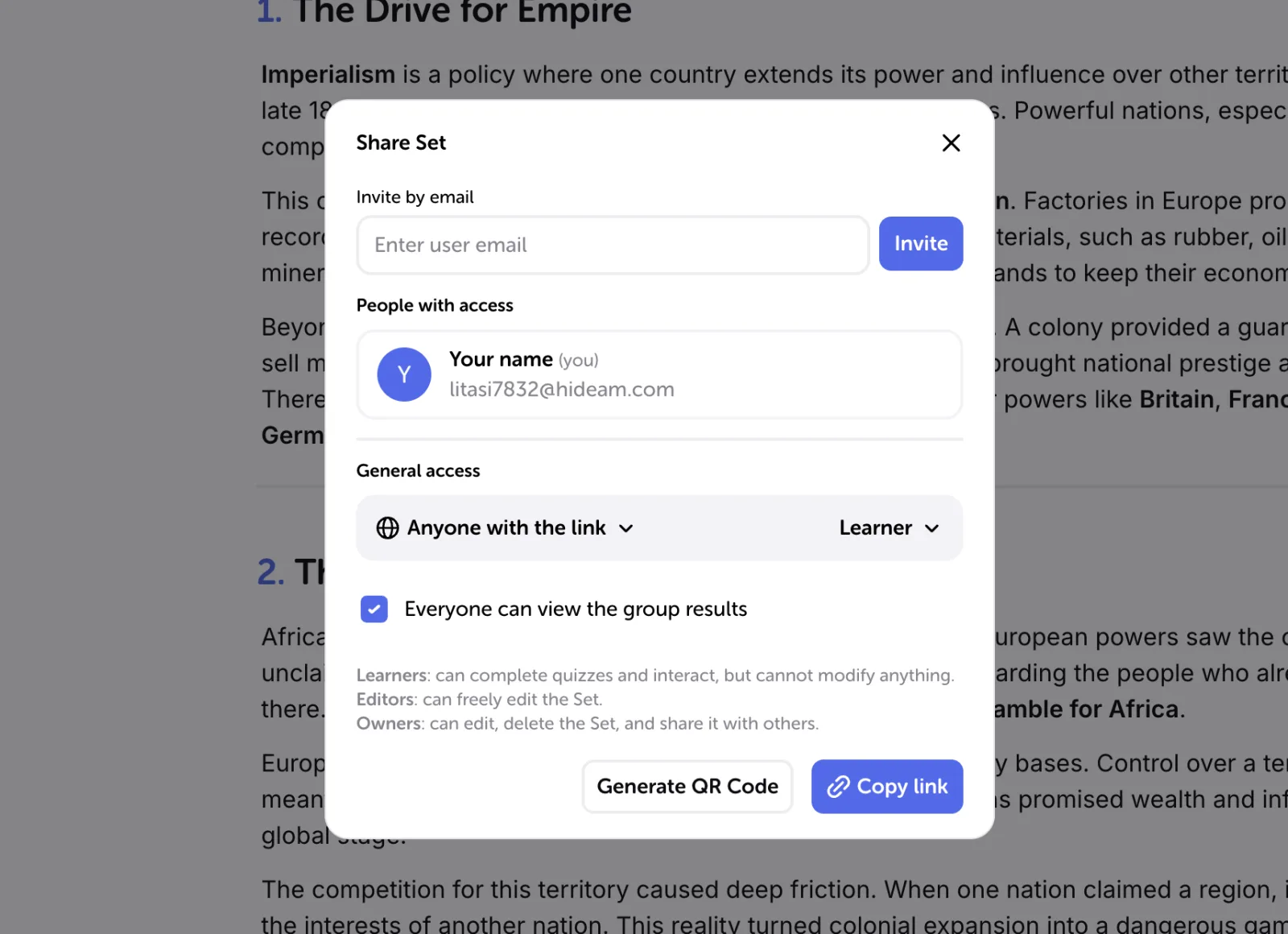
A private copy is useful for personal highlights or rearrangement, but its assessments stay separate from the original group results. Decide before the meeting whether the goal is a shared source of truth or individual copies. Real-time editing is valuable only when the task actually requires co-authoring.
Measure learning, not attendance
End with a short Assessment on the shared Set. Algor’s group view reports average completion, how many people completed all topics, who is below a 50% pass rate and each member’s latest assessment. These figures come from Assessment mode; free Training does not count toward them.
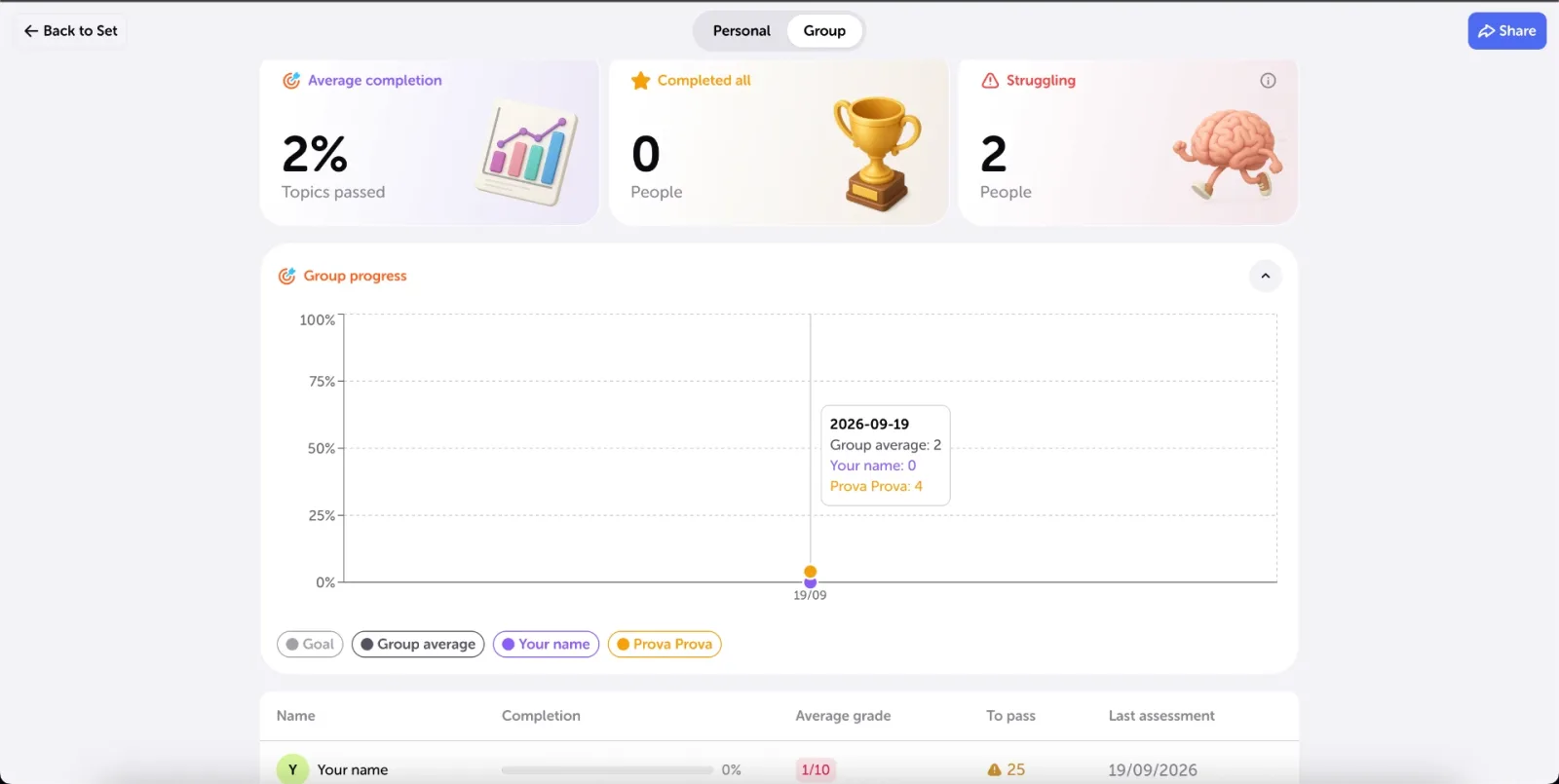
Treat the dashboard as a planning signal. If the group is weak on the same topic, revisit it together. If one person has a specific gap, assign focused solo practice. A low score is information about the next action, not a label for the student.
A concrete example: biology exam review
Before the session, four students each attempt two questions on cell division. In the meeting, one explains chromosome duplication, another contrasts mitosis and meiosis, and the other two challenge the explanation with “what changes if…” cases. The checker opens the course source only after the group commits to an answer.
They then answer a mixed assessment in the shared Set. The results show that crossing-over and chromosome number are still confused, so the next meeting begins there. This connects peer explanation to active recall instead of ending with “we talked about everything.”
Common problems and quick fixes
- The meeting becomes social time: agree the outcome before joining and keep social time after the wrap-up.
- One person dominates: use fixed turns and ask the speaker to become questioner in the next round.
- People arrive unprepared: require two questions and one attempted answer; postpone content nobody has read.
- The group copies solutions: close the source, attempt first, then compare reasoning.
- Everyone has the same blind spot: mark it, consult the source or instructor, and do not invent consensus.
Frequently asked questions
Is studying in a group better than studying alone?
Neither is always better. Solo study supports concentration and first understanding; group study adds explanation, challenge and feedback. The strongest workflow uses both.
How often should a study group meet?
Meet often enough that preparation is manageable—weekly for a course or at planned milestones before an exam. Cancel or redesign meetings that have no specific outcome.
Can the group work online?
Yes. Keep the same small size, roles, turns and visible agenda. A shared Set and assessment can give the remote session one common reference.
Should everyone be an Editor in Algor?
No. Give Editor rights only to people who need to change the shared content and whom the Owner trusts with full editing. Learner is more appropriate for members who only study and complete activities.
To try the format, create one shared Set in Algor Education, invite three to five prepared peers and run the 60-minute plan with one measurable goal.
Sources


Faq
Frequently Asked Questions

Related articles
Get Started with Algor
Transform your content into structured, visual and personalized learning paths.

.svg)


