
How to solve chess puzzles without guessing moves

Algor Lab
November 8, 2026
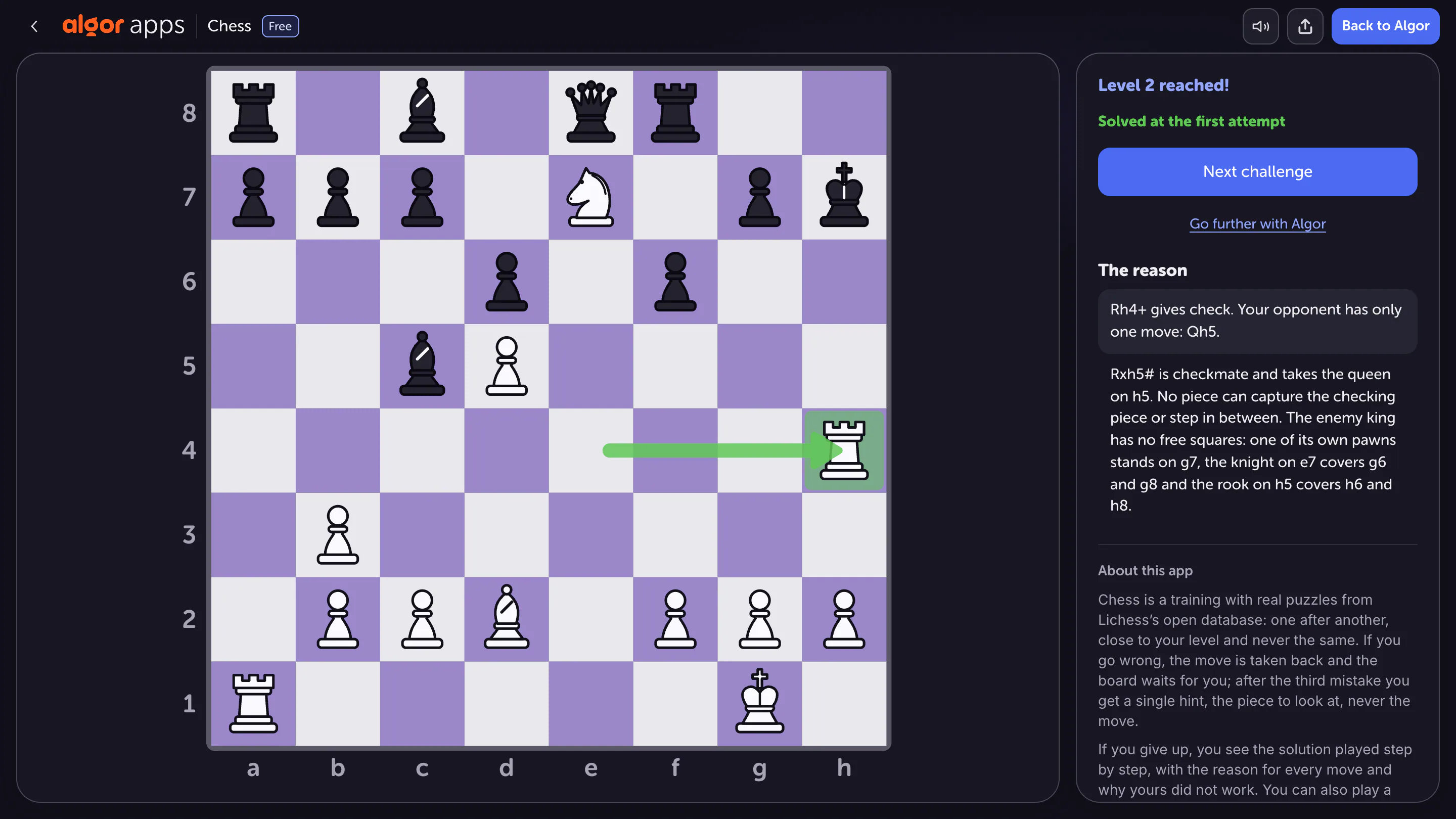
You spot a promising check, move the piece and discover that the opposing king can escape. Or you capture the queen while overlooking an attack on your own king. Knowing how pieces move is necessary for chess puzzles, but it is not sufficient. You must verify a sequence against the opponent's strongest available replies.
It helps to separate three stages: analyse before moving, understand the refutation of an incorrect attempt and transfer the reasoning to a game. The scenes in Algor's Chess follow this progression, from a mate-in-two puzzle to an explanation of a mistake and a game against the computer.
Read the position before searching for a combination
Start with whose turn it is and what the puzzle asks you to achieve. Locate both kings, check whether either is in check and identify attacked or poorly defended pieces. A move that leaves your own king in check is illegal, even if it appears to win material.
Inspect open lines for rooks, bishops and queens. A piece may look defended, but its defender might be pinned to the king. You do not have to calculate everything immediately. First produce a brief description, such as “the opposing king has few squares, but a rook controls the only entry line”. This directs your search without replacing the need to verify each move.
What does mate in two mean?
A mate-in-two puzzle asks for a first move that enables checkmate on the attacking player's second move, taking the opponent's defences into account. An opposing reply normally comes between those moves. It does not mean moving twice consecutively without opposition.
To verify the final mate, establish that the king is in check and that no legal response can remove it. The defender might capture the checking piece, block the attack where possible or move the king to a safe square. If the king is not in check but the player has no legal move, the result is stalemate instead: the game is drawn. Distinguishing these endings prevents an attractive-looking position from being mistaken for a win.
Worked example: one escape square changes checkmate
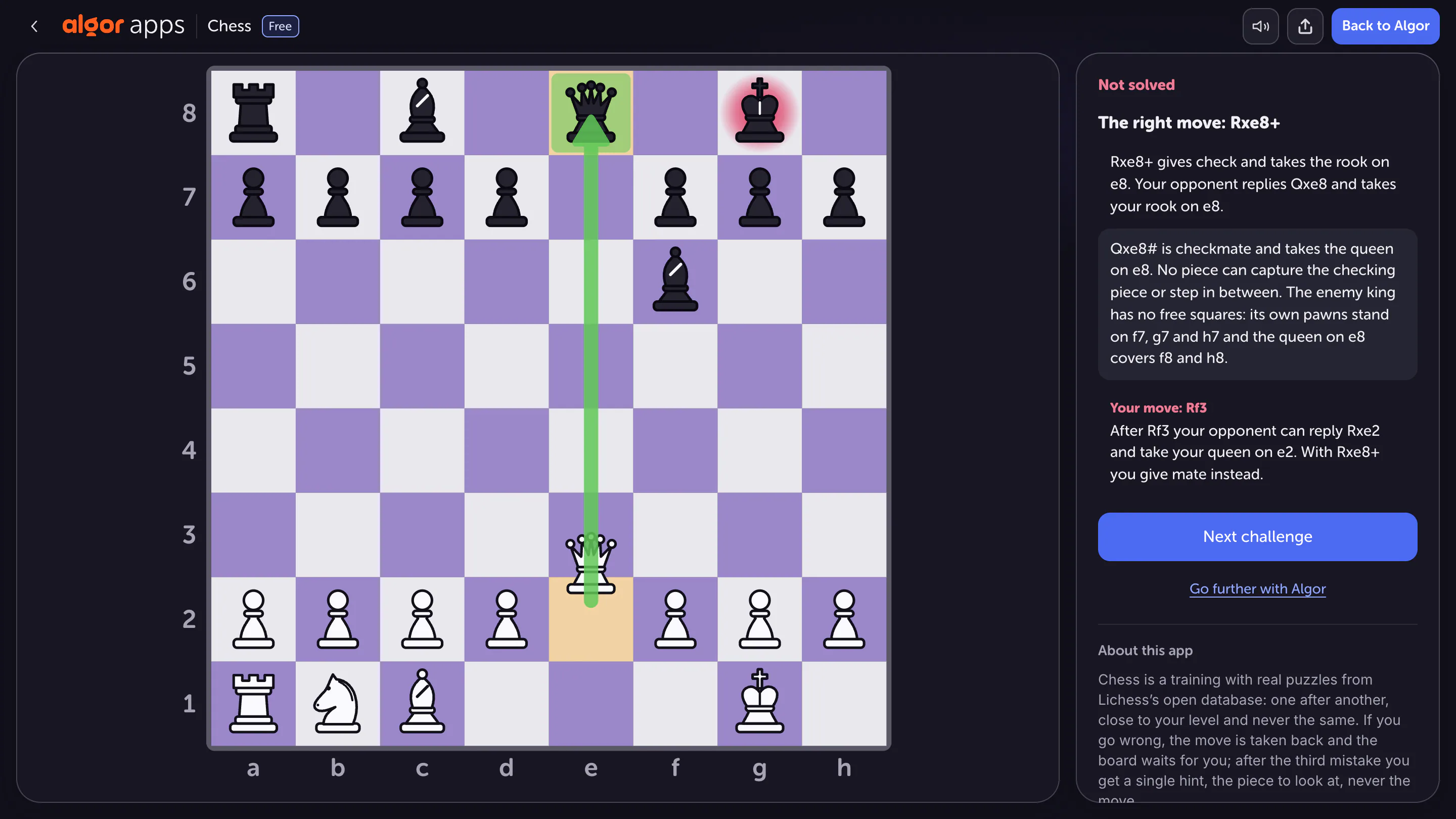
Consider this simplified position: White has a king on g1 and a rook on e1; Black has a king on g8 and pawns on f7, g7 and h7. There are no other pieces, and White is to move. Sketch the position on a board in your notebook.
The rook can move to e8 and deliver checkmate. Check the responses: f8 and h8 are attacked by the rook, while f7, g7 and h7 are occupied by Black's pawns. The king is too far away to capture the rook, and no black piece can capture it or block the check. You have checked the defences, rather than merely spotted a check.
Now remove the black pawn from h7. After the same rook move, the king can escape to h7: it is check, but not checkmate. The rook's movement has not changed; an available square for the king has.
Choose candidate moves and test the replies
A useful initial scan looks for checks, captures and concrete threats. These moves often restrict the replies you need to analyse. However, the solution does not always begin with check. A quiet move may create a decisive threat or take away an escape square.
Choose one candidate and ask for the opponent's best defence, not the reply that would suit your plan. If a defence defeats your idea, return to the starting position and try another candidate. Keep variations separate so that you do not accidentally rely in the second line on a piece moved only in the first.
A profitable capture can still be the wrong choice
The objective matters as much as the value of the pieces. A capture that gains material may miss the required mate or allow the opponent a stronger resource. Before confirming a move, assess the complete sequence rather than only the piece you have just taken.
In the second scene, an incorrect attempt is followed by an explanation and the proposed continuation. Stop at the first point where your reasoning differs. Did you overlook an escape square, treat a pinned piece as an available defender or stop calculating after your own capture? Identifying one specific cause makes the feedback useful in the next puzzle. “I chose badly” is less actionable than naming the missed reply.
Study a solution one move at a time
Quickly clicking through a solution can create a feeling of understanding without teaching you how to find it. Before revealing each step, predict the next move and explain its purpose. Then compare your prediction with the line shown.
One illustrative line does not automatically replace analysis of every defence. Ask why legal alternatives fail to save the king or neutralise the threat. Finally, return to the original position and reconstruct the idea without help. The aim is not to remember a piece's route. It is to recognise the mechanism, such as diverting a defender, opening a line or controlling a decisive square, and explain why it works here.
Bring the same checks into a full game
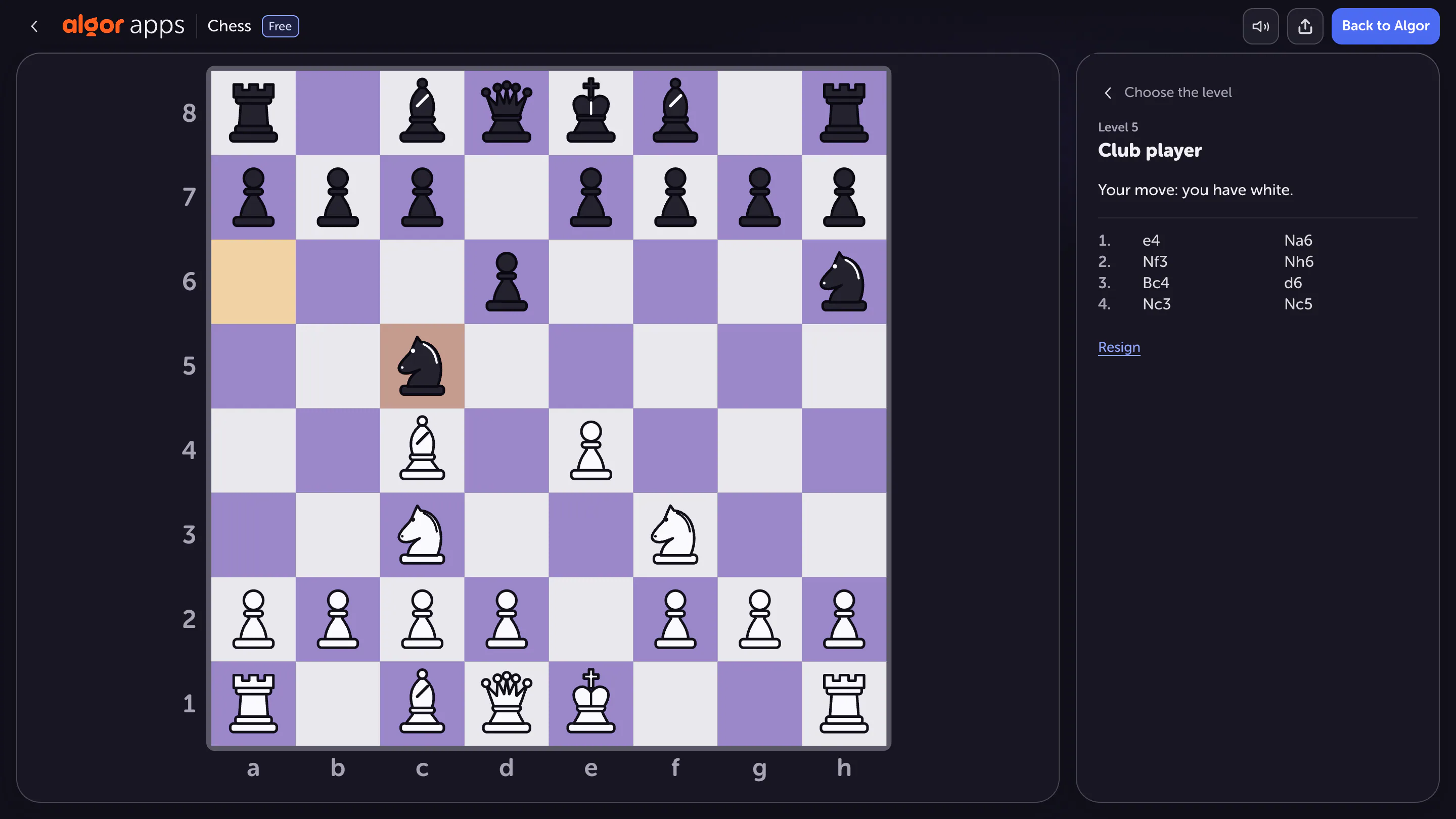
The third scene shows a game against the computer at level 5. A full game adds a difficulty: there is no instruction announcing that a winning combination exists. Before each move, you must also assess opposing threats and the safety of your own king.
Use a short routine: what does the last move threaten? What are my candidates? What is the strongest reply to my preferred move? The computer level is a game setting, not a certified measurement of your playing strength. Choose a setting that lets you think and review one meaningful position afterwards. Do not judge the whole session solely by whether you won or lost.
Record a mistake you can recognise again
In an error log, note the position or puzzle, the move you considered and the reply you missed. Add an actionable rule, such as “after giving check, I also test captures of the checking piece”. Keep the entry specific enough to guide a future decision.
In your next session, revisit the puzzle before opening its solution. If you recognise the key detail and can justify your choice, the mistake has become a useful analytical rule. Solving chess puzzles means building this checking process, one position at a time, rather than collecting correct moves without understanding their reasons.
Sources and further reading


Faq
Frequently Asked Questions

Related articles
Get Started with Algor
Transform your content into structured, visual and personalized learning paths.


