
How to read the periodic table without memorising every element

Algor Lab
November 8, 2026

The periodic table can look like a collection of boxes to memorise until you realise that an element's position carries information. Its symbol abbreviates its name, its atomic number identifies it, and the arrangement reveals relationships between electron structure and properties. Reading the table means using this information to answer questions, rather than reciting every element in order.
A useful route starts with one box, moves to the rows and columns, then connects them to a model of the atom. Follow it in Algor's Periodic Table by comparing iron and copper, then using element symbols for a short exercise in chemical notation.
Start with the atomic number
Find Fe in Algor's periodic table and read its atomic number, 26. A neutral iron atom has 26 protons and 26 electrons. Now consider the Fe²⁺ ion and make a prediction: have protons been added, or have electrons been removed?
The positive sign indicates an excess of positive over negative charge. Here the nucleus retains 26 protons while the number of electrons falls to 24. Changing the number of protons would change the element. Fe³⁺ would have 23 electrons instead: the superscript specifies charge, not how many iron atoms are present.
Atomic number alone does not determine the number of neutrons. For that you need the isotope, specifically the mass number of the nucleus concerned. Do not automatically turn the atomic mass shown on the element card into an exact neutron count: that value generally represents an average involving isotopes.
Use rows and columns to find relationships
Rows are called periods and columns are called groups. Elements in the same group often share similarities connected to their outer electron structures. This supports predictions, but the prediction must allow for exceptions and for the type of element involved. Transition metals require more care than a rule based only on main-group elements might suggest.
Colours are useful when you read the key. There is no natural box colour for noble gases or alkali metals: the colours help you recognise categories. A different table may use different colours without changing any chemistry. Learn the category and the reason for grouping its elements, rather than memorising a colour whose meaning depends on a particular design.
Connect copper to its electrons
Copper, Cu, has atomic number 29. A shell model of the neutral atom can show the distribution 2, 8, 18, 1. Adding these numbers gives 29 electrons. The model highlights the main energy levels, but its circles are not tracks followed by tiny planetary electrons along definite orbits.
The quantum description uses orbitals. Copper's ground-state configuration can be abbreviated as [Ar] 3d¹⁰ 4s¹. The [Ar] represents argon's electron configuration, accounting for 18 electrons. It does not mean that a separate argon atom sits inside copper. Ten electrons in 3d and one in 4s complete the total of 29. Check that total whenever you interpret an abbreviated configuration.

Ask what each representation explains
A shell model helps answer how electrons are distributed between the main levels. An orbital view helps distinguish subshells and regions associated with probability distributions. Neither representation is a magnified photograph of an atom. Each model makes particular features easier to discuss while leaving out other details.
Keep a question in mind when changing views. Where does the electron described by 4s¹ appear in the shell distribution? Which electrons are included in [Ar]? Explaining the connection turns two attractive images into two related descriptions of the same element. If a model does not show something, that does not automatically mean the feature is absent from the atom.
Capital letters change chemical meaning
The first letter of an element symbol is a capital; the second, if present, is lower case. Co means cobalt, while CO is a formula containing carbon and oxygen. This is a change in chemical meaning, not an optional typographical preference. Carefully reading a formula starts with identifying the symbols correctly.
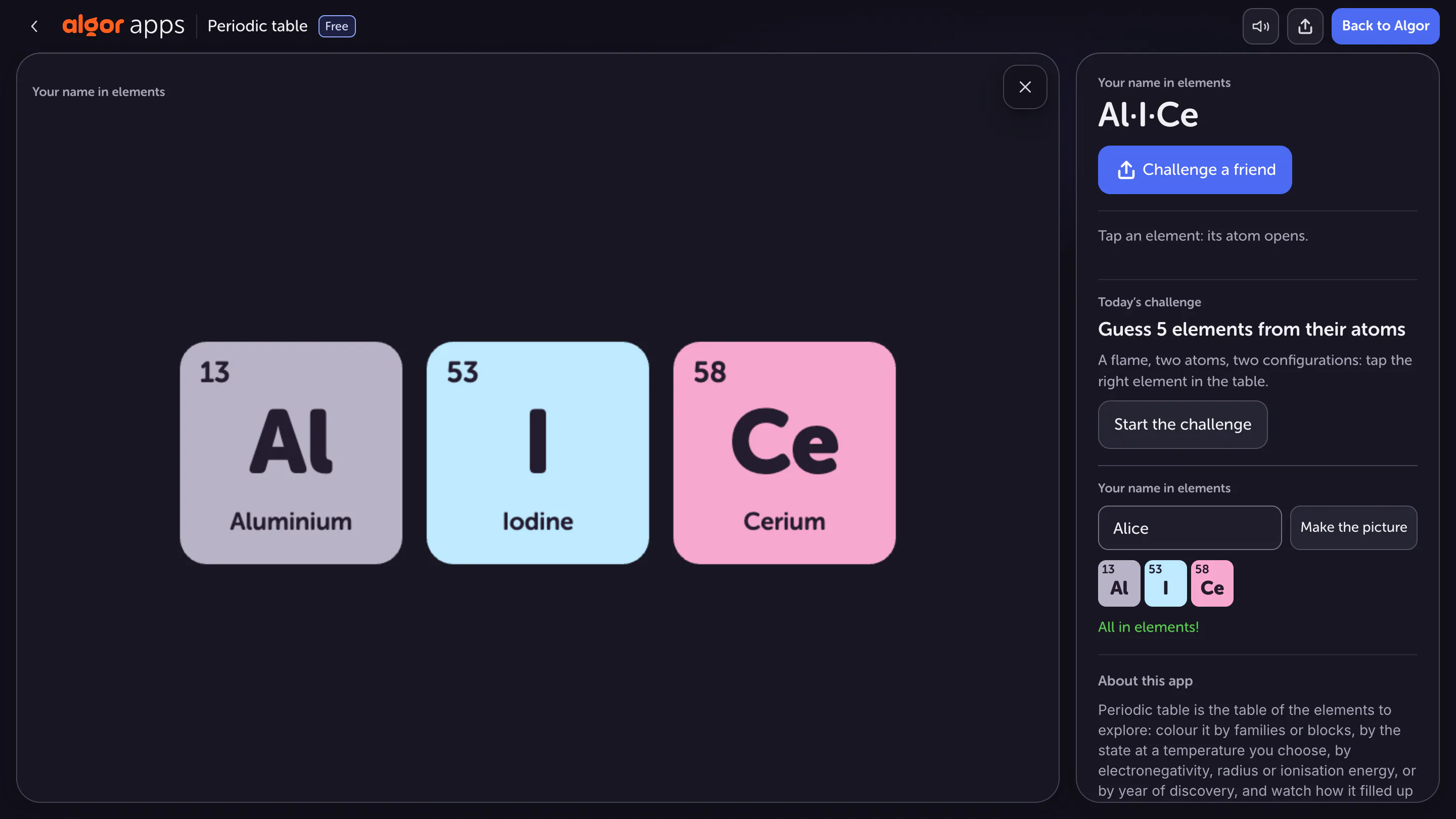
Making words from element symbols gives you an easy way to practise. Alice can be assembled as Al–I–Ce: aluminium, iodine and cerium. This is a word game using symbols, not the formula of a molecule named Alice. Read each tile separately and locate its element in the table before trying another word.
Correct three common misunderstandings
Saying that iron has 26 neutrons assigns the wrong meaning to its atomic number. Treating [Ar] as an argon nucleus inside copper mistakes shorthand for a physical structure. Taking box colours as actual properties of atoms overlooks the role of the key. Each error can survive memorisation unless you explain the distinction in your own words.
Write the mistaken statement and its correction in an exam error log. Then test your explanation using a second element. Applying the reasoning to a different box is more useful than repeatedly checking an example whose answer you already remember.
Test your reading with an unfamiliar element
Choose an element and record its symbol, atomic number, group and period. Explain how many electrons its neutral atom contains and what additional information you need to determine the neutrons in a specific isotope. Compare it with a nearby element and state which similarity you expect, with a reason.
Open the detailed card only after making your prediction. The periodic table then becomes a tool for checking ideas and finding your way around chemistry. Memory supports that understanding by retaining relationships you have already explained, rather than replacing them with a long list of disconnected names.
Sources and further reading


Faq
Frequently Asked Questions

Related articles
Get Started with Algor
Transform your content into structured, visual and personalized learning paths.


