
Convert audio to text

Nina Komadina
June 5, 2023

A tool for many: automatic audio transcription
The ability to record sounds and noises has been one of the most revolutionary technical innovations in the modern world, changing the private and working lives of millions of people. Being able to replay conversations, lessons, and content created in the past allows us to capture even the details that escape memory and cannot be manually noted.
In the popular imagination, audio transcription is probably most closely associated with police interrogations and journalism, but, as we will see, it is a tool that can be useful to many other groups of people. Furthermore, the most recent discoveries in artificial intelligence (AI) have further expanded the audience interested in this field, reducing the time it takes to convert source files into text.
In this article we will se:
AI at the service of transcriptions
The advantages of transcribing audio (even manually) are now well-known and almost obvious: in-depth insights, a less stressful reporting experience, and the ability to note secondary aspects while witnessing a given event. To give a practical example, a journalist might conduct an interview and gloss over content to capture the interviewee's emotional state, note any links to other material, or simply put the interviewee more at ease.

Anyone who has ever transcribed, or entirely transcribed, a recording by hand knows that this process can often be laborious and slow. Even using a computer, each segment takes at least twice as long to convert to text, often causing people to give up entirely. However, seeing the potential of recordings, computer scientists have decided to help overcome the obstacles associated with them.
Automatic transcriptions, a new frontier
Recent developments have made it possible to delegate the task of audio transcription to artificial intelligence. Thanks to powerful algorithms, it is now possible to have recordings converted by special software, which provides a faithful written reproduction of what was heard. Needless to say, this innovative approach initially faced numerous obstacles, primarily related to word recognition in confusing contexts and the enormous variety of pronunciations a language can encompass.

As time passed and greater attention was paid to the biases (or "prejudices") that the first transcription software had, a nearly complete and extremely precise tool was developed. Furthermore, many programs now offer the option of changing the recognition language, allowing for transcriptions that are reliable even in terms of spelling.
The advantages of automatic transcriptions
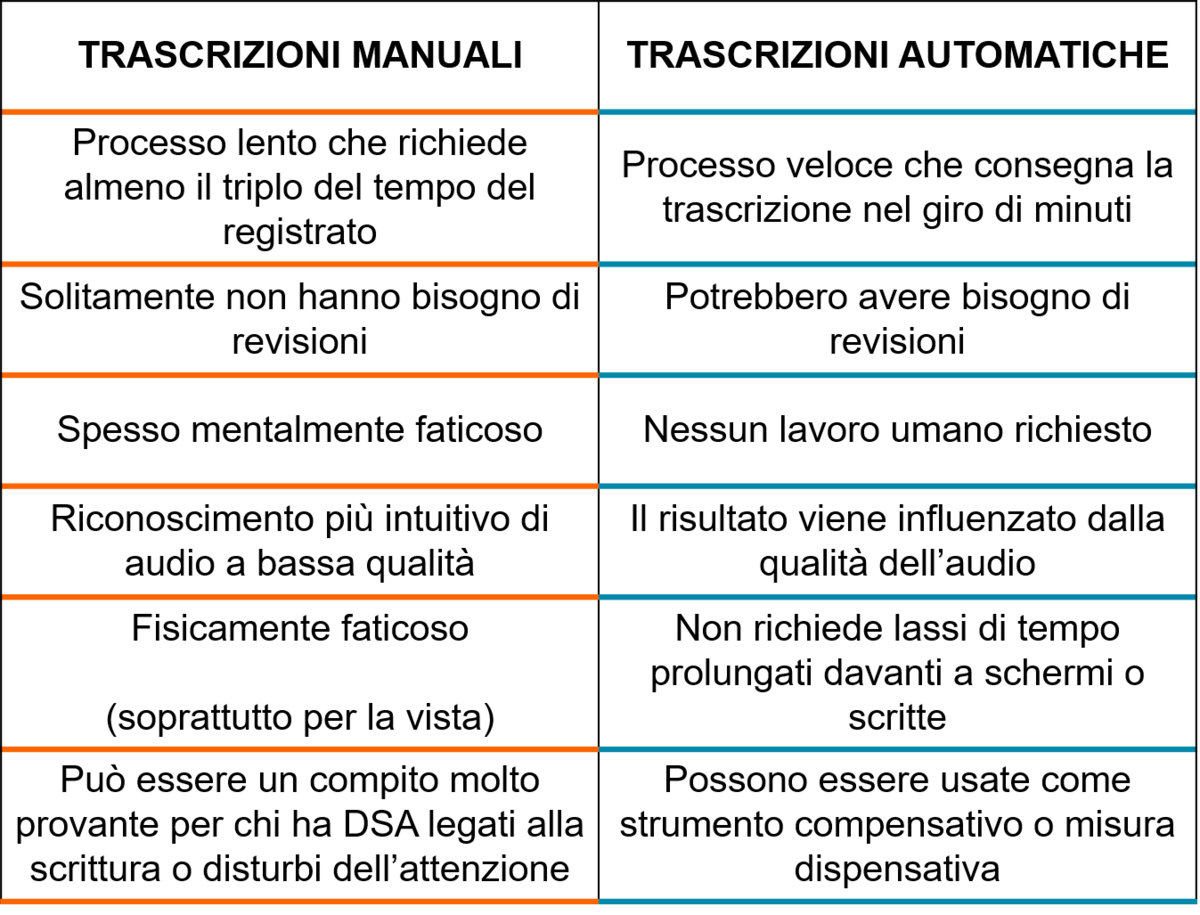
Before reviewing all the various categories that could benefit from automatic transcriptions, let's try to schematically compare the technological means with the traditional manual one:
From professionals to students: who needs transcription?
Countless categories of people can benefit from automatic audio transcription, a tool that is versatile not only in its uses but also in its objectives. Let's look at the specifics of each stakeholder group, perhaps offering some ideas for improving the overall experience—be it training, education, or work.
The world of education: from middle school to university
Students at every level of education are among the most frequent users of automatic transcription features, typically because they want a reliable reference point when they need to organise and enrich their own notes. From early schooling through to higher education, learners can use recordings as a formal accommodation for writing during classes, or simply as a fast and safe way to capture study materials. These tools support all learners, including those with specific learning differences or attention-related challenges (such as ADHD).
As learners progress through their studies, recording and transcribing the lessons they attend becomes an increasingly central part of the learning experience, especially because the depth and accuracy of the knowledge they need to master tends to grow over time. University students often rely on this practical solution to deal with timetable clashes and overlapping classes, and to personalise their learning journey in educational environments that do not always pay close attention to individual needs.

Within this broad category, there is an important distinction: lesson transcripts tend to be especially useful for integrating humanities subjects and traditional lecture-based classes. Students in more technical or scientific fields know that converting complex audio into text – particularly when done automatically – can sometimes lead to a confusing result, especially when numbers, formulas and symbols are involved. And when the session is not a standard lecture (for example workshops or seminars), audio quality may decrease and the conversational context can be lost, making the transcript significantly less helpful.
The world of work: independent professionals
From journalists and lawyers to content creators, independent professionals use automatic transcription for many different purposes. Beyond the classic benefits linked to annotating elements that go beyond the spoken content, systematically using audio-to-text software allows these workers to build a convenient archive where they can easily search by keyword and retrieve specific information that would otherwise be difficult to find.
The world of work: businesses
Businesses are probably the group that would least intuitively associate their work with automatic audio transcription. Nevertheless, modern marketing and corporate communication are increasingly driven by the use of big data. Converting audio files into text is therefore a powerful strategy for analysing customer (or target-audience) preferences, enabling teams to design better and more precisely targeted campaigns.
Trascribe with Algor Education
Alongside mind maps and summaries, Algor Education also offers automatic transcriptions of audio and video files, giving learners and professionals a complete workspace for turning their content into structured study materials. Its intuitive interface lets you upload the file you need and, after a short processing time, returns a clean, ready-to-use text document.
Of course, the transcript can then be the starting point for further processing, such as creating a summary or a mind map in just a few steps. If you’d like to learn more about how to move beyond traditional sbobinatura and make the most of our transcription features, you can take a look at the complete guide on how to use our automatic transcription for video and audio files.


Faq
Frequently Asked Questions


Jetzt mit Algor starten
Verwandle deine Inhalte in strukturierte, visuelle und persönliche Lernwege.

.svg)


